
Law must be based on facts, evidence – Query for judge in ADC, Accord, others’ de-registration saga

By Nnamdi Ojiego
nBy the time the Court of Appeal rose in Abuja on Tuesday, what had looked barely 24 hours earlier like the political funeral of five opposition parties had suddenly become a resurrection.
nThe appellate court halted the execution of a Federal High Court judgment that had directed the Independent National Electoral Commission (INEC) to deregister the African Democratic Congress (ADC), Action People’s Party (APP), Action Alliance (AA), Accord Party and Zenith Labour Party (ZLP).
nIn unusually stern language, the appellate court accused the trial judge of disregarding an earlier order restraining him from proceeding with the matter, describing his conduct as “judicial impertinence” and “judicial rascality.”
nYet beyond the legal fireworks lies a much deeper story.
nThe courtroom drama has opened a wider national conversation about the independence of the judiciary, the shrinking political space ahead of the 2027 elections, the powers of INEC, and whether Nigeria’s electoral laws are gradually making it harder for smaller political parties to survive.
nFor many stakeholders, the controversy is no longer simply about five political parties. It is about the health of Nigeria’s democracy itself.
nOrigin of controversy
nThe dispute originated from a suit filed by the National Forum of Former Legislators, which asked the Federal High Court to compel INEC to deregister five political parties for allegedly failing to satisfy the constitutional threshold under Section 225A of the Constitution.
nThe group argued that the affected parties failed to secure the minimum electoral performance required to retain their registration.
nJustice Peter Lifu agreed.
nIn a sweeping judgment delivered on Monday, he ordered INEC to deregister the ADC, APP, AA, Accord and ZLP.
nHe further restrained the electoral commission from recognising the affected parties or accepting candidates from them for future elections.
nThe ruling immediately threw the political environment into confusion.
nWith governorship elections approaching in Osun and Ekiti and preparations for the 2027 general elections already underway, questions arose over the fate of candidates who had emerged from the primaries of the affected parties.
nThe uncertainty was compounded by the fact that INEC itself opposed the judgment.
nAppearing before the Court of Appeal on Tuesday, the electoral commission disclosed that it was not even aware Justice Lifu would deliver judgment after an earlier appellate order had stayed proceedings.
nINEC’s counsel informed the court that the commission only learnt about the judgment through media reports and supported the application seeking a stay of execution. The appellate court promptly granted the application.
nIn defence of democracy
nAmong those present in court was the Chairman of the Inter-Party Advisory Council (IPAC) and National Chairman of the Allied Peoples Movement (APM), Alhaji Yusuf Dantalle.
nFor him, the legal battle represented something much larger than the survival of five political parties.
n“It was solidarity,” he said. “And to defend democracy that we swore to in the Inter-Party Advisory Council.”
nDantalle noted that political parties had already conducted congresses and primaries in line with INEC’s timetable before the deregistration issue surfaced.
nHe said: “The election is a process, it is not an event. INEC rolled out the timetable. Parties complied. They conducted primaries across the 36 states. Candidates emerged. It was just for INEC to release the final list before some faceless organisation suddenly went to court.
n“Then you want to deregister parties that have already conducted primaries? Adeleke is contesting in Osun. There is an election in Ekiti. Some of these parties already have candidates. It is not acceptable.”
nAccording to him, democracy thrives on inclusion, not exclusion. “It is about the people. It is about leadership. It is about representation. It is about inclusion. It is about fairness. Nigerians should be allowed to choose who they want democratically.”
nQuestions over motive
nPerhaps the most contentious issue raised during the controversy concerns motive.
nAlthough Dantalle stopped short of accusing any political party directly, he questioned why private individuals sought to compel INEC to deregister parties when the electoral commission itself insisted the affected parties met constitutional requirements.
n“The regulatory body is in court,” he noted.
n“INEC said these parties meet the standard to remain as political parties. So what is the interest of those coming to say they should be deregistered? If anybody should seek deregistration, it should come from INEC.”
nPressed on whether politics rather than law was driving the process, Dantalle did not hesitate.
n“It is more of politics,” he declared. “Today, opposition parties are struggling with leadership crises. The next thing is how to clean them up illegally through legal means. We must be careful about what we are planting today.”
n‘No party is weak’
nThe IPAC chairman also argued that Nigeria’s electoral framework favours bigger parties with access to public resources.
n“No party is weak,” he declared. “APC itself is a combination of political parties. They have many governors. Naturally they have resources. But smaller parties cannot compete equally. Until political parties operate on fair footing, these problems will continue.”
nHe blamed portions of the Electoral Act for making political participation unnecessarily difficult.
nAccording to him, IPAC and INEC had jointly submitted proposals during the amendment of the Electoral Act and Constitution.
n“One hundred per cent of what stakeholders submitted was ignored,” he lamented. “The constitution and enabling laws must favour Nigerians, not political interests.”
n‘You cannot appoint referee’
nDantalle also revived the long-running debate over INEC’s independence.
n“The first thing we have always advocated is the removal of the power of the executive to appoint the chairman of INEC, he noted
nYou cannot appoint the referee while you are a player. That is where genuine electoral reform should begin”, he stressed.
nPushing an agenda
nIf Dantalle questioned the politics behind the litigation, ZLP presidential candidate and lawyer, Chief Dan Nwanyanwu, reserved his strongest criticism for Justice Lifu.
n“He was either compromised or compromised himself,” he alleged.
n“Law is based on facts and evidence. It is not based on persuasion.”
nNwanyanwu argued that Section 225A provides clear performance thresholds which, according to him, several of the affected parties had already met.
n“Our party won over 50 local governments and more than 170 councillorship seats. ADC also won elections. Accord also won elections. Those facts were before the judge.”
nHe maintained that INEC’s position alone should have settled the matter.
n“INEC is the only body empowered by the Constitution to register or deregister political parties. INEC came to court and said these parties satisfied the constitutional threshold. Why then should any judge substitute his opinion for that of the constitutional authority?”
nAppeal Court saved judicial integrity
nRather than celebrating the stay of execution as merely a political victory, Nwanyanwu described it as a defence of judicial hierarchy.
n“We still have men of integrity in the judiciary. The Court of Appeal reminded everyone that courts must obey the hierarchy established by law”, he stated.
nThe ZLP presidential candidate insisted the appellate court’s unusually harsh language reflected the seriousness of the situation.
n“The court called it judicial rascality. Those were not my words. They came from the Court of Appeal.”
nAccording to him, allowing such decisions to stand would undermine public confidence in both the judiciary and Nigeria’s electoral system.
nShrinking political space
nFor many observers, perhaps the biggest concern raised by the case is the future of political competition.
nNwanyanwu believes the legal battle is part of a broader attempt to reduce electoral competition ahead of 2027.
n“They don’t want contests,” he alleged. “They don’t want strong opposition. But there will be contests. This election is not over.”
nWhile he declined to name those allegedly behind the litigation, he warned against any attempt to manipulate the democratic process.
n“You cannot use your hand to cover pregnancy. The truth will always come out.”
nAdeleke camp reacts
nFor the Accord Party and Governor Ademola Adeleke’s re-election campaign in Osun State, Monday’s judgment briefly created uncertainty.
nBut Chairman of the Media and Publicity Committee of the Imole Campaign Council, Hon. Bamidele Salam, said the camp never doubted the decision would be overturned.
n“We regarded it as simply a test of faith,” he said. “We knew the judgment could not stand because it had neither legal nor moral foundation.”
nAccording to him, the campaign proceeded with its scheduled activities despite the ruling. “We continued with our campaign. We received thousands of new members. We received endorsements. We were never distracted.”
nElectoral amendments backfired
nInterestingly, Salam also acknowledged that lawmakers bear part of the responsibility for today’s controversies.
nHe admitted that some provisions introduced into the Electoral Act have created fresh problems.
n“There are certain things Parliament did during the amendment of the Electoral Act that we should not have done”, Salam lamented.
nHe cited the decision to narrow options for party primaries. “Some of us warned then that restricting parties would create chaos. Unfortunately, many lawmakers have now become victims of those same amendments.”
nHe added that Nigeria should never again amend major electoral laws close to an election. “You don’t change the rules of the game when preparations are already underway. INEC needs time. The political parties need time. The police need time. Everybody needs time to adjust.”
nInstitutional questions
nThe controversy surrounding the attempted deregistration of the five political parties may ultimately be remembered less for the legal arguments than for the broader institutional questions it raised.
nCan courts compel INEC to deregister political parties where the electoral commission itself disagrees? How independent is Nigeria’s judiciary? Have recent electoral reforms strengthened democracy or narrowed political competition? Should smaller political parties receive greater institutional support if Nigeria truly seeks multi-party democracy?
nThose questions remain unanswered. For now, the Appeal Court’s intervention has merely paused the legal battle. The substantive appeal is still pending. But one thing appears certain. The controversy has become an early test of Nigeria’s democratic institutions ahead of the 2027 elections.
n nRelated Stories
 General News
CELEBRATING TWO YEARS OF TRANSFORMATIONAL LEADERSHIP IN THE PRESIDENTIAL AMNESTY PROGRAMME
Tomorrow, 14TH March 2026, as we look forward to the second anniversary, we reflect on the remarkable two years since the Administrator of the Preside
 General News
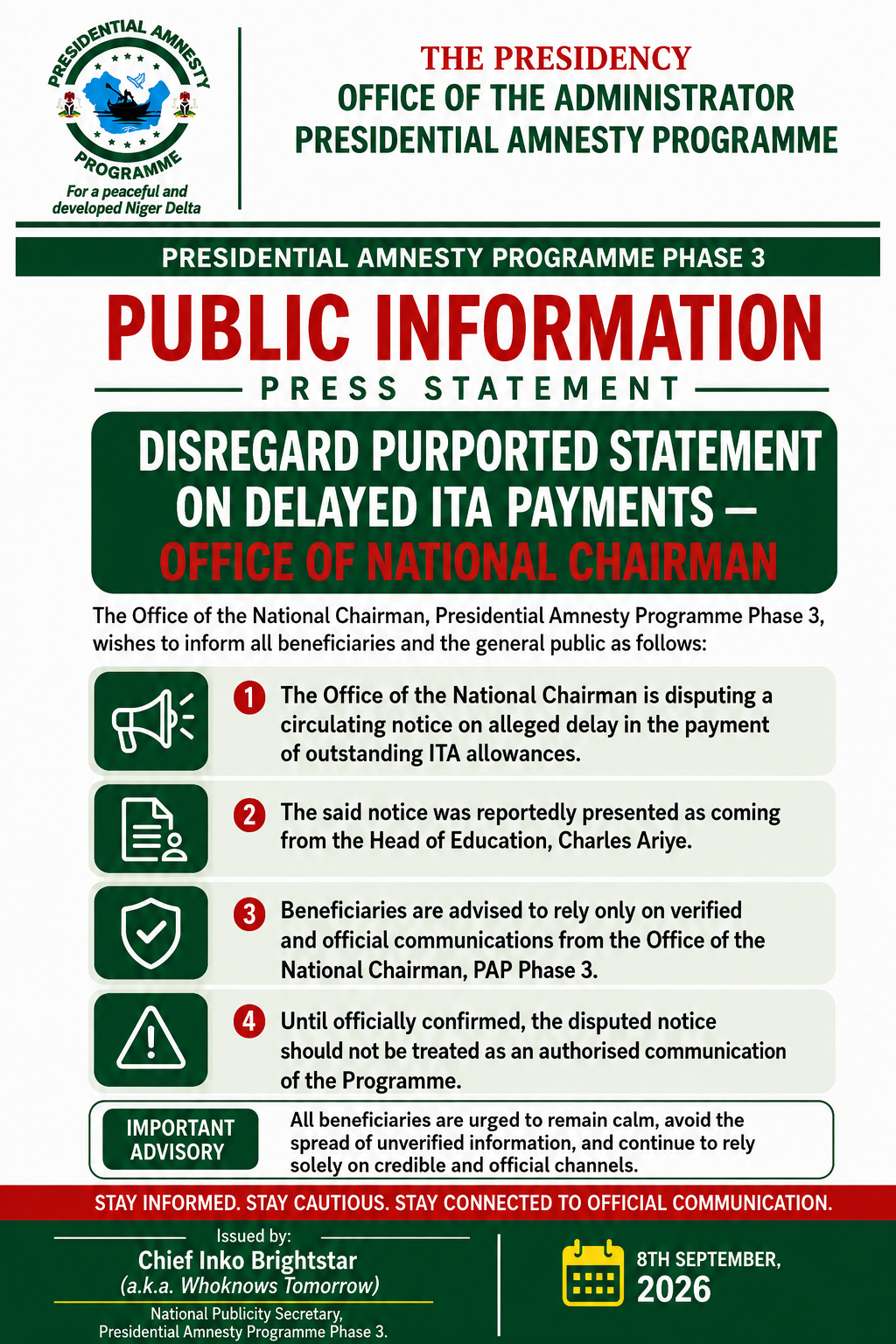
PRESIDENTIAL AMNESTY PROGRAMME PHASE 3: DISREGARD PURPORTED STATEMENT ON DELAYED ITA PAYMENTS — OFFICE OF NATIONAL CHAIRMAN
The Office of the National Chairman of the Presidential Amnesty Programme Phase 3, General Elaye ThankGod Dollar Slaboh, has called on beneficiaries a
 General News
RE: CLARIFICATION ON MY PERSONAL RELATIONSHIPS
PUBLIC NOTICErnrnRE: CLARIFICATION ON MY PERSONAL RELATIONSHIPSrnrnIt has become necessary to make this public clarification following the increasing