
Lagos’ 5.1m-tonne waste burden: The search for way out
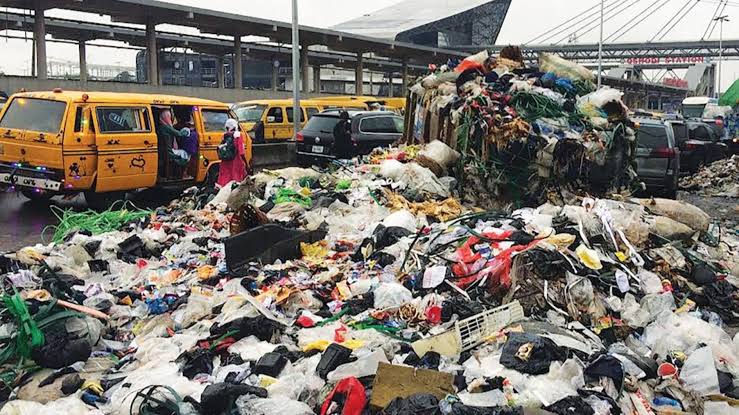
File image
nBy Divinegrace Onosetale
nFive million, one hundred and ten thousand tonnes. That is the amount of solid waste Lagos could generate in one year if the state’s upper daily estimate of 14,000 tonnes remains constant. In seven days, the figure would stand at about 98,000 tonnes. In 30 days, it would reach 420,000 tonnes.
nRead Also: ‘If God saves me, I’ll never drink again’ – Survivor of Ondo herbal drink tragedy
nFor a city already grappling with congestion, rapid population growth and pressure on infrastructure, the numbers present a question that can no longer be ignored: where does all the waste go?
nThe answer lies in a waste-management system that operates continuously across the metropolis.
nEvery day, food remnants, plastic bottles, cartons, discarded clothing, construction debris and commercial waste are generated by homes, markets, offices, factories, restaurants and shops. From the point where these materials are discarded, they enter a chain involving collection, transportation, sorting, recycling and eventual disposal or conversion.
nThe Lagos State Government, in October 2025, estimated that the city was generating between 13,000 and 14,000 tonnes of solid waste daily.
nThat volume makes waste management far more than the occasional removal of refuse from a street corner. It is a huge logistical operation requiring collection from millions of generators and transportation through some of the country’s most congested roads.
nWaste must then be transferred or sorted where necessary, with recoverable materials separated for recycling before what remains is finally disposed of or converted.
nFor years, the dominant approach was largely summed up in three words: generate, collect and dump.But that model is becoming increasingly difficult to sustain.
nLandfills have limited capacity, while the land available for disposal is not endless. Population growth and rising consumption continue to increase the amount of material entering the waste stream. There is also the cost of moving it. Trucks require fuel, maintenance and manpower, while every additional tonne taken to a landfill consumes space that cannot be replaced indefinitely.
nIt is against this background that Lagos is gradually changing the way it looks at waste. Rather than concentrating solely on getting refuse away from residential and commercial areas, the state is increasingly focusing on what can be recovered from the waste before it reaches final disposal.
nIn October 2025, the government disclosed arrangements for the conversion of approximately 4,000 tonnes of waste daily, with substantial portions expected to become compost and recyclable materials. It also disclosed partnerships relating to waste-to-energy and electronic waste as part of a longer-term strategy aimed at reducing dependence on dumpsites.
nThe shift means that materials once regarded simply as rubbish can have another life. A plastic bottle, when properly collected and separated, can become raw material for another product. Organic waste can be processed into compost, while discarded electronic devices can yield materials that can be recovered. Even some residual municipal waste can potentially be put to use as an energy source.
nThat is the practical thinking behind the circular economy , retaining materials in productive use instead of allowing them to move directly from consumption to disposal.And Lagos is already building part of the infrastructure required to support that model.
nAccording to the Lagos Waste Management Authority, LAWMA, the number of recycling companies operating in the state has increased from three to 78, generating more than 6,000 jobs. The figures point to an economic dimension of waste management that is sometimes overshadowed by the sanitation debate.
nEvery stage of the recovery process creates an opportunity for economic activity. Collection requires workers. Sorting creates businesses. Materials have to be aggregated and transported.
nProcessing facilities require labour and investment, while manufacturers can use recovered materials as inputs for new products.What is discarded by one person can therefore become a raw material for another. For Lagos, this offers the possibility of turning part of its environmental burden into a component of its green economy.
nBut that transition is still a work in progress. Government acknowledges challenges within the existing collection system, including residents who refuse to patronise their assigned Private Sector Participation, PSP, operators, difficulties faced by some operators and persistent illegal dumping.
nThose problems cannot be overlooked. The circular economy may change what happens to waste after collection, but it cannot solve the problem of waste that is never properly collected.
nFor residents, the immediate concern remains basic: whether the refuse generated in their homes and businesses is removed on time. That is why improving collection and expanding resource recovery must happen together.
nPSP operators need to provide reliable and efficient services. Billing needs to be more transparent. Communities that are underserved by conventional collection trucks require alternative systems, while illegal dumps must be tackled. There is also a need to make waste separation easier for residents.
nSeparating recyclable, organic and residual materials at source can improve recovery, but citizens are unlikely to embrace the practice if it becomes an additional burden with no visible benefit.
nEnvironmental responsibility works best when doing the right thing is easier than doing the wrong thing.That principle will be particularly important as Lagos seeks to move more of its waste away from the traditional disposal model.
nThe challenge is not going to disappear overnight. Nor should success be measured by an unrealistic expectation that the state will suddenly eliminate the need for landfills or conventional disposal.
nA more practical measure is whether Lagos can steadily reduce the quantity of waste that ultimately requires burial or permanent disposal. The mathematics alone makes the urgency clear.
nAt the upper estimate, more than five million tonnes of solid waste could enter Lagos’ waste stream in a single year. The same figure that illustrates the size of the environmental burden also reveals the scale of the potential opportunity.
nWithin that enormous stream are plastics that can be recycled, organic materials that can become compost, electronic components that can be recovered and residual materials that may have energy value. The challenge is to build a system capable of identifying and recovering those resources before they are lost.
nThat requires more than government policy. It requires functioning collection systems, efficient operators, appropriate infrastructure, investment in recycling and conversion, and the cooperation of residents.
nLagos may never completely eliminate final waste disposal. But it can reduce how much material reaches that point. Ultimately, the success of the state’s evolving waste strategy will not be determined only by how much refuse disappears from the streets.
nIt will be determined by how much of what Lagosians discard can be recovered and returned to productive use.
nFor Lagos, therefore, the real measure of progress may not simply be how quickly refuse disappears from the streets, but how much of it can be kept out of the dumpsites altogether.
nThat is where the future of waste management in the megacity may ultimately be decided: not at the point where waste is discarded, but in what happens to it afterwards.
n nRelated Stories
 General News
CELEBRATING TWO YEARS OF TRANSFORMATIONAL LEADERSHIP IN THE PRESIDENTIAL AMNESTY PROGRAMME
Tomorrow, 14TH March 2026, as we look forward to the second anniversary, we reflect on the remarkable two years since the Administrator of the Preside
 General News
PRESIDENTIAL AMNESTY PROGRAMME PHASE 3: DISREGARD PURPORTED STATEMENT ON DELAYED ITA PAYMENTS — OFFICE OF NATIONAL CHAIRMAN
The Office of the National Chairman of the Presidential Amnesty Programme Phase 3, General Elaye ThankGod Dollar Slaboh, has called on beneficiaries a
 General News
RE: CLARIFICATION ON MY PERSONAL RELATIONSHIPS
PUBLIC NOTICErnrnRE: CLARIFICATION ON MY PERSONAL RELATIONSHIPSrnrnIt has become necessary to make this public clarification following the increasing