
Koka Flyover: Heavy traffic overhead, rising nuisance, security concerns underneath
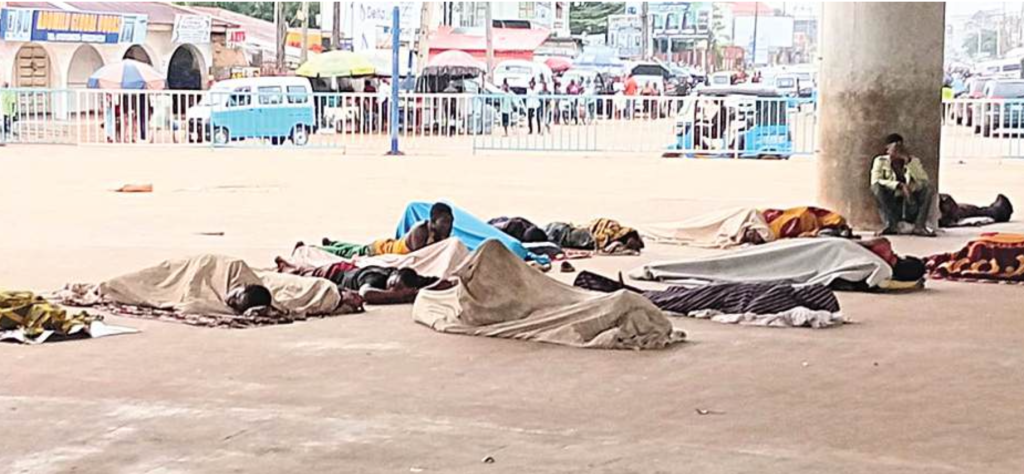
•Koka under bridge, now home for miscreants.
nBy Egufe Yafugborhi
nDelta State grapples with balancing human rights with public safety as squatters swell under Asaba overpass.
nIt’s 8:12am and traffic on the Asaba-Onitsha Highway is already heavy. Above, vehicles race across Koka Flyover. Underside, on bare concrete, men are just waking up. More had left earlier. Mats are rolled. Bedspreads folded. A few polythene bags with clothes are tucked to one side.
nNo cooking pots. No heavy luggage. Just the barest safeguards needed to push back mosquitoes and cold through the night. By evening, they’ll be back.
nFor months, the underbelly of one of only two flyovers in the Delta State capital has served as free shelter to dozens of young men, artisans, idlers, and migrants. To them, it’s rent-free. No landlord, no hindrance. To the city, it’s becoming a threat of particular concern.
nFrom infrastructure to free shelter
nKoka Flyover was built to ease traffic and beautify the gateway to Asaba. Today, its pillars are lined with mats spread out each night and picked up each morning.
nAt any time of day, you can still find groups sleeping or resting.
nThe space smells of damp concrete and urine. Drainage channels around the pillars are clogged with nylon and dirt.
nResidents say the number has tripled since March. “They come in the evening and leave in the morning to hustle. Nobody disturbs them,” a roadside trader said.
nVulnerability
nThe Delta State Council of the Nigeria Union of Journalists (NUJ) first flagged it at its June Congress in Asaba, presided over by Chairman, Comrade Churchill Oyowe.
nIn a communiqué signed by Andy Emephia, Mrs. Chissy Awunor, Egufe Yafugborhi and Josephine Omodior, the NUJ warned that the “increasing influx of undocumented migrants and persons of unknown identities” was putting pressure on the city.
n”Apart from defacing the aesthetics of the flyover, the development escalates population pressure on public infrastructure, social services and security vulnerabilities,” the union noted.
nThe NUJ called on the Nigeria Immigration Service, the State Security Council and other agencies to “strengthen surveillance, improve internal migration monitoring, and enhance community-based intelligence- gathering.”
nIt also urged the Delta State Government to “develop lawful mechanisms for addressing the challenges associated with undocumented persons residing within the state.”
nFlush them out – CSOs
nOne month later, with no government response, civil society joined the call and raised the temperature. The Forum of Delta State NGOs said Asaba cannot afford to turn a blind eye.
nIts Coordinator, Dcn. Okezi Odugala, said: “The government through the Delta State Environmental Task Force must use environmental laws to evacuate these miscreants who are a nuisance and security risk.
n”These are predominantly northerners who migrated to Delta State, constituting a nuisance and must be flushed out.
n”The unfortunate thing is no southerner can go to where they came from and be allowed to constitute such nuisance, as they will use sharia and Hisbah security to flush them out.”
nHe added: “The government that has the authority is not doing enough and I do not know why they are shying away from an issue that is a threat to our environment. A stitch in time saves nine.”
nA city at a crossroads
nFor urban planners, allowing public infrastructure to become an informal settlement creates health hazards and security gaps. For human rights advocates, it raises questions about housing, poverty, and migration policy and for the men under the bridge, it’s simpler: no rent, no landlord, and no harassment.
nThe Delta State Government is yet to respond to the NUJ and CSOs’ demands. But as more young men move in and visitors drive past daily, Asaba faces a hard choice. Evict with force? Provide alternatives? Or watch one of its landmark projects slowly become a slum?
nThe flyover was built to carry cars, not people.
n nRelated Stories
 General News
CELEBRATING TWO YEARS OF TRANSFORMATIONAL LEADERSHIP IN THE PRESIDENTIAL AMNESTY PROGRAMME
Tomorrow, 14TH March 2026, as we look forward to the second anniversary, we reflect on the remarkable two years since the Administrator of the Preside
 General News
PRESIDENTIAL AMNESTY PROGRAMME PHASE 3: DISREGARD PURPORTED STATEMENT ON DELAYED ITA PAYMENTS — OFFICE OF NATIONAL CHAIRMAN
The Office of the National Chairman of the Presidential Amnesty Programme Phase 3, General Elaye ThankGod Dollar Slaboh, has called on beneficiaries a
 General News
RE: CLARIFICATION ON MY PERSONAL RELATIONSHIPS
PUBLIC NOTICErnrnRE: CLARIFICATION ON MY PERSONAL RELATIONSHIPSrnrnIt has become necessary to make this public clarification following the increasing