
Japanese supporters showcase national pride by tidying up World Cup arena
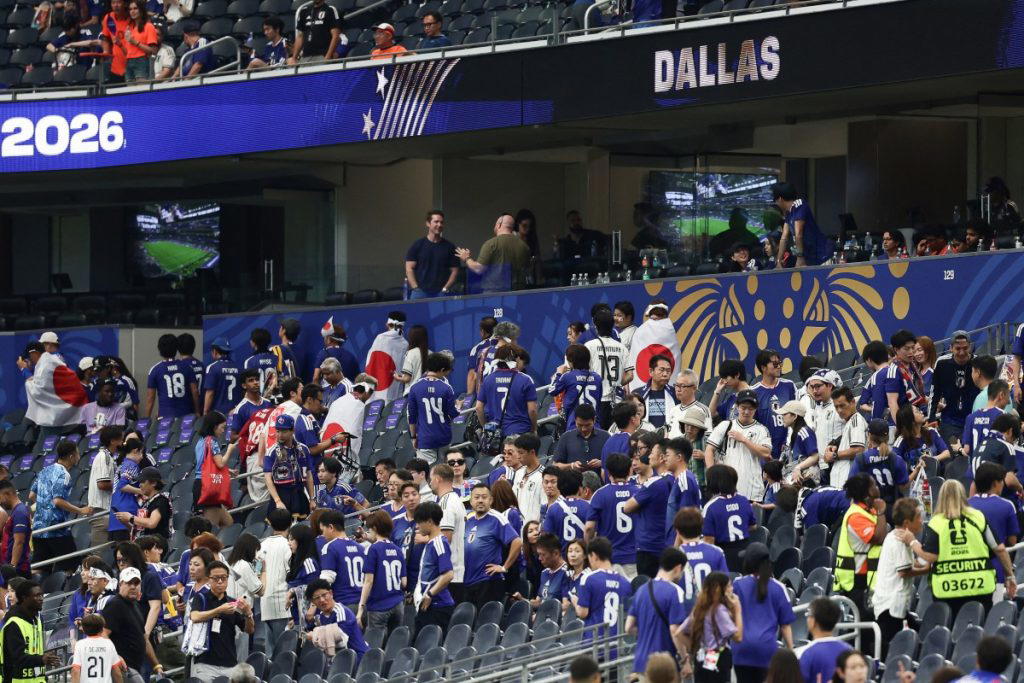
Japan supporters leave the tribunes after the 2026 World Cup Group F football match between the Netherlands and Japan at the Dallas Stadium in Arlington on June 14, 2026. (Photo by Aric Becker / AFP)
nJapan fans left the stands spotless after their World Cup opener against the Netherlands in Texas on Sunday, saying it was “Japanese culture” to tidy up after themselves.
nSpectators stayed behind after the 2-2 draw to make sure they left the stadium as they found it, meticulously picking up litter and stuffing it into blue plastic bags.
nIt is a habit first learned at primary school and Japan fan Eita Tanaka told AFP that “we have to think about everyone”.
n“Japanese people think that when we use a certain place, we were told that you have to make that place look tidier when you leave than it was when you arrived,” said the 20-year-old, clasping a beer and a couple of cups, and wearing Japan’s blue shirt.
n“For example, at school in our classrooms we tidy it up after ourselves without our teacher telling us.”
nJapan are appearing at their eighth straight World Cup and their fans’ cleanliness has become their international calling card.
nNFL quarterback Jameis Winston could even be seen joining in the clean-up after Sunday’s game, wearing a blue Japan shirt with his name on the back.
nJapan fan Futo Hagiwara said he was proud that the behaviour of his countrymen had been recognised in a positive light.
n“This is our culture, that means everywhere we go we need to clean it after ourselves, it’s our spiritual way, our attitude,” he said.
nSociologist and philosopher Masachi Ohsawa believes a mix of social responsibility and peer pressure is behind the fans’ behaviour.
n“While Japanese people tend not to take much interest in justice on a large scale — issues like global inequality, conflict or climate change — they are extremely sensitive to moral considerations on a smaller scale,” he said.
n“When it comes to people who they share the same space with or have direct personal contact with, they feel a strong desire not to cause them any trouble or make them feel uncomfortable.”
n– School of life –
nCleaning chores are a part of Japanese education from an early age, and children can be seen scrubbing floors and tables at schools every day.
nPublic waste bins are scarce in the country, and people are expected to take their rubbish home with them.
nGetting rid of household waste can be a labyrinthine task that involves separating rubbish into different categories.
nScott North, emeritus professor of sociology at the University of Osaka, said he and his neighbours get together twice a year to pull out weeds and rake up cuttings.
nHe said such groups are organised into leaders and followers, and operate in a similar way to Japanese football supporters.
n“Since everyone comes together, there’s an expectation that they’ll act as a group,” said North, an American who has lived in Japan for about 40 years.
n“And when the leaders break out the bags and say here you go, nobody is going to say no.”
nSociologist Ohsawa said such behaviour could be explained by what Japanese people refer to as “reading the air”.
n“In Japan, even if one person starts picking up litter, those around them feel they simply cannot help but join in,” he said.
n“That’s because if they don’t, the people they are with will think they are a bad person.”
nHe said peer pressure was a powerful social force.
n“In this case, the primary motivation isn’t so much a desire to keep the stadium clean or to avoid causing trouble for the people who have to clean the stadium afterwards,” he said.
n“It’s more a desire not to be seen as a nuisance in one’s own group.”
nWhatever the reasons, Japan’s fans will keep tidying up for as long as they stay in the tournament.
nTheir next game is against Tunisia in Mexico on Saturday, and fan Hagiwara is happy to keep leading by example.
n“We usually don’t tell children they should do it,” he said.
n“We just show our actions and behaviour, and other people follow.”
n nRelated Stories
 General News
CELEBRATING TWO YEARS OF TRANSFORMATIONAL LEADERSHIP IN THE PRESIDENTIAL AMNESTY PROGRAMME
Tomorrow, 14TH March 2026, as we look forward to the second anniversary, we reflect on the remarkable two years since the Administrator of the Preside
 General News
PRESIDENTIAL AMNESTY PROGRAMME PHASE 3: DISREGARD PURPORTED STATEMENT ON DELAYED ITA PAYMENTS — OFFICE OF NATIONAL CHAIRMAN
The Office of the National Chairman of the Presidential Amnesty Programme Phase 3, General Elaye ThankGod Dollar Slaboh, has called on beneficiaries a
 General News
RE: CLARIFICATION ON MY PERSONAL RELATIONSHIPS
PUBLIC NOTICErnrnRE: CLARIFICATION ON MY PERSONAL RELATIONSHIPSrnrnIt has become necessary to make this public clarification following the increasing