
Iranians vow to ‘resist until the end’ at Guards naval chief’s funeral
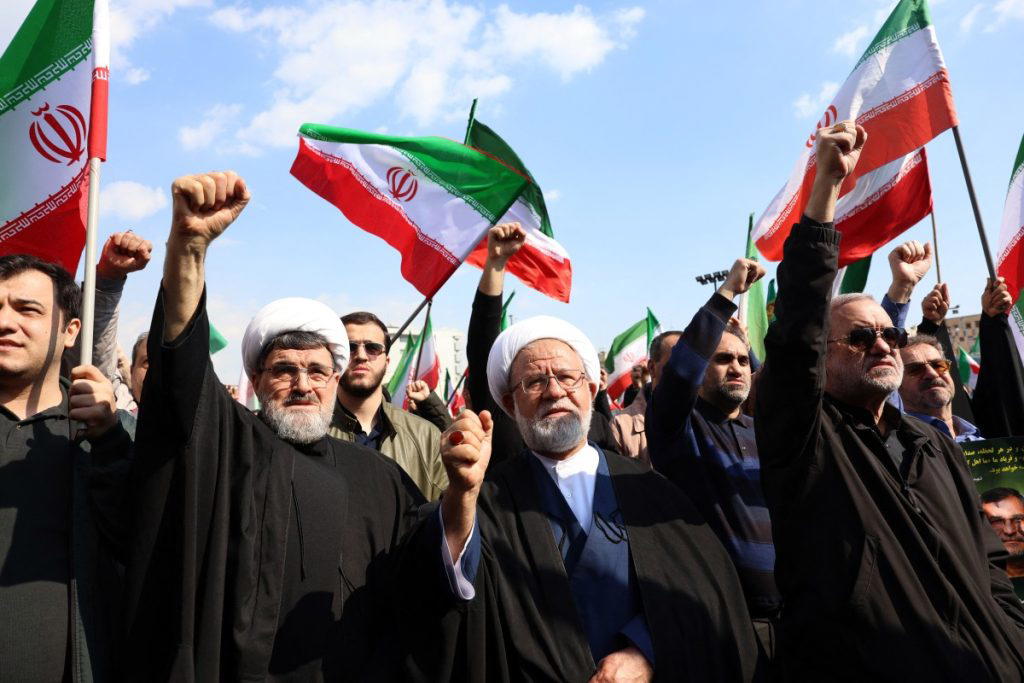
Iranians attend the funeral of Alireza Tangsiri, commander of the Iranian Revolutionary Guards’ navy alongside others killed in US-Israeli strikes on Iran at Enghelab Square in Tehran on April 1, 2026. Iran confirmed on March 30 that an Israeli strike had killed the commander of the naval force of the Revolutionary Guards, who Israel had said was responsible for the blocking of the Strait of Hormuz. A statement carried by the Guards’ Sepah News website said Alireza Tangsiri “succumbed to severe injuries” from the attack last week. (Photo by AFP) /
nThousands of Iranians gathered Wednesday in Tehran for the funeral of the Revolutionary Guards’ naval commander, killed in an Israeli strike, with mourners vowing to fight to the end despite tough talk from Washington.
nThe procession took place on the 47th anniversary of the Islamic republic, proclaimed on April 1, 1979, after the revolution that overthrew the last shah and ended more than 2,500 years of monarchy.
nBut this year, the public holiday carried particular weight, as Tehran fights for survival under relentless US-Israeli bombardment since February 28.
n“This war has lasted a month. However long it takes, we will continue,” said Moussa Nowruzi, a 57-year-old pensioner.
n“We will resist until the end.”
n“Revenge,” read one sign held high by a young boy, while other attendees unfurled massive Iranian flags as government supporters filled the symbolic Enghelab Square — named for the Islamic revolution — in the heart of the capital.
nAmong the chanting crowd repeating slogans such as “Allah Akbar, Khamenei Rahbar” (God is greatest, Khamenei is the supreme leader), a man wept in the arms of a woman dressed in black.
nLike many Iranians, they came to honour relatives killed in the conflict, their faces displayed on placards.
nThe coffin of commander Alireza Tangsiri made its way slowly through the crowd.
nTangsiri was one of the longest-serving senior figures in the Revolutionary Guards and one of its highest-profile faces, regarded as the architect of the effective closure of the Strait of Hormuz.
nAhead of a highly anticipated national address, US President Donald Trump said that Iran’s president had asked for a truce — a claim Tehran denied — adding he would only consider it once the Hormuz “is open, free, and clear”.
nUntil then, he said, the bombardment would continue, a threat shrugged off by mourners on Wednesday.
n– ‘Nothing they can do’ –
n“Until today, we have seen Trump say things that even the American people are confused and bewildered by,” said Homa Vosoogh, 36, at the funeral.
n“We do not care what his statement is and what he says,” she said.
nMohammad Saleh Momeni, a government employee, said Trump’s “remarks are completely nonsensical”.
n“He cannot put any of his words into practice, and we are behind our leader.”
nThe US and Israel initially suggested their goal in the war was to topple the Islamic republic, though Trump in particular has wavered on that point in the weeks since.
nStrikes have killed supreme leader Ayatollah Ali Khamenei, who ruled Iran for 36 years, as well as many other senior officials, but the country’s governing system remains intact, and it retains its ability to launch missiles and drones at its neighbours and Israel.
nAcross Tehran, portraits of the late leader and his son Mojtaba — who took his place but has yet to make a public appearance — are everywhere.
n“They think that they can do anything with killing our commanders and soldiers,” said Momeni, the government employee.
n“There is nothing they can do… These enemies of ours have a false idea that we will become weak,” he added.
nStill, after a wave of anti-government demonstrations that crested in January, some Iranians still privately long for political change, particularly after Trump himself had promised to come to their aid.
n“He betrayed the Iranians,” said one woman in her thirties, requesting anonymity for security reasons.
nSounding resigned, she added she no longer expects a change of government, but “if they could grant us more freedoms, we could live with that”.
nAFP
n nRelated Stories
 General News
CELEBRATING TWO YEARS OF TRANSFORMATIONAL LEADERSHIP IN THE PRESIDENTIAL AMNESTY PROGRAMME
Tomorrow, 14TH March 2026, as we look forward to the second anniversary, we reflect on the remarkable two years since the Administrator of the Preside
 General News
PRESIDENTIAL AMNESTY PROGRAMME PHASE 3: DISREGARD PURPORTED STATEMENT ON DELAYED ITA PAYMENTS — OFFICE OF NATIONAL CHAIRMAN
The Office of the National Chairman of the Presidential Amnesty Programme Phase 3, General Elaye ThankGod Dollar Slaboh, has called on beneficiaries a
 General News
RE: CLARIFICATION ON MY PERSONAL RELATIONSHIPS
PUBLIC NOTICErnrnRE: CLARIFICATION ON MY PERSONAL RELATIONSHIPSrnrnIt has become necessary to make this public clarification following the increasing