
Iranian officials hold talks with Pakistani leader prior to planned discussions with America
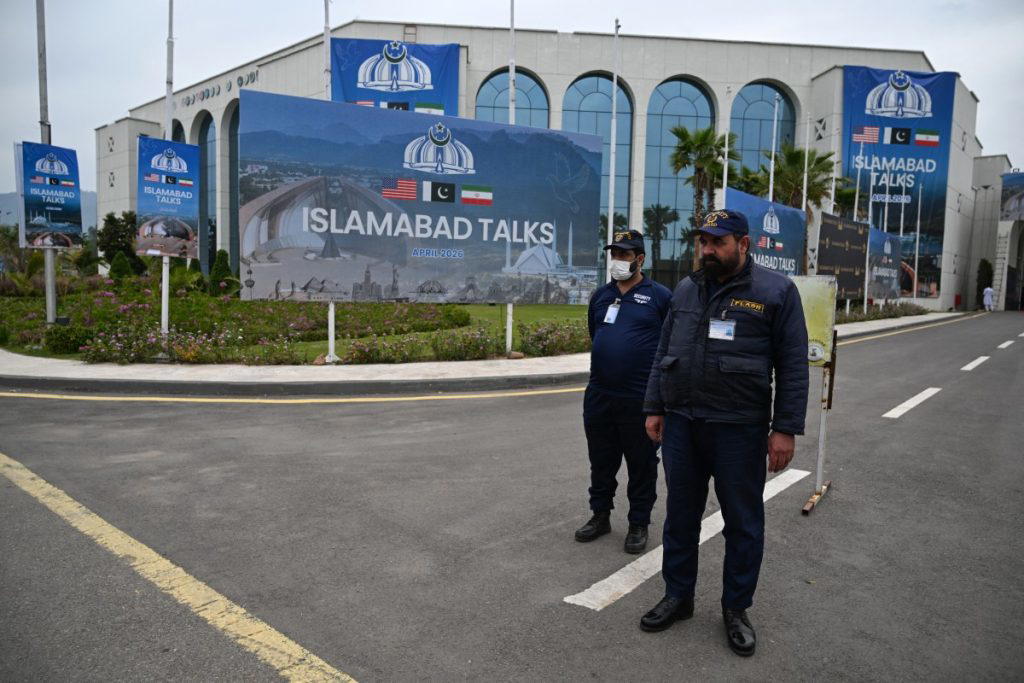
As US Vice President JD Vance traveled to Islamabad on April 11, 2026, for talks with Iran, Pakistani Prime Minister Shehbaz Sharif described the negotiations as a "make or break" effort to end the weeks of fighting in the Middle East, with private security personnel standing guard at the media centre.
nAn Iranian government delegation, led by parliamentary speaker Mohammad Bagher Ghalibaf, met with Prime Minister Sharif on Saturday to discuss the terms of the planned negotiations, which were set to take place at Islamabad's Serena Hotel.
nThe Iranian side would decide at the end of the meeting with Sharif whether to proceed with negotiations with the US, according to Iranian media reports, with Iran previously stating that any agreement must include the unfreezing of sanctioned Iranian assets and an end to Israel's war on Hezbollah in Lebanon.
nUS Vice President JD Vance had said that the issue of Israel's war on Hezbollah in Lebanon would not be up for discussion in Islamabad, highlighting the significant differences between the two parties on key issues, including sanctions and the opening of the strategic Strait of Hormuz.
nPakistan's powerful army chief, Asim Munir, who has a personal rapport with US President Donald Trump, greeted Vance upon his arrival at an air base near the capital and escorted him down a red carpet, where US special envoy Steve Witkoff and Trump's son-in-law Jared Kushner were waiting.
nThe Iranian delegation, which included Foreign Minister Abbas Araghchi, had arrived overnight at the air base, and Ghalibaf expressed skepticism about the negotiations, stating that "our experience in negotiating with the Americans has always been met with failure and broken promises".
nAraghchi told his German counterpart in a call on Saturday that "Iran enters negotiations with complete distrust due to repeated breaches of commitments and betrayals by the United States", according to the Tasnim news agency.
nVance, on the other hand, said before leaving the US that if the other side was "willing to negotiate in good faith, we're certainly willing to extend the open hand", but warned that "if they're going to try to play us, then they're going to find the negotiating team is not that receptive".
nThe ceasefire was already under strain due to Israel's continued strikes in Lebanon, which Iran and Pakistan insist is covered under the current truce, with Prime Minister Sharif acknowledging that the talks would not be easy and that "an even more difficult stage lies ahead".
nThe talks aimed to permanently end the fighting that began with US-Israeli strikes on Iran on February 28, sparking Iranian retaliation against Israel and across the Gulf, with Sharif describing the current stage as the "make or break" equivalent.
nIran had insisted on the truce covering Lebanon and the unfreezing of its assets for the Islamabad talks to proceed, neither of which had materialized so far, while the US had demanded the opening of the Strait of Hormuz as a condition for the two-week ceasefire.
nTrump had vowed to have the strait open soon "with or without" Iran's cooperation and stated that his top priority at the Islamabad talks was to ensure Iran had "no nuclear weapon, that's 99 percent of it".
nSecurity was tight in the Pakistani capital on Saturday, with a heavy police and paramilitary presence on the streets and road diversions around the "red zone" where government and diplomatic buildings are located.
nPakistan had formulated a team of subject matter specialists to facilitate the negotiations on navigation, nuclear, and other key matters, according to a diplomatic source familiar with the matter.
nThe negotiations would be closely watched by other key regional players, including Egypt, Turkey, and China, which had helped with mediation and was still being coordinated with by Pakistan for the talks, the source said.
nBeijing had been sought as a possible guarantor of any lasting agreement, with Trump confirming that China had helped get Tehran to the negotiating table, according to official sources.
nIsrael's assertion that the current truce did not cover Lebanon complicated the path to a permanent ceasefire, with Israeli air strikes continuing in Lebanon on Friday against Iran-backed Hezbollah despite Iranian demands for a halt.
nIsrael's ambassador to the US, Yechiel Leiter, said his country would hold discussions with Lebanon's government in Washington next week but would not discuss a ceasefire with Hezbollah, which had carried out drone and rocket attacks on northern Israel and Israeli forces in southern Lebanon.
nA 30-year-old resident in Tehran expressed skepticism about the negotiations, describing most of what Trump says as "pure noise and nonsense", according to AFP.
Related Stories
 General News
CELEBRATING TWO YEARS OF TRANSFORMATIONAL LEADERSHIP IN THE PRESIDENTIAL AMNESTY PROGRAMME
Tomorrow, 14TH March 2026, as we look forward to the second anniversary, we reflect on the remarkable two years since the Administrator of the Preside
 General News
PRESIDENTIAL AMNESTY PROGRAMME PHASE 3: DISREGARD PURPORTED STATEMENT ON DELAYED ITA PAYMENTS — OFFICE OF NATIONAL CHAIRMAN
The Office of the National Chairman of the Presidential Amnesty Programme Phase 3, General Elaye ThankGod Dollar Slaboh, has called on beneficiaries a
 General News
RE: CLARIFICATION ON MY PERSONAL RELATIONSHIPS
PUBLIC NOTICErnrnRE: CLARIFICATION ON MY PERSONAL RELATIONSHIPSrnrnIt has become necessary to make this public clarification following the increasing