
International Women's Day: CAPPA calls for enhanced safeguards and more equitable laws to support females
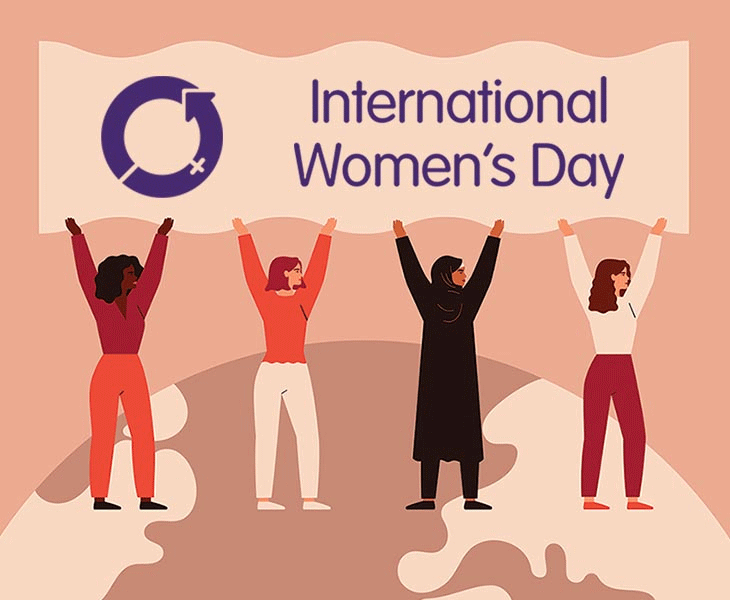
The Corporate Accountability and Public Participation Africa has urged the Federal Government and state authorities to implement stronger safeguards for women and adopt more inclusive policies, as the world marks International Women’s Day 2026 with the theme “Give to Gain”.
nThis theme highlights the significant contributions women make to their families, communities, and the national economy, often without receiving adequate support or recognition, according to the civil society organisation.
nNigerian women bear a substantial share of the labour that sustains households and communities, managing family resources and providing care for children and relatives, particularly amidst rising economic pressures.
nDespite keeping families afloat in difficult economic conditions, many women lack access to basic services and protections necessary for a dignified life, according to CAPPA.
nMillions of women and girls in Nigeria still struggle to access safe water, sanitation, healthcare, and quality education, conditions that undermine their well-being and limit opportunities for social and economic advancement.
nCAPPA has also raised concern about the prevalence of gender-based violence in the country, citing data from the Nigeria Demographic and Health Survey which shows that about 31 percent of Nigerian women aged 15 to 49 have experienced physical violence.
nRoughly 9 percent of Nigerian women have experienced sexual violence at some point in their lives, and more than 10,326 cases of gender-based violence were reported between January and September 2025, a trend described as alarming.
nAccording to CAPPA, women continue to give so much to sustain society, yet many remain trapped in systems that fail to guarantee their safety, health, political participation, and economic security.
nThe organisation expressed concern over the rising incidents of femicide, noting that civil society groups and advocates have repeatedly urged authorities to treat the killing of women as a national emergency and strengthen prevention and accountability mechanisms.
nEconomic inequality remains a major challenge for women, with data from the National Bureau of Statistics showing that women are more likely to work in low-income or informal sectors where job security and social protection are limited.
nWomen farmers, traders, and small-scale entrepreneurs across the country face difficulties accessing credit, land, and other resources needed to grow their businesses, while rising living costs continue to increase the burden on women responsible for managing household welfare.
nThe low representation of women in political decision-making in Nigeria is also a concern, with women currently occupying about 3.9 percent of legislative seats in the country.
nOut of 469 members of the National Assembly, only 19 are women, including 15 in the House of Representatives and four in the Senate, a figure described as one of the lowest rates globally.
nNigeria currently ranks 180 out of 185 countries in the Inter-Parliamentary Union ranking for women’s parliamentary representation, making it the lowest-ranked country in Sub-Saharan Africa.
nEven the few women who have broken through into political leadership still face sexism, exclusion, and attempts to undermine their contributions in male-dominated political spaces.
nCAPPA said the theme “Give to Gain” should serve as a call for accountability, urging governments at all levels to recognise women’s contributions by creating conditions that allow them to live and lead with dignity.
nThe organisation called for increased investment in public services such as water, healthcare, sanitation, and education, alongside stronger laws and enforcement mechanisms to prevent and respond to gender-based violence.
nCAPPA also emphasised the need to protect civic space to enable women leaders, organisers, and advocates to carry out their work without intimidation or repression.
nThe organisation urged policymakers to address the unequal burden of unpaid care work through policies such as affordable childcare, paid family leave, and infrastructure improvements that reduce the time women spend on domestic responsibilities.
nCAPPA advocated for gender-responsive budgeting, improved access to credit for women entrepreneurs, and measures aimed at closing the gender pay gap.
nOn political participation, CAPPA said legislative reforms such as the proposed Special Seats for Women Bill could help increase women’s representation and ensure that women play a stronger role in shaping national policies.
nThe group called for the swift passage of the bill, stating that true progress for Nigeria lies in recognising and reciprocating the contributions of its women.
nInvesting in women’s rights remains fundamental to building a just and sustainable future for all Nigerians, according to CAPPA.
Related Stories
 General News
CELEBRATING TWO YEARS OF TRANSFORMATIONAL LEADERSHIP IN THE PRESIDENTIAL AMNESTY PROGRAMME
Tomorrow, 14TH March 2026, as we look forward to the second anniversary, we reflect on the remarkable two years since the Administrator of the Preside
 General News
PRESIDENTIAL AMNESTY PROGRAMME PHASE 3: DISREGARD PURPORTED STATEMENT ON DELAYED ITA PAYMENTS — OFFICE OF NATIONAL CHAIRMAN
The Office of the National Chairman of the Presidential Amnesty Programme Phase 3, General Elaye ThankGod Dollar Slaboh, has called on beneficiaries a
 General News
RE: CLARIFICATION ON MY PERSONAL RELATIONSHIPS
PUBLIC NOTICErnrnRE: CLARIFICATION ON MY PERSONAL RELATIONSHIPSrnrnIt has become necessary to make this public clarification following the increasing