
How to Estimate Demand Before Launching a Product (Using Public Traffic Data)
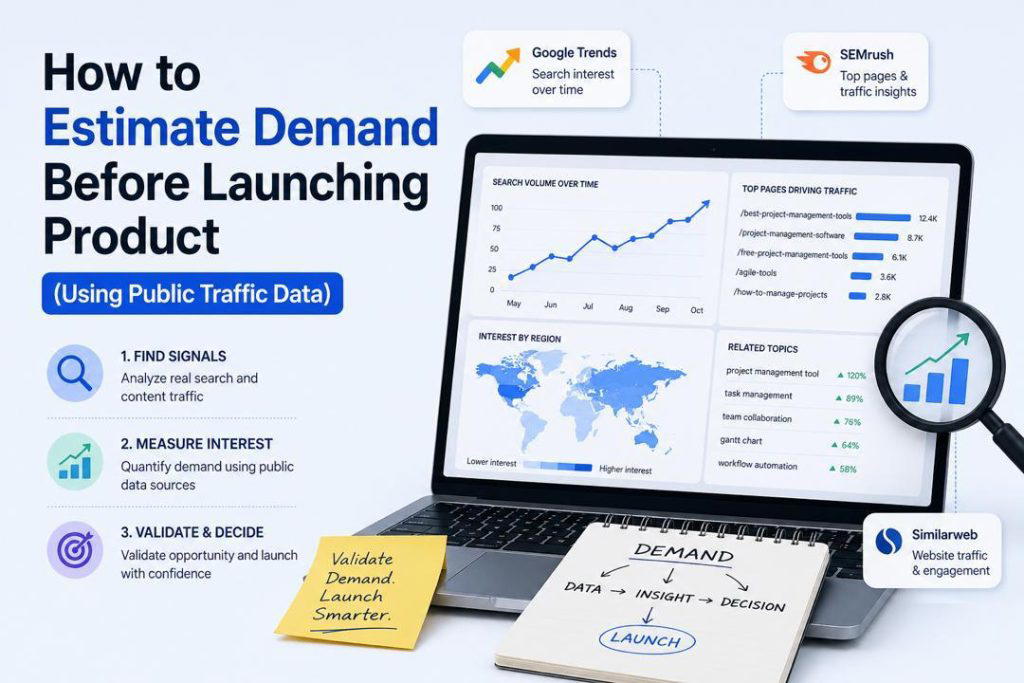
For many entrepreneurs, the excitement of a new idea often leads straight into development. However, one of the most common and costly mistakes in business is launching a product without confirming whether real demand exists.
nResearch consistently shows that lack of market need is a leading cause of startup failure. This highlights a critical truth: a great idea is not enough, there must be an audience actively looking for it.
nToday, entrepreneurs have a powerful advantage. With access to public traffic data and digital analytics tools, it is now possible to validate demand quickly, accurately, and at little to no cost before investing significant time or capital.
nWhy Demand Validation Matters
nThe internet has become the largest source of consumer behavior data in history. With billions of users actively searching, browsing, and engaging online, every click leaves behind signals that can be analyzed.
nFor entrepreneurs, this means one thing you no longer have to guess if people want your product you can measure it.
nStep 1: Identify Competitor Websites in Your Niche
nThe first step in estimating demand is to identify 5 to 10 competitor or similar websites within your niche.
nThese don’t have to be exact replicas of your idea. Instead, look for businesses that:
n- n
- Solve a similar problem n
- Serve the same target audience n
- Operate within your intended market space n
Their presence alone is an important signal. A market with multiple active players often indicates existing demand, not saturation.
nStep 2: Scan Competitor Traffic to Measure Demand
nOnce you’ve identified relevant websites, the next step is to analyze their traffic.
nUsing tools like Prostats, entrepreneurs can estimate how many people visit competitor websites, where that traffic comes from, and how it trends over time.
nKey Insight:
nBy scanning multiple competitor URLs, you begin to see patterns. If several websites in your niche consistently attract visitors, it is a strong indication that people are actively interested in that problem space.
nA simple benchmark approach:
n- n
- Analyze 5–10 competitor sites n
- Look at their combined traffic levels n
- If they generate consistent, meaningful traffic, demand likely exists n
This shifts your decision-making from assumption to evidence.
nStep 3: Understand Where the Traffic Comes From
nTraffic volume alone is useful but traffic sources tell the real story.
n- n
- Organic Search Traffic: Indicates people are actively searching for solutions n
- Direct Traffic: Suggests brand awareness or repeat users n
- Paid Traffic: Shows companies are investing money to acquire customers n
A strong presence of organic traffic is particularly important. It signals natural demand, meaning users are already looking for what you plan to offer.
nStep 4: Analyze Trends Over Time
nDemand is not just about current numbers, it’s about direction when reviewing competitor data:
n- n
- Growing traffic = expanding market opportunity n
- Stable traffic = consistent demand n
- Declining traffic = potential market challenges n
To strengthen your analysis, you can combine traffic insights with search trend tools to confirm whether interest in your niche is increasing or fading.
nStep 5: Validate with Additional Signals
nWhile traffic data is powerful, combining it with other signals provides a more complete picture:
n- n
- Social media engagement n
- Customer reviews and feedback n
- Search volume trends n
- Content activity (blogs, videos, ads) n
When multiple signals point in the same direction, your confidence in the opportunity increases significantly.
nWhat This Means for Entrepreneurs
nIf several competitor websites in your niche are attracting steady traffic, it tells you something critical:
n- n
- People are already interested. n
- The problem is real. n
- The market exists. n
On the other hand, if traffic is consistently low across multiple players, it may indicate weak demand—or a need to refine your idea.
nConclusion: Replace Guesswork with Data
nLaunching a product without validating demand is a risk modern entrepreneurs no longer need to take.
nBy simply:
n- n
- Identifying competitor websites n
- Analyzing their traffic n
- Understanding user behavior you can make smarter, faster, and more confident decisions. n
In today’s digital economy, the most successful founders are not just creative—they are data-driven.
nBefore you build, before you spend, and before you launch:
check the traffic.
Because when demand is proven, your chances of building something people truly want and are willing to pay for increase dramatically.
n nRelated Stories
 General News
CELEBRATING TWO YEARS OF TRANSFORMATIONAL LEADERSHIP IN THE PRESIDENTIAL AMNESTY PROGRAMME
Tomorrow, 14TH March 2026, as we look forward to the second anniversary, we reflect on the remarkable two years since the Administrator of the Preside
 General News
PRESIDENTIAL AMNESTY PROGRAMME PHASE 3: DISREGARD PURPORTED STATEMENT ON DELAYED ITA PAYMENTS — OFFICE OF NATIONAL CHAIRMAN
The Office of the National Chairman of the Presidential Amnesty Programme Phase 3, General Elaye ThankGod Dollar Slaboh, has called on beneficiaries a
 General News
RE: CLARIFICATION ON MY PERSONAL RELATIONSHIPS
PUBLIC NOTICErnrnRE: CLARIFICATION ON MY PERSONAL RELATIONSHIPSrnrnIt has become necessary to make this public clarification following the increasing