
How Federal might came to Osun and met the people, by Stephanie Shaakaa
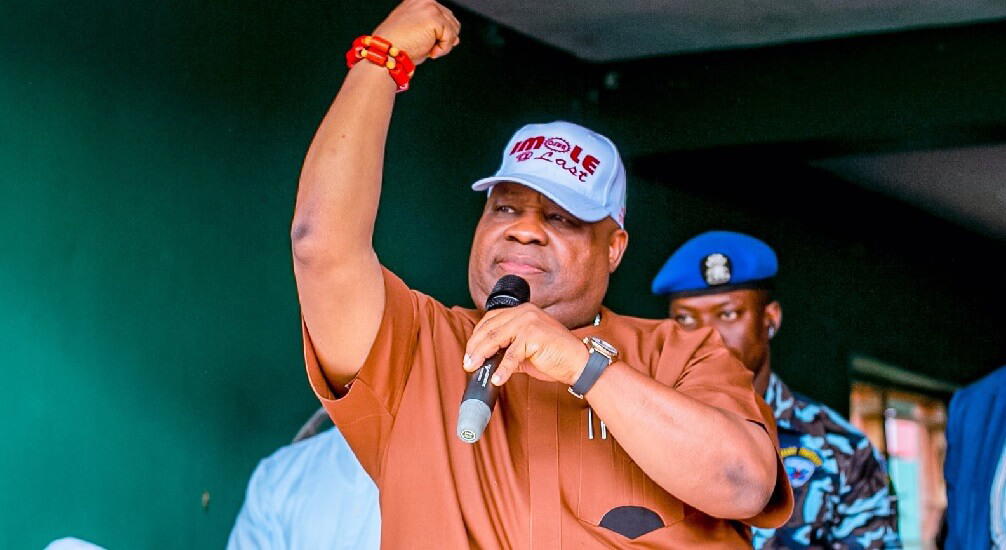
File: Governor Ademola Adeleke
nOsun was supposed to be a governorship election.
nThen Abuja arrived.
nThe problem is not that Abuja came to Osun. The problem is what Nigerian democracy becomes when Abuja can become the largest political presence in a state election.
nWhat followed was not illegal simply because it was powerful. Political parties are entitled to mobilise. Governors are entitled to campaign for their party. National leaders can travel to states and ask voters to support their candidates. There is nothing inherently undemocratic about any of that.
nThe discomfort begins somewhere else.
nIt begins when a state election starts to look like a national political operation, when the machinery of a ruling party becomes so enormous that the distinction between party strength and the aura of government power begins to blur.
nThat is what made Osun worth watching.
nThe All Progressives Congress did not treat the August 15 election as an ordinary contest. It constituted a national campaign council that was initially announced as 276 members and later reported at 291, drawing in governors, National Assembly leaders, ministers, federal and state lawmakers and senior party figures from across the country. Imo Governor Hope Uzodimma was made chairman, with Yobe Governor Mai Mala Buni, Senate President Godswill Akpabio and Speaker Tajudeen Abbas among the senior figures in the leadership of the campaign structure.
nThen, as the campaign entered its final hours, the spectacle became even more visible. Four serving governors were reported in Osogbo for the APC’s final mega rally .Uzodimma, Edo’s Monday Okpebholo, Kogi’s Ahmed Usman Ododo and Ondo’s Lucky Aiyedatiwa. They were joined by Akpabio and other national political heavyweights.
nThere was nothing subtle about the message.
nAbuja was interested in Osun.
nThe APC itself had already described the election as a “must win” contest and as a crucial test of its readiness for 2027. Its national chairman said the party would deploy its nationwide political structures, elected officials and grassroots network to reclaim the state.
nAgain, none of this, by itself, proves that federal government resources were unlawfully used for partisan purposes. That would require evidence, and serious political writing should not manufacture it.
nBut democracy is concerned with more than illegality.
nIt is also concerned with power.
nAnd power has a psychological dimension.
nWhen a candidate goes into a state election surrounded by governors, ministers, senators, the leadership of the National Assembly and the full political machinery of the party controlling the federal government, voters do not see only a campaign team. They see the weight of the centre.
nThat weight is often deliberately amplified to manufacture an air of inevitability. The concentration of national heavyweights in a state capital is frequently deployed as a psychological tool,a bandwagon effect designed to demoralize local opposition, overwhelm undecided voters, and signal that resistance is futile.
nThat weight can be felt without anyone issuing a threat.
nIt can be communicated in a sentence as ordinary as the one APC National Secretary Ajibola Basiru delivered during the campaign, when he urged Osun voters to choose an APC governor because, he argued, the state would benefit from having a governor whose party controls the Federal Government.
nThere is a legitimate argument inside that proposition. Federal and state governments work together. A governor who belongs to the governing party may indeed find cooperation with Abuja easier.
nBut there is another question hiding inside it.
nWhen does cooperation become leverage?
nAnd what happens to federalism when voters begin to hear a state election partly as a choice between having access to Abuja and being outside the governing party at the centre?
nThat is not a trivial question.
nA governorship election is supposed to answer a relatively simple question. Who do the people of this state want to govern them?
nIt should not quietly become another question.Who will give us the best relationship with the President?
nThose questions are not the same.
nOne is about representation.
nThe other is about political dependency.
nThis is the deeper danger of federal might in state elections. It does not necessarily arrive carrying a threat. Sometimes it arrives carrying promises, access, prestige and proximity to power. It tells voters that the road to development may be smoother if they choose the candidate who sits on the same political side as Abuja.
nYet, when external actors descend too heavily, they frequently miscalculate the local psyche. Electorates often view an overwhelming federal onslaught not as a persuasive pitch, but as an infringement on their political maturity,a subtle insult that triggers a protective local backlash and turns the ballot box into a referendum on local pride versus external dictation.
nPerhaps that is still viewed as legitimate political persuasion by its architects.
nBut we should still ask what kind of democracy we are building when the federal government becomes such a powerful presence in contests that are supposed to be decided at the state level.
nNigeria is a federation, not a political pyramid in which every important decision must eventually be traced back to the centre.
nA governor should be able to govern effectively without owing his legitimacy to the President. A state should be able to choose an opposition governor without being made to feel that it has chosen political isolation.
nAnything else risks turning federalism into patronage.
nAnd that is where the Osun election becomes particularly instructive.
nBecause after all the governors came, after the national leaders mobilised, after the ruling party assembled one of the most formidable campaign structures imaginable, the voters still had the last word.
nAdemola Adeleke won with 511,067 votes against Bola Oyebamiji’s 444,815, carrying 19 of the state’s 30 local government areas.
nThe national political machine had arrived.
nThe electorate did not surrender its independence.
nThat is perhaps the most important lesson of Osun.
nPower can campaign.
nIt cannot vote.
nGovernors can stand on platforms and make promises. Ministers can explain the advantages of alignment with Abuja. Party chairmen can assemble structures that stretch across the country. National lawmakers can descend on a state and transform a local rally into a national spectacle.
nBut when the curtain closes and the voter enters the polling booth, all of that power must become irrelevant for a few precious seconds.
nThe voter stands alone with the ballot.
nThat small privacy is one of democracy’s greatest protections.
nIt is also why politicians should be careful about becoming intoxicated by the size of their own machinery.
nThe APC’s campaign in Osun demonstrated impressive organisation. There is nothing wrong with a political party knowing how to mobilise. In fact, weak political parties are a danger to democracy too.
nBut there is a difference between political organisation and political omnipotence.
nThe first strengthens democracy.
nThe second begins to frighten it.
nThis distinction matters particularly as Nigeria approaches 2027. When ruling parties treat off-cycle state contests as militarized proxy tests of national supremacy, they exhaust public goodwill, strain state resources, and turn routine democratic transitions into high-stakes existential battles.
nIf the lesson political parties take from Osun is that every state election should become a test of the federal government’s strength, then state politics will gradually become an extension of presidential politics. Governors will increasingly be judged not by what they can do for their people but by how close they are to the centre. Opposition parties will be forced to campaign not only against candidates but against the gravitational pull of Abuja itself.
nThat would be a terrible direction for a federation.
nAnd the principle should apply regardless of who occupies Aso Rock.
nToday the APC controls the Federal Government and has the machinery to deploy its national political establishment into a state contest. Tomorrow another party may control Abuja and do exactly the same thing.
nThe objection, therefore, should not be partisan.
nIt should be constitutional in spirit and democratic in principle.
nNo president should need to fear an opposition governor. No state should need to belong to the President’s party before it can expect fair treatment. And no voter should ever be made to feel that choosing the “wrong” party means choosing development’s wrong side.
nThat is not federalism.
nThat is political dependence.
nOsun has given Nigeria an unusually useful warning because the people of the state ultimately demonstrated that the centre can come with all its weight and still fail to determine the outcome.
nThe APC brought governors.
nThe people brought ballots.
nThe APC brought national structures.
nThe people brought their judgment.
nThe APC brought Abuja’s political gravity.
nThe people remained in Osun.
nAnd that is the point Nigerian democracy must never forget.
nA political party can bring the whole country to a state election, but it cannot bring the whole country into the polling booth.
nThere, for one brief moment, the governor, the minister, the senator, the party chairman and the President disappear.
nThere is only the voter and the ballot.
nThat is where federal might must end.
nBecause the moment Abuja becomes the invisible candidate in a state election, the election is no longer simply about who should govern the state.
nIt becomes a test of whether the people still believe that the state belongs to them.
nOsun answered that question more clearly than the politicians expected.
nAbuja came calling.
nThe people answered at the ballot box.
n nRelated Stories
 General News
CELEBRATING TWO YEARS OF TRANSFORMATIONAL LEADERSHIP IN THE PRESIDENTIAL AMNESTY PROGRAMME
Tomorrow, 14TH March 2026, as we look forward to the second anniversary, we reflect on the remarkable two years since the Administrator of the Preside
 General News
PRESIDENTIAL AMNESTY PROGRAMME PHASE 3: DISREGARD PURPORTED STATEMENT ON DELAYED ITA PAYMENTS — OFFICE OF NATIONAL CHAIRMAN
The Office of the National Chairman of the Presidential Amnesty Programme Phase 3, General Elaye ThankGod Dollar Slaboh, has called on beneficiaries a
 General News
RE: CLARIFICATION ON MY PERSONAL RELATIONSHIPS
PUBLIC NOTICErnrnRE: CLARIFICATION ON MY PERSONAL RELATIONSHIPSrnrnIt has become necessary to make this public clarification following the increasing