
From theory to the lab: How two Nigerian brothers are changing science education in Africa
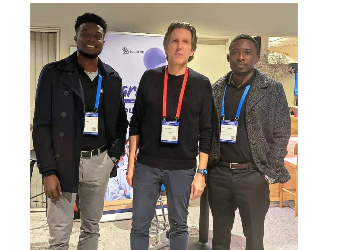
Davis and Emmanuel Eban founded Edugene – a science and biotechnology education startup. It is the first and only organisation in Africa to be admitted into the European Genomic Medicine Consortium
nBy Sola Ogundipe
nTwo Nigerian brothers, Davis and Emmanuel Eban, have taken their education technology initiative, Edugene, a step closer to the international genomic medicine community after the platform was admitted into the European Genomic Medicine Consortium (EGMEDC).
nThe milestone was announced at the CRISPRMED26 Conference in Copenhagen, Denmark, in April 2026, where Edugene was formally welcomed into the pan-European consortium.
nAccording to the brothers, Edugene is the first African organisation to join EGMEDC. The admission could open opportunities for African students to gain exposure to European laboratories, research projects, mentorship programmes and international internships.
nEdugene is a life science and biotechnology education platform created to bridge the gap between academic learning and practical experience in areas such as genomics, bioinformatics and molecular biology.
nIts admission into EGMEDC also gives the Nigerian initiative access to a wider network of European organisations working in genomic medicine and CRISPR (Clustered Regularly Interspaced Short Palindromic Repeats) – a fast, and precise gene-editing tool adapted from natural bacterial defense systems. Scientists use CRISPR like molecular scissors to find, cut, and modify DNA sequences in living cells, offering a way to study biology and treat genetic diseases.
nEGMEDC is a pan-European non-profit organisation focused on promoting the development and clinical application of CRISPR and genomic medicine across Europe. Its founding partners and supporters include major research, academic and biotechnology institutions such as Amsterdam UMC, Bayer, Chiesi Group, Aldevron, Charité Universitätsmedizin Berlin, INSERM and University College London (UCL).
nFor the Eban brothers, however, the significance of the development goes beyond membership of a European scientific network. They see it as an opportunity to build practical connections between African students and the wider global scientific community.
nGiving an insight into their accomplishment, Davis, who is Edugene’s Chief Executive Officer told Saturday Vanguard that the platform grew out of a problem he had seen repeatedly among science graduates in Nigeria and across Africa.
n“We kept seeing brilliant African students with no pathway. Nigeria produces thousands of science graduates every year, but many leave university with mainly theoretical knowledge and limited opportunities to acquire practical skills required by laboratories, research institutions and biotech companies,” he said.
nSpeaking further, Davis, a cell biologist with clinical research experience, noted that the lack of laboratory experience, professional mentorship and international exposure leaves many graduates struggling to remain in their chosen fields.
n“Some eventually take jobs in banks and other unrelated sectors simply to earn a living, despite having trained to become scientists and researchers. It shouldn’t be so,” he said.
nHaving witnessed the gap first-hand, Davis said he became convinced that technology could provide a practical bridge between academic learning and professional scientific work. That conviction led to the development of Edugene, built around what its founders call the “Theory-to-Bench” model.
n“Our admission into EGMEDC is not just recognition of Edugene, it is a signal that African led solutions are being acknowledged as genuine contributors to the global scientific ecosystem,” Davis noted.
nOn his part, Emmanuel, an experienced software engineer, and Edugene’s Chief Technology Officer, said the initiative was built as a platform that combines digital learning with practical exposure, mentorship and opportunities for students to connect with institutions and professionals working in the field.
n“Our goal has always been to make world class scientific training genuinely accessible to African students, wherever they are,” Emmanuel said.
nEdugene is expected to officially launch to students in 2027, offering expert-led courses in genomics, bioinformatics and molecular biology, alongside access to named mentors and internship pathways with research institutions.
n
The Eban brothers are confident that this combination can help African students move beyond theoretical knowledge and develop practical skills and professional networks needed to pursue science as a career. The EGMEDC admission of Eugene is notable as it is expected to strengthen this model.
Through the consortium, Edugene plans to create structured pathways connecting African students with European laboratories, research projects and international internship opportunities.
nThe Eban brothers say their ambition goes beyond creating another online learning platform. They want to help change the direction of science education in Africa by giving students access to practical experience, mentorship and international connections that are often unavailable through traditional academic pathways.
n
Evans and Emmanuel are convinced that the admission into EGMEDC unlocks significant opportunities for Nigeria and Africa as a whole.
“Joining EGMEDC isn’t just a badge. It’s a bridge. Through the consortium, Edugene will create structured pathways for African students into European labs, research projects, and international internship placements,” they assert.
nThe bottom line: For Africa often described as a consumer rather than a producer of scientific knowledge and technology, the next step is to build the infrastructure, talent and institutions needed to change that narrative. Edugene’s entry into EGMEDC is one step towards achieving that goal.
n nRelated Stories
 General News
CELEBRATING TWO YEARS OF TRANSFORMATIONAL LEADERSHIP IN THE PRESIDENTIAL AMNESTY PROGRAMME
Tomorrow, 14TH March 2026, as we look forward to the second anniversary, we reflect on the remarkable two years since the Administrator of the Preside
 General News
PRESIDENTIAL AMNESTY PROGRAMME PHASE 3: DISREGARD PURPORTED STATEMENT ON DELAYED ITA PAYMENTS — OFFICE OF NATIONAL CHAIRMAN
The Office of the National Chairman of the Presidential Amnesty Programme Phase 3, General Elaye ThankGod Dollar Slaboh, has called on beneficiaries a
 General News
RE: CLARIFICATION ON MY PERSONAL RELATIONSHIPS
PUBLIC NOTICErnrnRE: CLARIFICATION ON MY PERSONAL RELATIONSHIPSrnrnIt has become necessary to make this public clarification following the increasing