
Four things to know about South Africa’s anti-migrant protests
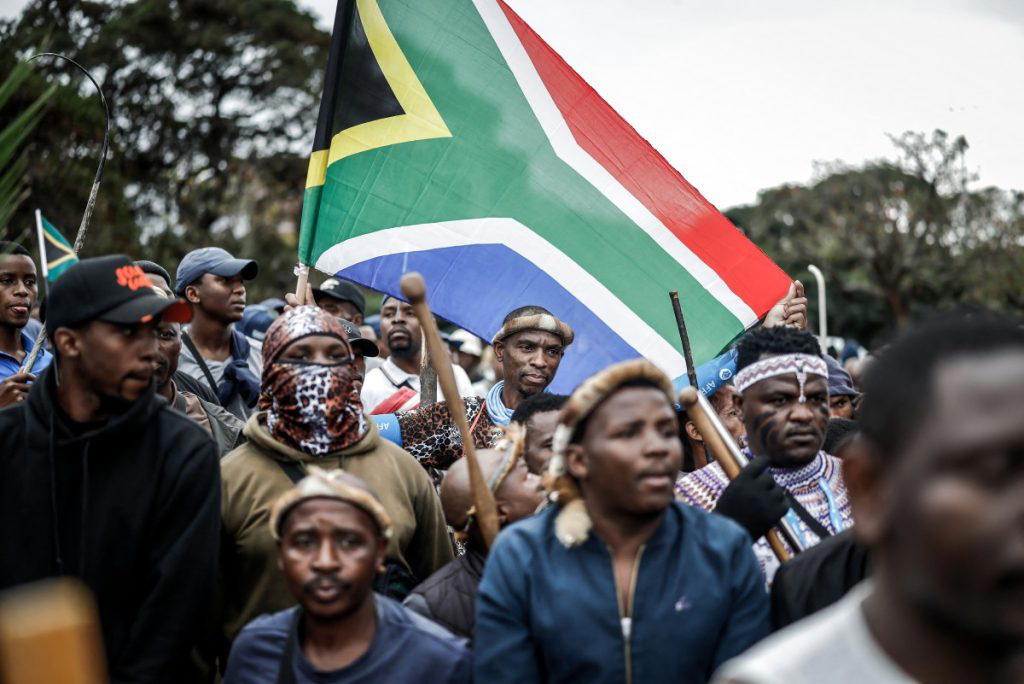
Members of the Zulu regiment known as the Amabutho hold a South African flag as they march during a demonstration by the “March and March” movement marking an unofficial deadline set by citizen-led groups for undocumented foreign nationals to leave South Africa, in Durban, on June 30, 2026. South African police deployed to head off unrest and protests on June 30, 2026, the unofficial deadline set by anti-immigrant groups for undocumented foreign nationals to leave that has already pushed thousands to flee. Officers were out in force to prevent violence and looting by the xenophobic groups, while hundreds of foreign nationals took refuge in several cities, urgently seeking help to leave. (Photo by Marco LONGARI / AFP)
nSouth Africa faces nationwide anti-immigrant marches after hardline citizen-led groups ordered undocumented foreigners to leave the country by Tuesday.
nThe unrest has already killed at least four people, with thousands of African migrants fleeing home or huddling in makeshift camps for fear of attack.
nHere are four things to know about the protests.
n– Who is behind them? –
nProtests have been mobilised by a loose coalition of minor political parties and small citizen-led vigilante groups, some fronted by men in traditional Zulu attire and carrying sticks and shields.
nThey claim migrants drive crime and take jobs from locals, fuelling tensions in townships grappling with poverty, unemployment and weak policing.
nThe groups seem well organised and well resourced, analysts say, and have a strong presence on social media that includes disinformation debunked by AFP.
n“The main ingredient is right-wing political opportunism,” political scientist Sandile Swana told AFP.
n“We are seeing a new form of black-on-black violence diverting attention from the true culprits of the economic crisis.”
n– Why now? –
nMostly low-key demonstrations flared late last year when undocumented foreign nationals were blocked from accessing clinics and hospitals.
nProtests intensified this year with vigilante groups warning irregular migrants to go home by June 30.
nThey were driven by growing public anger in Africa’s richest nation over issues such as soaring joblessness — at nearly 33 percent — crime and pressure on resources, analysts say.
nThey say a steady influx of mostly African migrants have become a convenient scapegoat, with political actors leveraging the tensions ahead of municipal elections in November.
nThere are roughly three million immigrants in the country, about 5.1 percent of the population, according to the national statistics agency.
nMore than 63 percent come from other countries in southern Africa, many of which are facing economic crisis and political instability.
n– What has happened? –
nSouth African police are investigating the killings of two Mozambique nationals and a Malawian in the recent unrest.
nThere have also been reports of South Africans demanding to check the papers of foreign nationals, or going to their homes or workplaces to tell them to leave.
nSome of those heading home say they were told to go by their employers or landlords who feared being fined by inspectors or attacked by vigilantes.
nThe violence, threats and intimidation have prompted several African countries — including Kenya, Uganda and the Democratic Republic of Congo — to organise voluntary repatriations.
nAt least 988 Ghanaians and about 600 Nigerians left by plane this month, the Border Management Authority (BMA) said.
nMore than 15,000 people crossed land borders into Zimbabwe, Malawi and Mozambique over the same period, it added.
nThe BMA told AFP on Monday that some 25,000 people had been repatriated in recent weeks.
nThe agency said most people it had processed were in the country illegally, some of them having overstayed their visas.
nThousands more foreign nationals were meanwhile in makeshift camps in the eastern city of Durban, or centres in Johannesburg and Cape Town, awaiting assistance to return home.
nAhead of Tuesday’s unofficial deadline, government officials outlined their actions against illegal immigration — including reinforcing border controls and inspections — and called for calm.
n– How this compares to past protests –
nWaves of xenophobic violence have swept South Africa over the past decades.
nIn 2008, 62 people were killed in anti-immigrant riots and thousands were displaced. Further outbreaks followed in 2015 and 2016.
nViolence in 2019 saw armed mobs descend on foreign-owned businesses around Johannesburg, leaving at least 12 people dead — 10 of them South African citizens.
nBut this is the first time that such threats have prompted several governments to simultaneously organise coordinated voluntary repatriations for thousands of their nationals.
n nRelated Stories
 General News
CELEBRATING TWO YEARS OF TRANSFORMATIONAL LEADERSHIP IN THE PRESIDENTIAL AMNESTY PROGRAMME
Tomorrow, 14TH March 2026, as we look forward to the second anniversary, we reflect on the remarkable two years since the Administrator of the Preside
 General News
PRESIDENTIAL AMNESTY PROGRAMME PHASE 3: DISREGARD PURPORTED STATEMENT ON DELAYED ITA PAYMENTS — OFFICE OF NATIONAL CHAIRMAN
The Office of the National Chairman of the Presidential Amnesty Programme Phase 3, General Elaye ThankGod Dollar Slaboh, has called on beneficiaries a
 General News
RE: CLARIFICATION ON MY PERSONAL RELATIONSHIPS
PUBLIC NOTICErnrnRE: CLARIFICATION ON MY PERSONAL RELATIONSHIPSrnrnIt has become necessary to make this public clarification following the increasing