
Forced migration: The emerging humanitarian time bomb
By Victor-Bandele Dada
nHuman history has always been accompanied by migration. Communities have moved in search of fertile land, economic opportunity, political freedom, religious liberty, and security. Migration, in itself, is therefore neither abnormal nor undesirable. Throughout history it has contributed to cultural exchange, economic development, technological diffusion, and the advancement of civilizations.
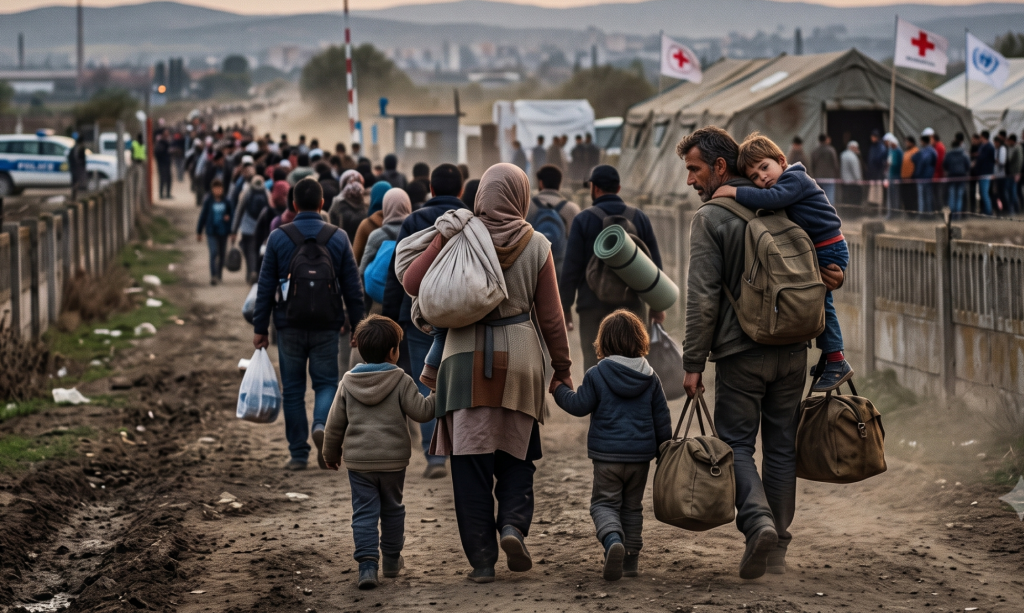
nForced migration, however, represents a fundamentally different phenomenon. It is migration without meaningful choice. Individuals, families, and entire communities are compelled to abandon their homes because remaining has become incompatible with safety, dignity, or survival. Armed conflict, terrorism, environmental degradation, climate change, economic collapse, political instability, communal violence, and development-induced displacement have collectively transformed forced migration into one of the defining humanitarian crises of our age (Castles, 2003; UNHCR, 2024).
nThe scale of contemporary displacement is unprecedented in modern history. Tens of millions of people worldwide have been displaced within or across national borders. Nigeria itself continues to experience large-scale internal displacement arising from insurgency in the North-East, armed banditry in the North-West, communal conflicts in the Middle Belt, flooding, environmental pressures, and other forms of insecurity. These developments have generated profound humanitarian, economic, and governance challenges that extend far beyond the immediate needs of displaced populations (Internal Displacement Monitoring Centre [IDMC], 2024).
nPublic discourse has largely concentrated on managing these humanitarian consequences through emergency relief, refugee protection, border management, and international assistance. These interventions are indispensable. Yet they remain predominantly reactive. Far less attention has been devoted to the deeper structural question:
nWhy do communities continually produce displaced populations instead of producing sustainable prosperity?
nThis article argues that this neglected question represents one of the most important research frontiers confronting contemporary scholarship.
nDefining the Emerging Humanitarian Time Bomb
nThe expression humanitarian time bomb should not be understood as rhetorical exaggeration. Rather, it describes a measurable structural condition in which interacting trends increase the probability of systemic humanitarian failure if left unaddressed.
nThe present crisis is defined by the convergence of three powerful global dynamics.
nFirst, the number of forcibly displaced people continues to increase as conflicts become more protracted, climate-related hazards intensify, fragile states struggle to maintain security, and demographic pressures grow. Humanitarian agencies face mounting demands that increasingly exceed available resources.
nSecond, countries that historically absorbed significant numbers of migrants and refugees are adopting progressively more restrictive immigration and asylum policies. Governments cite border security, fiscal pressures, social integration challenges, labour-market considerations, and domestic political concerns as reasons for strengthening migration controls. Recent policy developments in several advanced economies-including tighter visa regimes, expanded border enforcement, and additional financial requirements for certain categories of travellers-illustrate a broader international trend toward more restrictive migration governance rather than expanding migration opportunities.
nThird, many migrant-producing countries continue to experience structural conditions that generate displacement faster than they can create sustainable livelihoods. Persistent insecurity, weak institutions, environmental degradation, inadequate local economic opportunities, and uneven regional development continue to encourage both internal and international migration.
nThe significance of these developments lies not in any one trend individually but in their interaction.
nThe world is simultaneously producing more displaced people while becoming less willing or less able to absorb them.
nThis widening structural imbalance constitutes the emerging humanitarian time bomb.
nUnless scientific, institutional, and developmental solutions address the causes of displacement, humanitarian interventions alone will struggle to keep pace with expanding needs.
nBeyond Politics: The Forgotten Responsibility of Academia
nOne of the most striking features of contemporary discussions on forced migration is the overwhelming tendency to assign responsibility almost exclusively to political leaders, security institutions, humanitarian organizations, and international development agencies.
nGovernments are expected to formulate migration policies.
nInternational organizations are expected to coordinate humanitarian assistance.
nSecurity agencies are expected to restore stability.
nDevelopment partners are expected to provide financial support.
nThese responsibilities are legitimate.
nYet an equally important institution receives comparatively little scrutiny: the university.
nThroughout history, universities have not merely interpreted society; they have generated the knowledge that has transformed it. Modern medicine emerged through sustained scientific inquiry. Agricultural revolutions resulted from decades of research. Advances in engineering, communications, and information technology were products of university laboratories, research institutes, and collaborative scientific endeavour.
nIf knowledge has transformed nearly every major sector of modern civilization, why should one of humanity’s greatest contemporary crises depend predominantly upon political negotiation and humanitarian relief rather than sustained interdisciplinary scientific research?
nThis article therefore advances a central proposition:
nForced migration is not only a humanitarian emergency. It is also an intellectual challenge.
nUntil universities assume greater leadership in understanding, preventing, and redesigning the structural systems that generate displacement, the international community risks remaining trapped in an endless cycle of crisis management rather than crisis prevention.
nThe question confronting Nigerian academia is therefore not whether forced migration deserves scholarly attention. It is whether higher education institutions will accept the responsibility of developing transformative solutions equal to the magnitude of the challenge.
nConclusion: From Humanitarian Crisis to Scientific Opportunity
nForced migration is widely recognised as one of the defining humanitarian crises of the twenty-first century. Yet the prevailing response remains overwhelmingly reactive. Governments strengthen border controls. International organisations expand humanitarian assistance. Security agencies attempt to contain conflicts. Development partners finance emergency interventions. These measures remain indispensable, but they are primarily directed towards managing the consequences of displacement rather than systematically preventing its structural causes.
nThis article has advanced a different proposition.
nThe emerging humanitarian time bomb is not defined solely by the increasing number of displaced persons. It is created by the convergence of three accelerating realities: the continuing expansion of forced migration, the growing reluctance of many destination countries to absorb additional migrants, and the limited scientific progress in redesigning communities so that displacement becomes progressively unnecessary.
nIf these trends continue unchecked, the international community will face increasing humanitarian pressures while possessing diminishing opportunities for durable solutions.
nThis is no longer merely a migration problem.
nIt is a development problem.
nIt is a governance problem.
nIt is an environmental problem.
nIt is an economic problem.
nAbove all, it is an intellectual problem.
nThe Responsibility of Nigerian Academia
nEvery generation of scholars is ultimately judged not only by the knowledge it preserves but also by the new knowledge it contributes to humanity.
nNigeria’s universities have produced outstanding graduates, influential scholars, and significant research across numerous disciplines. The nation therefore possesses the intellectual capacity required to confront complex development challenges.
nThe question is whether that intellectual capacity can now be mobilised around one of the greatest humanitarian challenges confronting contemporary Africa.
nForced migration should become one of Nigeria’s foremost interdisciplinary research priorities.
nIt demands collaboration among geographers, engineers, economists, sociologists, planners, environmental scientists, agricultural scientists, public health specialists, legal scholars, management scientists, political scientists, and development practitioners.
nThe complexity of the challenge requires an equally integrated scientific response.
nProsperity Governance and Management: An Invitation to Collaborative Scholarship
nProsperity Governance and Management is not presented as a finished doctrine or an unquestionable theory.
nIt is presented as the outcome of more than four decades of multidisciplinary inquiry inspired by the intellectual foundations established by Emeritus Professor Isaac Ayinde Adalemo and strengthened through the systems-oriented scholarship of Emeritus Professor Oyewusi Ibidapo-Obe.
nThroughout this research journey, one central question remained constant:
nCan communities be scientifically organised to generate enduring prosperity and thereby reduce the structural conditions that compel people to migrate?
nThe resulting framework now seeks independent scientific examination.
nIts value will ultimately be determined not by the conviction of its originator but by the quality of evidence generated through rigorous academic investigation.
nThat is the standard to which all scientific propositions should be held.
nAUTOSUCOM: The Next Stage of Scientific Inquiry
nProsperity Governance and Management has now reached a decisive milestone.
nThe research has advanced beyond theoretical formulation to the design of the Automatically Sustainable Community (AUTOSUCOM) prototype.
nThe proposed demonstration is neither a commercial venture nor a request for unconditional governmental adoption.
nIt is a research platform.
nIt is intended to provide a controlled environment within which universities and independent researchers may examine whether scientifically integrated community systems can improve prosperity, strengthen resilience, enhance institutional performance, and reduce the structural drivers of forced migration.
nThe prototype is therefore an invitation to empirical science.
nEvery indicator should be measured.
nEvery assumption should be tested.
nEvery outcome should be independently evaluated.
nEvery conclusion should remain open to revision in the light of evidence.
nSuch openness is the hallmark of credible scholarship.
nA Call for National and International Collaboration
nAccordingly, this article respectfully calls upon the National Universities Commission, Nigerian universities, research institutes, professional associations, development partners, philanthropic organisations, cooperative institutions, and the wider international scholarly community to participate in the scientific evaluation of Prosperity Governance and Management and the AUTOSUCOM prototype.
nThe collaboration sought is primarily intellectual.
nIt seeks research partnerships, interdisciplinary investigation, peer review, pilot studies, comparative analyses, doctoral research, policy dialogue, and independent validation.
nIf the framework withstands scholarly scrutiny, it may contribute not only to Nigeria’s development discourse but also to broader international debates on sustainable development, migration governance, resilient communities, and prosperity creation.
n•*Dr. Dada is CEO, DESI Consultants Ltd.
n nRelated Stories
 General News
CELEBRATING TWO YEARS OF TRANSFORMATIONAL LEADERSHIP IN THE PRESIDENTIAL AMNESTY PROGRAMME
Tomorrow, 14TH March 2026, as we look forward to the second anniversary, we reflect on the remarkable two years since the Administrator of the Preside
 General News
PRESIDENTIAL AMNESTY PROGRAMME PHASE 3: DISREGARD PURPORTED STATEMENT ON DELAYED ITA PAYMENTS — OFFICE OF NATIONAL CHAIRMAN
The Office of the National Chairman of the Presidential Amnesty Programme Phase 3, General Elaye ThankGod Dollar Slaboh, has called on beneficiaries a
 General News
RE: CLARIFICATION ON MY PERSONAL RELATIONSHIPS
PUBLIC NOTICErnrnRE: CLARIFICATION ON MY PERSONAL RELATIONSHIPSrnrnIt has become necessary to make this public clarification following the increasing