
FG to expand Deep Blue Project across Nigeria’s vulnerable maritime corridors
By Efe Onodjae
nThe Federal Government has disclosed plans to expand the Deep Blue Project to vulnerable coastal and maritime corridors across the country, including the Bakassi axis, as part of efforts to strengthen Nigeria’s maritime security architecture.
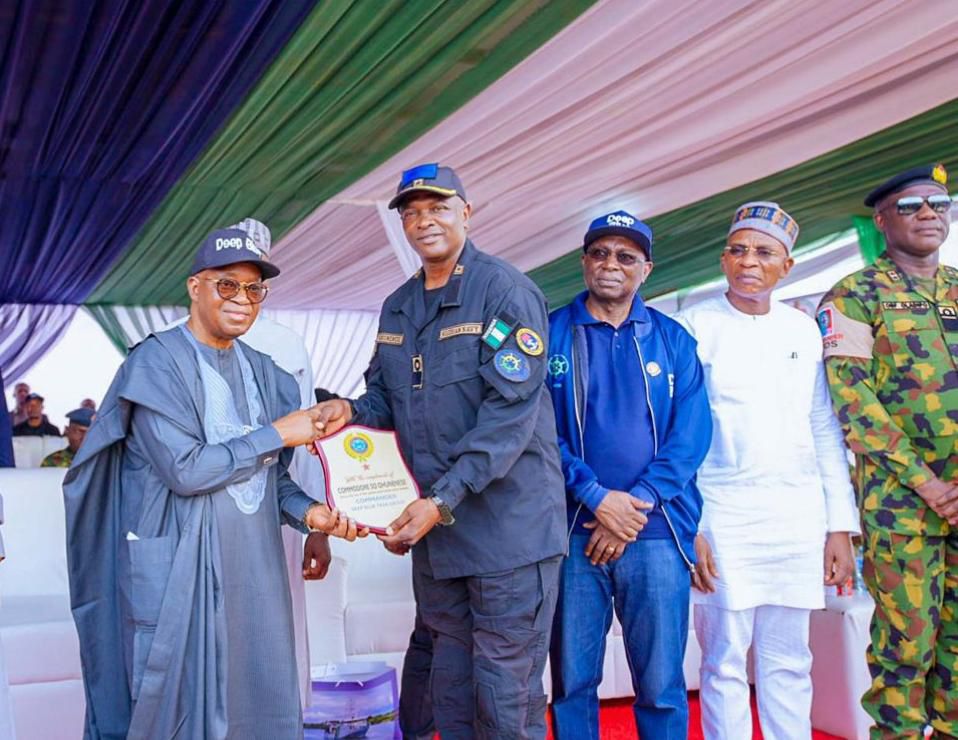
nThe Minister of Marine and Blue Economy, Adegboyega Oyetola, disclosed this on Thursday during the graduation ceremony of 492 Advanced Combat Personnel and Capability Presentation of the Deep Blue Project Task Group held at the 5 Battalion Army Barracks, Elele, Rivers State.
nOyetola said the expansion would cover critical coastal areas such as the Bakassi Peninsula, Igbokoda and other vulnerable maritime corridors.
nAccording to him, the initiative is aimed at consolidating gains already recorded under the Integrated National Security and Waterways Protection Infrastructure, also known as the Deep Blue Project.
nHe said, “Building on the significant strides already made, the Federal Ministry of Marine and Blue Economy is currently evaluating strategic frameworks for the expansion of the Deep Blue Project to further strengthen our maritime security architecture in critical coastal areas such as Igbokoda, Bakassi and other vulnerable maritime corridors.”
nThe minister explained that the move would further curb maritime insecurity, enhance operational capacity, improve maintenance systems and ensure maritime security assets remain effective in safeguarding Nigeria’s waters.
nHe stated that Nigeria had recorded zero piracy incidents within its territorial waters in the last four years due to the sustained implementation of the Deep Blue Project and collaboration among security agencies. He added that piracy incidents across the Gulf of Guinea had declined by more than 70 per cent within the same period.
nAccording to Oyetola, before the establishment of the Deep Blue Project in 2021, the Gulf of Guinea was regarded as one of the most dangerous maritime corridors globally, accounting for about 45 per cent of reported global piracy incidents and over 90 per cent of crew kidnappings at sea during peak periods.
nHe said the project had transformed Nigeria’s maritime security framework through the deployment of integrated air, land and sea assets supported by advanced surveillance systems and rapid response capabilities.
nThe minister linked the achievements of the project to the Federal Government’s broader economic agenda under President Bola Tinubu, noting that maritime security remains critical to economic growth, trade facilitation and investment promotion.
nHe urged the graduating personnel to uphold professionalism, patriotism, teamwork and respect for the rule of law in the discharge of their duties.
nOyetola also commended the Nigerian Maritime Administration and Safety Agency, NIMASA, the Armed Forces, security agencies and training partners for their contributions to the success of the initiative.
nEarlier, Director-General of NIMASA, Dayo Mobereola, described the event as a demonstration of Nigeria’s “operational readiness, institutional resilience and determination to maintain a safe, secure and economically viable maritime environment.”
nMobereola said the graduating officers completed 33 specialised training programmes covering multiple operational units within the Deep Blue architecture.
nAccording to him, the graduates comprised 232 Maritime Security Unit operatives, 19 armoured vehicle drivers, 13 armoured vehicle mechanics, eight special mission helicopter pilots, eight helicopter technicians, five special mission aircraft pilots, six aircraft technicians, 49 special mission vessel crew members, 28 interceptor boat mechanics, 62 interceptor boat drivers, 52 Command, Control, Communication, Computer and Intelligence, C4I, operators, and 10 Vertical Take-Off and Landing Unmanned Aerial Systems operators.
nHe added that the personnel underwent advanced security and operational training in countries including Syria, Italy, Swaziland, Australia and Nigeria.
nThe NIMASA boss also listed operational assets of the Deep Blue Project to include two special mission aircraft fitted with maritime surveillance sensors, two special mission helicopters, two special mission vessels, eight unmanned aerial vehicles, 16 fast interceptor boats and 15 armoured coastal patrol vehicles.
n nRelated Stories
 General News
CELEBRATING TWO YEARS OF TRANSFORMATIONAL LEADERSHIP IN THE PRESIDENTIAL AMNESTY PROGRAMME
Tomorrow, 14TH March 2026, as we look forward to the second anniversary, we reflect on the remarkable two years since the Administrator of the Preside
 General News
PRESIDENTIAL AMNESTY PROGRAMME PHASE 3: DISREGARD PURPORTED STATEMENT ON DELAYED ITA PAYMENTS — OFFICE OF NATIONAL CHAIRMAN
The Office of the National Chairman of the Presidential Amnesty Programme Phase 3, General Elaye ThankGod Dollar Slaboh, has called on beneficiaries a
 General News
RE: CLARIFICATION ON MY PERSONAL RELATIONSHIPS
PUBLIC NOTICErnrnRE: CLARIFICATION ON MY PERSONAL RELATIONSHIPSrnrnIt has become necessary to make this public clarification following the increasing