
FG targets jobs through research commercialisation
By Luminous Jannamike
nABUJA — The Federal Government has stepped up efforts to turn scientific research produced in Nigeria’s universities, polytechnics and research institutes into real products, startups and industries that can create jobs and drive economic growth.
nThe move reflects growing concern within government circles that many innovations developed in Nigerian laboratories never make it beyond academic papers or research reports.
nOfficials say the new push is meant to ensure that research leads to practical solutions, viable businesses and employment opportunities.
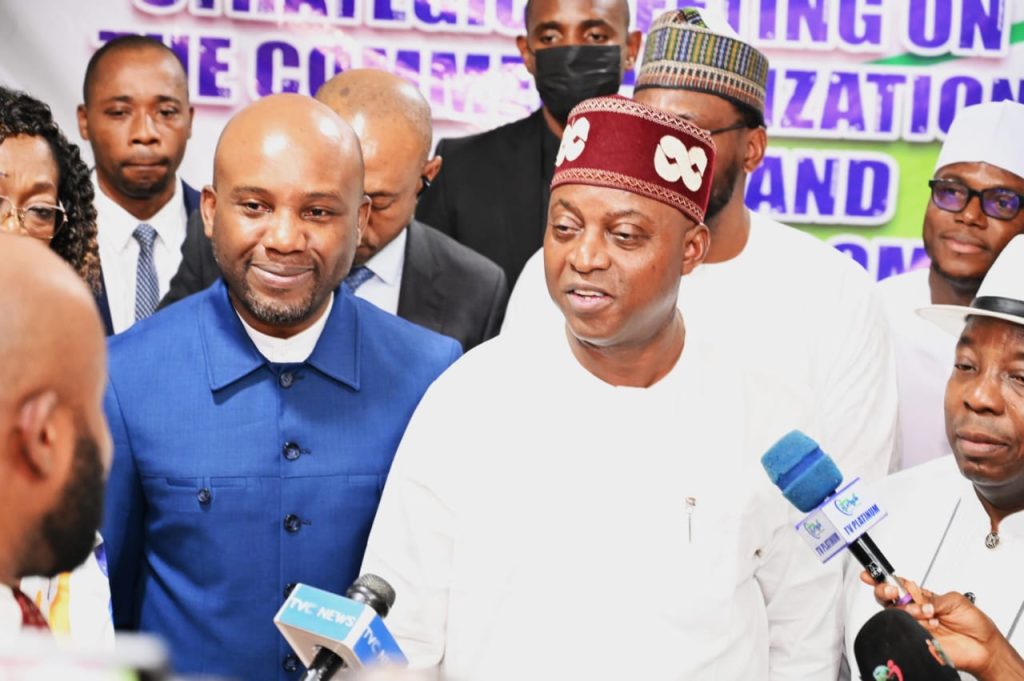
nThis was the focus of a strategic meeting convened in Abuja by the Federal Ministry of Innovation, Science and Technology.
nThe meeting brought together state Commissioners for Science, Technology and Innovation, heads of agencies and industry stakeholders. Among those who spoke were the Minister of Innovation, Science and Technology, Kingsley Tochukwu Udeh; the Permanent Secretary of the ministry, Philip Ndiomu Ebiogeh; the Director-General of the National Board for Technology Incubation, Kazeem Kolawole Raji; and the Commissioner for Innovation, Science and Technology in Kogi State, Helen Adeniyi.
nDelivering the keynote address, Udeh said Nigeria must move beyond producing academic research and begin turning knowledge into products, services and businesses that can support national development.
n“Too many valuable research outputs remain on laboratory shelves, in technical reports, or in academic journals without translating into products, services, or enterprises that can transform lives.
n“Economic power today is defined not just by natural resources but by the ability to convert knowledge into value. Nigeria must bridge the gap between research outputs and market outcomes,” he added.
nUdeh announced that a committee has been set up to develop a National Policy on Commercialization of Research and Development Results and Inventions, which will serve as a framework to guide collaboration between the federal and state governments.
nHe said state governments have a critical role to play in building innovation ecosystems because industries, startups and research institutions operate largely at the sub-national level.
n“Innovation ecosystems are built not only at the federal level but within states where industries operate, SMEs grow and local economies evolve.
n“Public funding alone cannot drive this transformation. We must explore partnerships and create investor confidence through transparency, regulatory clarity and protection of intellectual property,” he stated.
nEarlier in his welcome remarks, Ebiogeh stressed the need for deliberate systems that will help convert research knowledge into economic value.
n“Nigeria cannot afford to remain a nation where research findings gather dust on shelves. We must deliberately build systems that support patenting, prototyping, incubation, venture financing and market access,” he said.
nHe noted that state commissioners are strategically positioned to bridge the gap between laboratory discoveries and industrial application because they work closely with local innovation ecosystems.
nAlso speaking, Raji highlighted ongoing efforts to support young innovators through programmes such as the NextGen Innovation Challenge, which encourages Nigerian youths to develop commercially viable innovations.
nRaji disclosed that the competition attracted about 3,000 innovative entries within three weeks last year, while more than 1,000 applications have already been received for the 2026 edition.
n“Our goal is to ensure that Nigerian youths become employers of labour. If each innovation creates jobs for 20 or 30 people, imagine the multiplier effect on employment and GDP,” he said.
nHe added that the programme uses a technology readiness level framework to assess innovations and reduce bureaucratic bottlenecks that often slow down young innovators.
nMeanwhile, Adeniyi commended the federal government for convening the meeting and pledged Kogi State’s continued collaboration.
n“We have the human capability, the political will and the natural resources to leverage innovation. Kogi State will continue to work with the federal ministry to support initiatives that promote research commercialization,” she said.
nThe meeting is expected to produce a national roadmap with timelines, responsibilities and measurable targets aimed at strengthening Nigeria’s innovation ecosystem, boosting local manufacturing and creating sustainable jobs.
n nRelated Stories
 General News
CELEBRATING TWO YEARS OF TRANSFORMATIONAL LEADERSHIP IN THE PRESIDENTIAL AMNESTY PROGRAMME
Tomorrow, 14TH March 2026, as we look forward to the second anniversary, we reflect on the remarkable two years since the Administrator of the Preside
 General News
PRESIDENTIAL AMNESTY PROGRAMME PHASE 3: DISREGARD PURPORTED STATEMENT ON DELAYED ITA PAYMENTS — OFFICE OF NATIONAL CHAIRMAN
The Office of the National Chairman of the Presidential Amnesty Programme Phase 3, General Elaye ThankGod Dollar Slaboh, has called on beneficiaries a
 General News
RE: CLARIFICATION ON MY PERSONAL RELATIONSHIPS
PUBLIC NOTICErnrnRE: CLARIFICATION ON MY PERSONAL RELATIONSHIPSrnrnIt has become necessary to make this public clarification following the increasing