
FG moves to end open grazing, identifies 470 gazetted reserves
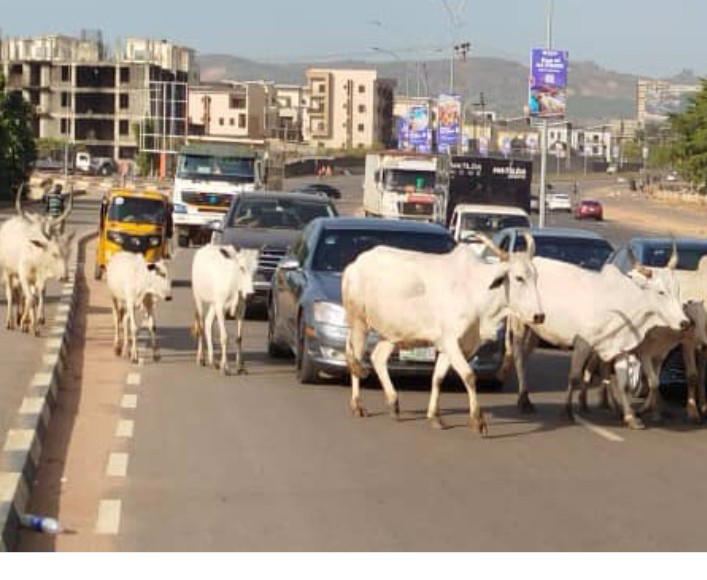
File: Cows on Mabuchi Road, Mabuchi District, Abuja, at 4.30 p.m. on Thursday, November 13, 2025. Photo: Onochie Anibeze
nBy Cynthia Alo
nThe Federal Government has identified 470 gazetted and legally protected grazing reserves for the rehabilitation and resettlement of pastoralists, as part of efforts to end the era of cattle roaming the streets of Abuja, Lagos and other parts of the country.
nThe Minister of Livestock Development, Idi Maiha, disclosed this on Arise News, while speaking on the implementation of the National Dairy Policy Framework and plans to transform Nigeria’s livestock sector.
nAccording to him, relocating herders into these reserves will strengthen disease surveillance, breed improvement and animal health management.
nAsked whether Nigerians should expect an end to cattle roaming the streets in cities, the minister replied in affirmative, adding that open grazing was no longer sustainable, as long-distance cattle movement contributes significantly to low productivity and the inability to meet domestic dairy demand.
nHe said: “We are sensitising pastoralists to adopt a sedentary lifestyle. Once they settle in designated reserves, all the interventions required to improve productivity become easier to implement.
n“We are also introducing jaw-tagging of animals so that once a cow steps outside its designated boundary, an alarm is triggered, indicating it has either strayed or been stolen, and it can be returned immediately.”
nOn daily milk production, Maiha said Nigeria currently recorded average milk yields of between 1.2 and 2 litres per cow per day, compared to countries such as Kenya, where yields can be up to 30 litres daily.
nHe attributed the gap to poor livestock genetics, inadequate feeding systems and weak disease management practices.
nMaiha explained that despite Nigeria’s estimated 270 million ruminants, cattle, sheep, goats and camels, the country had failed to modernise its livestock genetics over time.
nAccording to him, while other African countries have deliberately upgraded their breeds, Nigeria has largely retained traditional cattle with low productivity.
nHe added that although research institutes and veterinary faculties existed across the country, genetic improvement had not been implemented at scale.
nHe said: “While every other thing in our national space has changed, we have not been able to transform our livestock by introducing new genetics or selecting based on performance traits.
n‘’Either of those approaches would have lifted yields from two litres to 15, 20, 30 or even 50 litres per cow per day.”
nTo address the problem, Maiha said the government was pursuing a strategy centred on improved feeding, disease control and genetics, while implementing the National Dairy Policy Framework to boost local milk production and reduce imports.
n nRelated Stories
 General News
CELEBRATING TWO YEARS OF TRANSFORMATIONAL LEADERSHIP IN THE PRESIDENTIAL AMNESTY PROGRAMME
Tomorrow, 14TH March 2026, as we look forward to the second anniversary, we reflect on the remarkable two years since the Administrator of the Preside
 General News
PRESIDENTIAL AMNESTY PROGRAMME PHASE 3: DISREGARD PURPORTED STATEMENT ON DELAYED ITA PAYMENTS — OFFICE OF NATIONAL CHAIRMAN
The Office of the National Chairman of the Presidential Amnesty Programme Phase 3, General Elaye ThankGod Dollar Slaboh, has called on beneficiaries a
 General News
RE: CLARIFICATION ON MY PERSONAL RELATIONSHIPS
PUBLIC NOTICErnrnRE: CLARIFICATION ON MY PERSONAL RELATIONSHIPSrnrnIt has become necessary to make this public clarification following the increasing