
Efforts to Revitalize the Cotton and Textile Sector
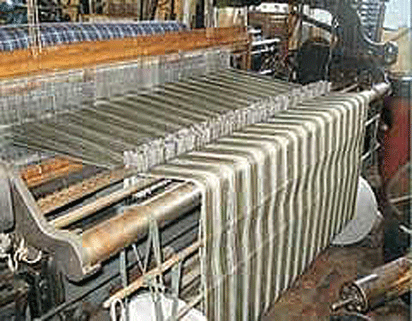
The Federal Government has made a significant move to revitalize Nigeria's ailing textile industry by inaugurating the Cotton, Textile and Garment Development Board, with the goal of stimulating growth, diversifying the economy, and creating jobs nationwide.
nThis decision to revive the industry is a welcome development that could have a profound impact on the country's economy, given that the sector was once a thriving pillar of the economy that provided livelihoods for millions and drove manufacturing growth.
nFor decades, the industry has struggled due to poor policy implementation, smuggling, power shortages, and stiff competition from cheaper imports, causing it to languish and lose its former glory.
nAt its peak in the 1980s and early 1990s, the industry was a vibrant sector that employed hundreds of thousands of workers and supported cotton farmers across several Northern states, including Kaduna, Kano, Katsina, and Zamfara.
nDuring this period, textile factories were bustling with activity, and Nigerian-made fabrics were widely popular both locally and internationally, but today, only a handful of factories remain operational.
nMany cotton farmers have abandoned the crop due to poor returns and lack of market access, but the revival initiative could stimulate rural economies by encouraging farmers to return to cotton cultivation, creating significant employment opportunities along the agricultural value chain.
nThe textile industry also offers strong prospects for industrial diversification, as Nigeria has long relied heavily on crude oil revenues, leaving the economy vulnerable to external shocks, and reviving cotton production and textile manufacturing could help strengthen the non-oil sector.
nReviving the industry would also boost exports and reduce the country's dependence on imported fabrics and garments that currently drain valuable foreign exchange, but the success of the newly inaugurated board will depend largely on its ability to address the structural challenges crippling the industry.
nTo achieve this, there must be a deliberate effort to support cotton farmers through improved seedlings, access to credit, and guaranteed off-take arrangements with textile manufacturers, as a steady supply of quality cotton is essential for textile mills to operate efficiently.
nAdditionally, the government must tackle the persistent problem of smuggling and the influx of cheap textiles that undermine local production, with countries like China currently dominating Nigeria's textile market with around 80 per cent of its textiles.
nChina's success in Nigeria's textile market is due to a combination of price advantages, industrial strength, and weaknesses within Nigeria's manufacturing sector, which has allowed it to flood the market with cheap substandard textiles, including traditional Nigerian fabrics like Adire and Aso-Oke.
nTo protect domestic manufacturers, stronger border enforcement and clear trade policies are necessary, while the industry will also require close collaboration with private investors, state governments, farmers' associations, and financial institutions to address the challenges facing the sector.
nFurthermore, the issue of electricity must be addressed, as the industry is energy-intensive and requires a reliable power supply to operate efficiently.
Related Stories
 General News
CELEBRATING TWO YEARS OF TRANSFORMATIONAL LEADERSHIP IN THE PRESIDENTIAL AMNESTY PROGRAMME
Tomorrow, 14TH March 2026, as we look forward to the second anniversary, we reflect on the remarkable two years since the Administrator of the Preside
 General News
PRESIDENTIAL AMNESTY PROGRAMME PHASE 3: DISREGARD PURPORTED STATEMENT ON DELAYED ITA PAYMENTS — OFFICE OF NATIONAL CHAIRMAN
The Office of the National Chairman of the Presidential Amnesty Programme Phase 3, General Elaye ThankGod Dollar Slaboh, has called on beneficiaries a
 General News
RE: CLARIFICATION ON MY PERSONAL RELATIONSHIPS
PUBLIC NOTICErnrnRE: CLARIFICATION ON MY PERSONAL RELATIONSHIPSrnrnIt has become necessary to make this public clarification following the increasing