
Edun outlines Nigeria’s economic growth imperatives
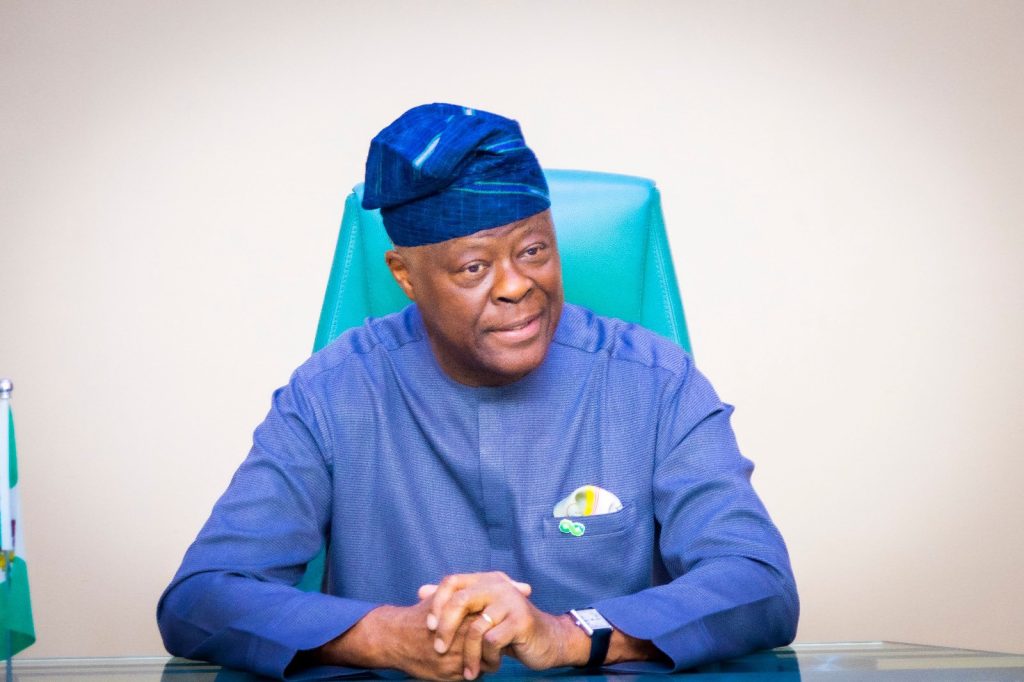
Edun
nBy Emma Ujah, Abuja Bureau Chief
nMinister of Finance and Coordinating Minister of the Economy, Wale Edun, on Monday, outlined the nation’s economic growth imperatives, including diversification, deepening of productivity and value addition across various sectors.
nHe spoke while receiving participants of the Senior Executive Course (SEC) 48, 2026 of the National Institute for Policy and Strategic Studies (NIPSS), Kuru, in Abuja, according to a statement by the Deputy Director, Information and Public Relations, of the Federal Ministry of Finance, Mrs. Efe Ovuakporie.
nHis words, “The imperative before us is clear. We must deliberately broaden the base of our economic activity, deepen productivity, and create sustainable value across multiple sectors.”
nCommending the theme of this year’s course, “Economic Diversification and National Development: Leveraging the Orange Economy and Entrepreneurship for Sustainable Growth in Nigeria”, the Minister described the focus as both timely and necessary, particularly as Nigeria continues to intensify efforts to recalibrate its economic structure.
nHe observed that Nigeria’s growth model has, over the years, been constrained by an overdependence on a narrow revenue base, a situation that has repeatedly exposed the economy to external shocks and internal fragilities.
nThis, he noted, has reinforced the urgency of building a more resilient and diversified economic framework capable of sustaining long-term development.
nWithin this broader context, he highlighted the Orange Economy as a compelling, yet insufficiently harnessed, driver of growth.
nMr. Edun explained that global economic momentum is increasingly shaped by creativity, innovation, and digital enterprise, areas in which Nigeria already demonstrates a natural comparative advantage.
nHe noted that from film and music to design and digital content, Nigerians continued to command global respect through ingenuity and resilience, often thriving despite structural constraints.
nHe cautioned, however, that talent alone cannot deliver systemic transformation.
n“Our challenge is not the absence of creativity,” he said. “It is how to design policies that can convert that creativity into scalable economic outcomes like job creation, enterprises, and measurable contributions to GDP.”
nThe minister also emphasised that meaningful diversification must be anchored on deliberate policy alignment and strong institutional frameworks.
nHe outlined key enablers to include coherent regulation, sustainable financing mechanisms, skills development, improved market access, and a stable macroeconomic environment that incentivises investment and innovation.
nHe further linked these priorities to the ongoing economic reforms under the administration of President Bola Tinubu, noting that recent policy measures are directed at restoring macroeconomic stability and repositioning the economy for sustainable growth.
n“Macroeconomic stability is not an abstract goal,” he explained. “It is the foundation upon which enterprise can flourish, investments can grow, and livelihoods can improve.”
nOn the issue of entrepreneurship, the Minister described it as the engine that translates ideas into tangible economic value.
nHe stressed that fostering entrepreneurship extends beyond supporting small businesses to building a dynamic ecosystem where innovation can thrive and scale.
nHe reaffirmed the Ministry’s commitment to prudent fiscal management, enhanced efficiency in public finance, and reforms aimed at removing barriers to productive activity.
nAccording to him, sustainable economic transformation depends on coherence across fiscal, monetary, trade, investment, and human capital policies.
nThe Minister also underscored the importance of disciplined execution, noting that Nigeria’s policy landscape is not constrained by a shortage of ideas, but often by gaps in coordination and implementation.
nEarlier, the Director-General (D-G) of NIPSS, Prof. Ayo Omotayo, represented at the session by Deputy Inspector- General of Police Adeleye Otebada (retd), explained that the Institute’s engagement with the ministry formed part of its statutory mandate to generate practical policy solutions to national challenges.
nHe noted that since its establishment over four decades ago, the Institute has remained a critical policy think tank, with its flagship Senior Executive Course consistently producing research outputs that have shaped government decisions and reforms.
nThe leader of the delegation disclosed that the current study theme was drawn from a presidential mandate by President Tinubu, focusing on the Orange Economy and entrepreneurship as viable pathways for sustainable growth and job creation.
n nRelated Stories
 General News
CELEBRATING TWO YEARS OF TRANSFORMATIONAL LEADERSHIP IN THE PRESIDENTIAL AMNESTY PROGRAMME
Tomorrow, 14TH March 2026, as we look forward to the second anniversary, we reflect on the remarkable two years since the Administrator of the Preside
 General News
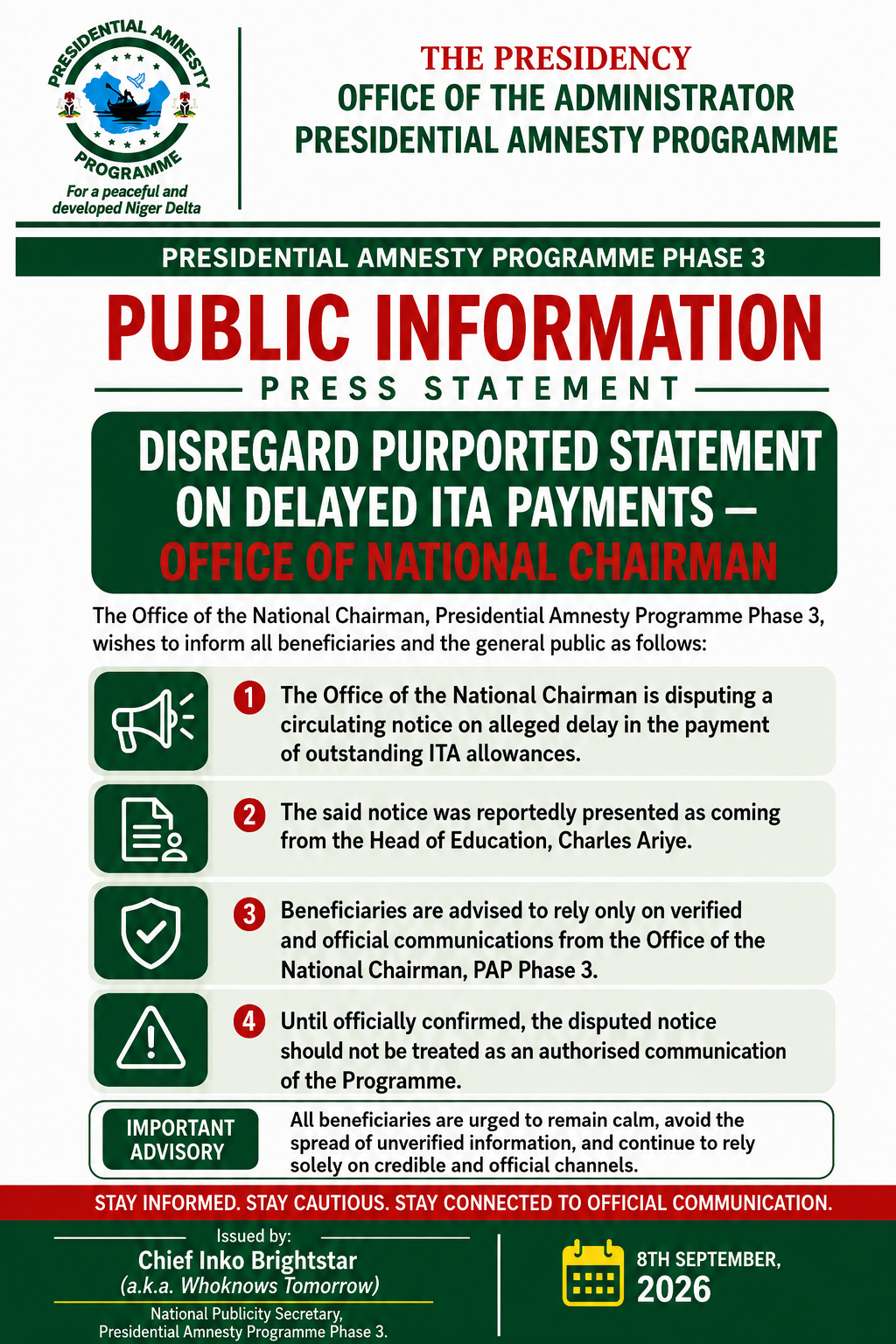
PRESIDENTIAL AMNESTY PROGRAMME PHASE 3: DISREGARD PURPORTED STATEMENT ON DELAYED ITA PAYMENTS — OFFICE OF NATIONAL CHAIRMAN
The Office of the National Chairman of the Presidential Amnesty Programme Phase 3, General Elaye ThankGod Dollar Slaboh, has called on beneficiaries a
 General News
RE: CLARIFICATION ON MY PERSONAL RELATIONSHIPS
PUBLIC NOTICErnrnRE: CLARIFICATION ON MY PERSONAL RELATIONSHIPSrnrnIt has become necessary to make this public clarification following the increasing