
Djibouti's Guelleh declares win, set to extend decades-long grip on presidency
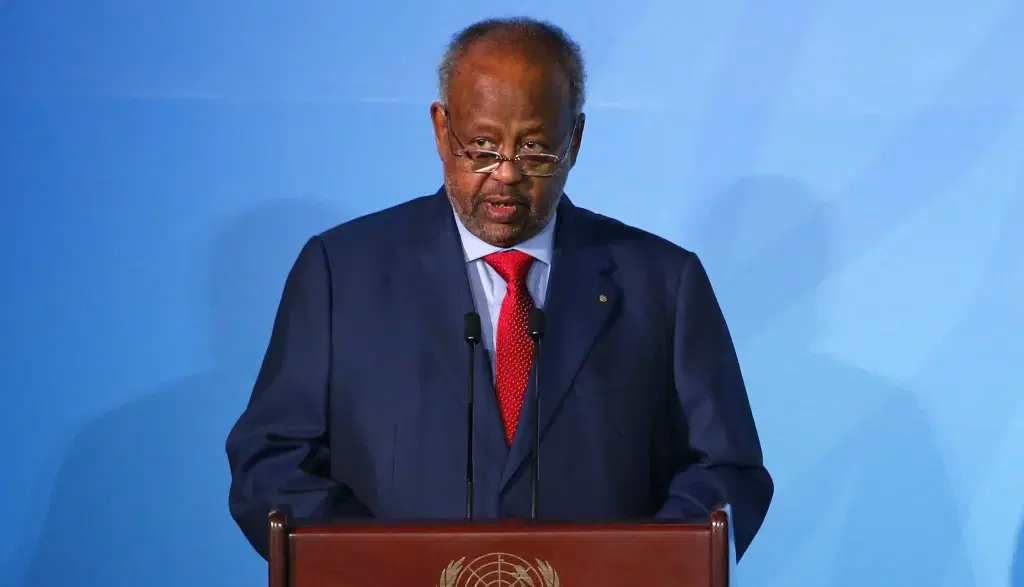
Ismail Omar Guelleh, the President of Djibouti, declared victory on Saturday in an election that has secured him a sixth consecutive term as the leader of the strategically located Horn of Africa nation.
nAt 78 years old, Guelleh announced his re-election on social media, citing early results that gave him a substantial lead over his opponent in the Friday election, with the election commission's tally showing him garnering over 96 percent of the vote with about six percent of votes counted.
nGuelleh has been at the helm of the tiny nation of one million people for 27 years, ruling with a firm grip and leveraging Djibouti's key location to transform it into an international military and maritime hub.
nThe country's 23,000 square kilometres host military bases and contingents from France, the United States, China, Japan, and Italy, generating significant financial, security, and political benefits.
nWith the early results giving Guelleh more than 96 percent of the vote, his opponent, Mohamed Farah Samatar, the leader of the Unified Democratic Centre, trailed behind with about 3.5 percent.
nGuelleh won the previous election in 2021 with over 97 percent of the vote, a contest that was boycotted by most of the opposition, and had initially announced his intention to step down this year before a constitutional amendment in November removed the upper age limit of 75 for presidential candidates.
nSome polling stations remained open an hour longer due to delays at the start of the voting day, but few people in Djibouti were uncertain about the outcome of the election.
nUnder heavy security, Guelleh, widely known by his initials IOG, cast his vote before noon at City Hall alongside his wife, while his opponent, Samatar, had voted earlier in the day.
nGuelleh expressed his hopes for victory, stating, "By the grace of God, we have arrived here, and we hope that this will end in victory," as he spoke to reporters after voting.
nGuelleh's campaign has been highly visible, with posters plastered across the capital and large crowds attending his rallies, in contrast to Samatar, who has struggled to garner support, with one of his events broadcast by the national broadcaster drawing only a few dozen people.
nA voter, Deka Aden Mohamed, 38, expressed her support for Guelleh, stating, "I'm going to vote for Ismail Omar Guelleh because he has a good programme for young people, I don't even know what his opponent looks like."
nGuelleh has faced minimal opposition since taking over as president in 1999, succeeding the country's first president, Hassan Gouled Aptidon, whom he had served as chief of staff.
nIn 2005, Guelleh was re-elected unopposed, and his candidacy is seen by some as a guarantee of stability in the troubled Horn of Africa region, although analysts argue that it is driven by the lack of a universally accepted successor.
nQuestions have been raised about the president's health, and despite claims by the Djibouti League of Human Rights that the vote is a "masquerade", many people expressed their eagerness to participate in the election.
nYussuf Mohamed Hussein, a voter, stated, "It's a duty to go vote, I'm going to vote for the president; Samatar, I don't even know him."
nDjibouti faces significant challenges, including an unemployment rate of around 70 percent among young people and substantial debt, particularly to China, with the country's development relying heavily on its ports, which account for 70 percent of its gross domestic product.
nLocated on the key Bab al-Mandeb strait, which divides the Red Sea and the Gulf of Aden, Djibouti is situated on one of the world's busiest shipping routes, and without agriculture, the country relies heavily on its ports, with Ethiopia being its main maritime outlet.
nThe nation has been accused by human rights organisations of suppressing dissent, while Guelleh has faced allegations of favouring his own majority Issa ethnic group at the expense of the Afar minority.
Related Stories
 General News
CELEBRATING TWO YEARS OF TRANSFORMATIONAL LEADERSHIP IN THE PRESIDENTIAL AMNESTY PROGRAMME
Tomorrow, 14TH March 2026, as we look forward to the second anniversary, we reflect on the remarkable two years since the Administrator of the Preside
 General News
PRESIDENTIAL AMNESTY PROGRAMME PHASE 3: DISREGARD PURPORTED STATEMENT ON DELAYED ITA PAYMENTS — OFFICE OF NATIONAL CHAIRMAN
The Office of the National Chairman of the Presidential Amnesty Programme Phase 3, General Elaye ThankGod Dollar Slaboh, has called on beneficiaries a
 General News
RE: CLARIFICATION ON MY PERSONAL RELATIONSHIPS
PUBLIC NOTICErnrnRE: CLARIFICATION ON MY PERSONAL RELATIONSHIPSrnrnIt has become necessary to make this public clarification following the increasing