
Did the ADC presidential primary truly have competition, as Amaechi's outrage and Atiku's mediation effort reveal divisions within the opposition alliance
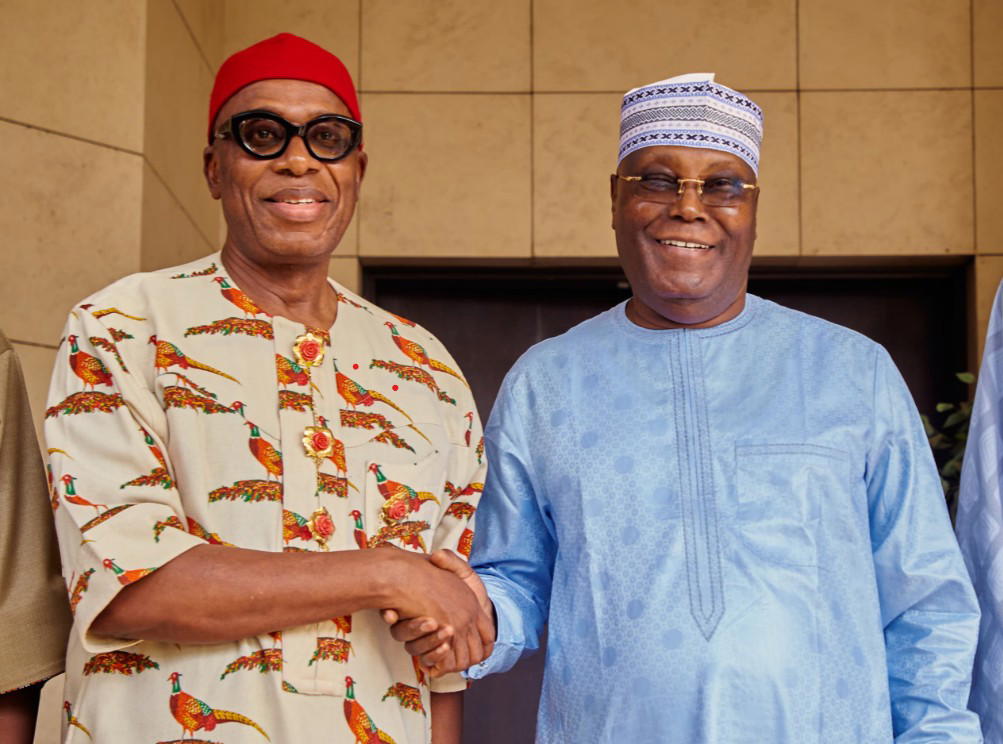
File: Rotimi Amaechi (left) and Atiku Abubakar.
nBy Luminous Jannamike, ABUJA
nBy the time fisherman soup, Arsenal banter and reconciliation smiles entered the conversation, the damage had already been done.
nRead Also: Fruits of Poisonous Tree: Outrage as fraudulent party primaries throw up candidates
nInside the African Democratic Congress, ADC, victory had already started giving way to suspicion. The party had just concluded its nationwide direct presidential primary conducted across more than 8,000 wards.
nFormer Vice President Atiku Abubakar emerged with a commanding 1,846,370 votes, defeating former Rivers State governor and ex-Minister of Transportation, Rotimi Amaechi, who secured 504,117 votes, while businessman and banker Mohammed Hayatu-Deen polled 177,120 votes.
nOn paper, the result looked decisive. But before the final announcement ended late Wednesday, tension had already started building around parts of the collation process.
nIn Abuja, rival camps huddled around phones deep into the night. Supporters traded accusations quietly across political WhatsApp groups, while some questioned figures emerging from certain areas.
nThen came the public revolt. Amaechi dismissed the outcome as ‘concocted.’ Hayatu-Deen boycotted the final announcement altogether, citing irregularities and claiming he personally witnessed some of the alleged malpractices.
nAnd suddenly, the conversation inside the coalition changed. The issue was no longer simply who won. It became whether the primary had ever truly been competitive in the first place.
nThe shadow of Atiku’s dominance
nInside opposition politics, few genuinely doubted that Atiku entered the race as the dominant figure. His political machinery remains one of the broadest in the country. His networks stretch across regions, while his experience from multiple presidential campaigns gives him advantages few opposition politicians can easily match.
nEven before the primary, many within the coalition quietly spoke of the ADC as gradually becoming Atiku’s political vehicle following his frustrations within the Peoples Democratic Party, PDP.
nSo when the final numbers emerged, they reinforced a perception already circulating within sections of the opposition: that the race may have been open officially, but psychologically tilted long before voting began.
nPerhaps the real shock for some rivals was not that Atiku won, but that the primary exposed how completely the coalition already revolved around him.
nEven some critics privately admit that Atiku was always likely to dominate a nationwide direct primary conducted by the ADC on that scale. His margin was simply too wide to casually dismiss as pure fabrication.
nThat uncomfortable reality complicated the outrage. Was the process manipulated? Or did Atiku simply possess a political structure far stronger than everybody else inside the coalition?
nIn Nigerian politics, those two possibilities are not always completely separate.
nWhen the Opposition
nStarts sounding like APC
nFor an opposition coalition hoping to challenge the APC on questions of democratic credibility, the optics were awkward.
nThe same language routinely deployed against the ruling party: imposition, manipulation, exclusion and predetermined outcomes, suddenly entered the ADC’s own internal conversation.
nThe contradiction was difficult to ignore: an opposition coalition accusing the APC of democratic bad faith was suddenly battling similar accusations inside its own house.
nIronically, the party had gone into the primary eager to project the exercise as evidence of superior internal democracy.
nChairman of the Presidential Primary Election Committee, Ikechi Emenike, declared that, “Unlike the culture of imposition, consensus manipulation and predetermined outcomes that have become prevalent in contemporary political parties, the ADC has embraced a credible democratic process that gives every qualified aspirant an equal opportunity.”
nBut as allegations surfaced during collation, the tone within the party became noticeably more careful.
nNational Publicity Secretary, Bolaji Abdullahi, admitted: “We do not have any evidence at this point to either support or dismiss those claims because the results have not yet been fully collated.”
nThat cautious response reflected the coalition’s dilemma.
nWhat Amaechi’s anger really revealed
nA senior opposition source familiar with coalition discussions told Saturday Vanguard: “The real issue is not even whether the election was rigged or not. The deeper problem is trust. Some people came into this coalition already believing certain decisions had been quietly settled before voting even started.”
nAnother party insider spoke more bluntly: “Honestly, many people expected Atiku to win. That was not the shock. The shock was the margin. It created the impression that some aspirants were contesting more for appearance than for a truly competitive fight.”
nAmaechi’s anger carried weight precisely because he is not a fringe political actor.
nThe former Rivers State governor remains one of the opposition’s strongest southern figures and one of the few politicians within the coalition capable of independently mobilising elite support structures across regions.
nHis rejection of the process therefore exposed something deeper than ordinary post-primary disappointment.
nIt exposed quiet anxiety inside a coalition stitched together by urgency, ambition and the shared desire to challenge President Bola Tinubu and the APC in 2027.
nFisherman soup, football banter… and quiet damage control
nPerhaps that was why the reconciliation effort came so quickly.
nWithin hours of the controversy, Atiku visited Amaechi in Abuja alongside coalition figures including former Sokoto State governor Aminu Tambuwal and former ADC National Chairman Ralph Nwosu.
nOfficially, discussions centred on unity, insecurity, the economy and strategies for defeating the APC in 2027. Reports of relaxed moments involving Arsenal banter and fisherman soup projected familiarity and political brotherhood at a moment when the coalition badly needed reassurance.
nNwosu dismissed suggestions of division.
n“There is no faction in ADC. What you are seeing are efforts by powerful interests to throw mud at a party that Nigerians now see as a credible alternative,” he said.
nStill, the speed of the reconciliation effort raised its own questions. In Nigerian politics, speed often reveals fear. And the speed of the ADC’s peace moves suggested the coalition understood how dangerous public distrust could become if left unattended.
nADC’s biggest battle may already be internal
nFormer Senate President and ADC National Chairman, David Mark, attempted to steady the coalition’s nerves by framing the crisis as part of a broader democratic struggle.
n“We will not surrender, because what is at stake is not just the ADC or the opposition, but the survival of our democracy,” he declared.
nBut the ADC’s first major national exercise may already have revealed both the coalition’s greatest strength and its deepest weakness at the same time.
nIts strength lies in its ability to gather powerful political actors under one platform against the ruling party.
nIts weakness lies in the lingering suspicion among some of those same actors that influence inside the coalition may already be unevenly settled.
nAnd if that internal struggle is not carefully managed, the ADC may come to find that defeating the APC is less difficult than managing the ambitions gathered under its own roof.
n nRelated Stories
 General News
CELEBRATING TWO YEARS OF TRANSFORMATIONAL LEADERSHIP IN THE PRESIDENTIAL AMNESTY PROGRAMME
Tomorrow, 14TH March 2026, as we look forward to the second anniversary, we reflect on the remarkable two years since the Administrator of the Preside
 General News
PRESIDENTIAL AMNESTY PROGRAMME PHASE 3: DISREGARD PURPORTED STATEMENT ON DELAYED ITA PAYMENTS — OFFICE OF NATIONAL CHAIRMAN
The Office of the National Chairman of the Presidential Amnesty Programme Phase 3, General Elaye ThankGod Dollar Slaboh, has called on beneficiaries a
 General News
RE: CLARIFICATION ON MY PERSONAL RELATIONSHIPS
PUBLIC NOTICErnrnRE: CLARIFICATION ON MY PERSONAL RELATIONSHIPSrnrnIt has become necessary to make this public clarification following the increasing