
Crude prices soar, equities plummet after Trump threatens to block Strait of Hormuz
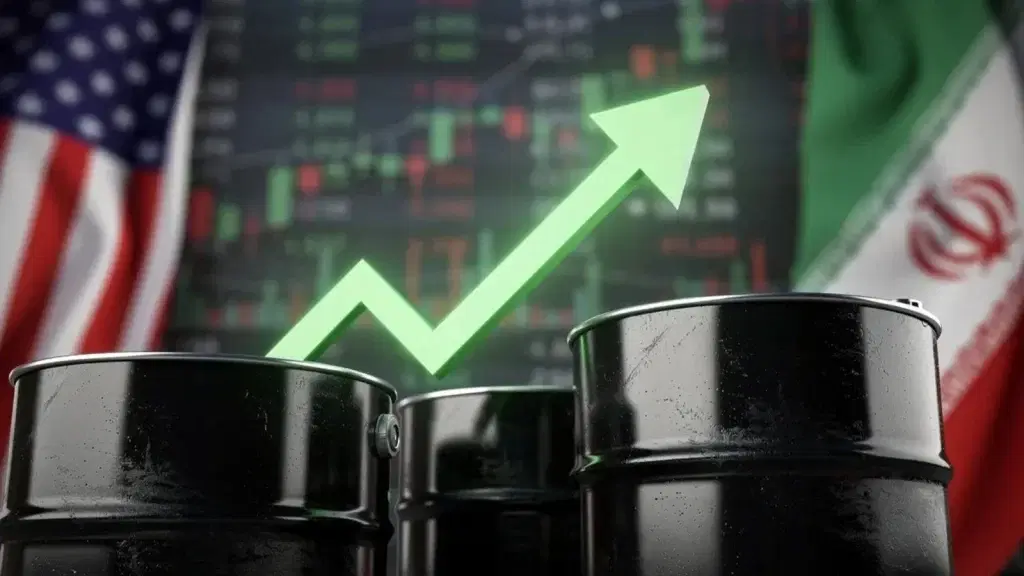
Oil prices experienced a significant surge on Monday, while stocks plummeted, as the US-Iran peace talks collapsed and Donald Trump announced a blockade of the strategic Strait of Hormuz, exacerbating concerns about energy supplies from the Middle East.
nThe negotiations, which took place in Islamabad over the weekend, ended in failure, with the US delegation, led by Vice President JD Vance, blaming Iran's refusal to abandon its nuclear program, and Tehran retaliating by accusing the US of "maximalism, shifting goalposts, and blockade".
nThe collapse of the talks dealt a blow to hopes for a swift end to the six-week conflict, which has driven crude prices up, fueled inflation, and sent shockwaves through the global economy.
nOil prices, which had declined last week following the US and Iran's agreement to a ceasefire, jumped over 8% at one point on Monday, with both contracts exceeding $100 a barrel.
nEquities suffered losses, with markets in Tokyo, Hong Kong, Seoul, Sydney, Mumbai, Singapore, Taipei, and Jakarta all experiencing significant declines, although Shanghai saw a slight increase.
nLondon, Paris, and Frankfurt markets opened on a weak note, reflecting the global economic uncertainty.
nIn a surprise development, shares in Hungary surged over 3% after conservative Peter Magyar won a decisive majority in parliamentary elections on Sunday, ousting Prime Minister Viktor Orban, who had been in power for 16 years.
nIn a lengthy social media post, President Trump stated that his objective was to clear the Strait of Hormuz of mines and reopen it to all shipping, but emphasized that Iran must not be allowed to profit from controlling the waterway, through which a fifth of global oil and gas typically passes.
nTrump declared that "Effective immediately, the United States Navy, the Finest in the World, will begin the process of BLOCKADING any and all Ships trying to enter, or leave, the Strait of Hormuz," and warned that "Any Iranian who fires at us, or at peaceful vessels, will be BLOWN TO HELL!".
nThe US military announced that it would blockade all Iranian Gulf ports on Monday at 1400 GMT, effectively taking control of maritime traffic, with the blockade only applying to vessels traveling to or from Iranian ports.
nIran's Revolutionary Guards claimed that their security forces had full control over the strait and cautioned that enemies would be trapped in a "deadly vortex" if they made any "wrong move".
nIran's navy chief, Shahram Irani, dismissed Trump's threat as "ridiculous and funny", according to state TV.
nFollowing the talks, the highest-level meeting between the two sides since the 1979 Islamic revolution, Vance stated that Washington had made Tehran its "final and best offer", and added, "We'll see if the Iranians accept it".
nIran's Foreign Minister, Abbas Araghchi, said that the rivals had been "inches away" from a deal, but encountered "maximalism, shifting goalposts, and blockade" during the negotiations.
nNicole Grajewski, an assistant professor at the Center for International Research at Sciences Po in Paris, warned that a US blockade would be considered an effective resumption of the war, rather than a minor coercive signal.
nMalcolm Melville, of Schroders, cautioned that even if a breakthrough in ending the war is eventually achieved, prices would likely remain elevated for some time, due to the 10 million barrels a day of shut-in production and damage to some facilities.
nCharu Chanana of Saxo Markets noted that "It was always a tall order to secure a deal in one sitting given the number of sticking points still on the table, including missiles, nuclear restrictions, proxy dynamics, the Strait of Hormuz, and sanctions."
nChanana added that "The fact the talks happened at all matters, and there is still a chance negotiations restart, especially with some reports suggesting the two sides were not far apart on at least some points."
nInvestors are also monitoring attempts to resolve the conflict between Israel and Hezbollah, as Lebanese Prime Minister Nawaf Salam said he was working to ensure the withdrawal of Israeli forces.
nSalam stated that "We will continue to work to stop this war, to ensure the Israeli withdrawal from all our lands, the return of all the prisoners, to rebuild our destroyed villages and towns, and the safe return of the displaced".
nThe prospect of the Middle East crisis continuing indefinitely has heightened inflation fears and weighed on gold, amid expectations that interest rates will remain elevated.
nData released on Friday highlighted the impact of the conflict on prices, with the US consumer price index surging 3.3% in March, its highest level since May last year.
nKey figures at around 0715 GMT included West Texas Intermediate, which rose 7.4% to $103.69 a barrel, and Brent North Sea Crude, which increased 6.9% to $101.78 a barrel.
nThe Tokyo Nikkei 225 closed down 0.7% at 56,502.77, while the Hong Kong Hang Seng Index fell 1.2% to 25,587.30, and the Shanghai Composite rose 0.1% to 3,988.56.
nThe London FTSE 100 declined 0.5% to 10,544.99, and the euro/dollar exchange rate dropped to $1.1679 from $1.1728 on Friday, while the pound/dollar exchange rate fell to $1.3406 from $1.3463.
Related Stories
 General News
CELEBRATING TWO YEARS OF TRANSFORMATIONAL LEADERSHIP IN THE PRESIDENTIAL AMNESTY PROGRAMME
Tomorrow, 14TH March 2026, as we look forward to the second anniversary, we reflect on the remarkable two years since the Administrator of the Preside
 General News
PRESIDENTIAL AMNESTY PROGRAMME PHASE 3: DISREGARD PURPORTED STATEMENT ON DELAYED ITA PAYMENTS — OFFICE OF NATIONAL CHAIRMAN
The Office of the National Chairman of the Presidential Amnesty Programme Phase 3, General Elaye ThankGod Dollar Slaboh, has called on beneficiaries a
 General News
RE: CLARIFICATION ON MY PERSONAL RELATIONSHIPS
PUBLIC NOTICErnrnRE: CLARIFICATION ON MY PERSONAL RELATIONSHIPSrnrnIt has become necessary to make this public clarification following the increasing