
Crude prices remain over $100, equities decline amid Khamenei's threat to Hormuz Strait
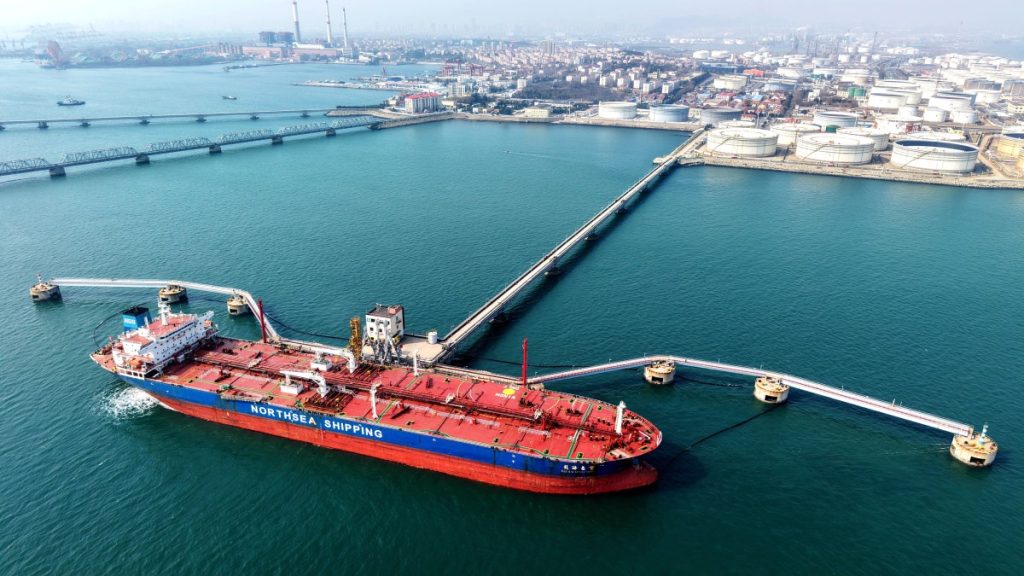
On March 10, 2026, an oil tanker was unloading crude oil at a terminal in the port city of Qingdao, located in China's eastern Shandong province, amidst rising tensions in the Middle East.
nOil prices remained above $100 on Friday, while most equity markets declined, following a statement from Iran's leader calling for the closure of the Strait of Hormuz and the opening of new fronts in the conflict against the US and Israel.
nThe conflict, now entering its third week, has sparked concerns among investors about a prolonged crisis that could fuel inflation and severely impact the global economy, with Tehran targeting energy facilities across the Gulf, including ships near Iraq, fuel tanks in Bahrain, and oil fields in Saudi Arabia.
nIran's leader warned that the country would "set the region's oil and gas on fire" if its own energy infrastructure and ports were targeted, prompting Ayatollah Mojtaba Khamenei to declare that the Strait of Hormuz, through which a fifth of global oil and gas passes, must be effectively shut.
nAyatollah Khamenei stated, "The lever of blocking the Strait of Hormuz must definitely be used," and added that "studies have been conducted into opening other fronts where the enemy has little experience and would be highly vulnerable, and their activation will take place if the state of war persists."
nCrude oil prices surged over 9% on Thursday, with Brent ending above $100 for the first time since 2022, when Russia launched its invasion of Ukraine, and Brent is now up around 40% since the Middle East war began on February 28.
nThe record 400 million barrels released from International Energy Agency stockpiles had little impact on the market, with analysts noting that the war "is creating the largest supply disruption in the history of the global oil market."
nUS President Donald Trump faced intense political pressure as the global economic fallout of the crisis mounted, despite his assertions that the battle would be short-lived, and he struck a defiant tone in a social media post on Thursday.
nTrump wrote, "The United States is the largest Oil Producer in the World, by far, so when oil prices go up, we make a lot of money," and added, "BUT, of far greater interest and importance to me, as President, is stopping an evil Empire, Iran, from having Nuclear Weapons, and destroying the Middle East and, indeed, the World."
nAccording to Pepperstone's Chris Weston, "With crude closing near its highs, markets are increasingly pricing in a longer duration for the conflict and the continued impact of a potential closure of the Strait of Hormuz," and he noted that Trump may explore assisting vessels through the strait, which could lead to a relief rally.
nFor now, Weston said, the dominant features are higher energy prices and extremely elevated volatility markets, which has led equity traders to take flight, particularly in Asian economies that are heavily reliant on energy imports.
nMajor Asian markets, including Tokyo, Hong Kong, Shanghai, Singapore, Seoul, Mumbai, Bangkok, Wellington, Manila, and Jakarta, all declined, while the dollar held its gains against major rivals due to its safe-haven status and expectations of elevated interest rates.
nMatt Weller, head of market research at City Index, warned that markets could be in for more pain, saying "Those trends have reversed, and the default assumption as long as the Strait of Hormuz remains functionally closed is that stocks will be under pressure, oil prices will trend higher, and interest rates will tick up in unison."
nWeller advised traders to shift their expectations, noting that "Unless or until we see meaningful progress toward a ceasefire in the Middle East, traders should expect the coming weeks and months to look different than the past couple of years, weighing on risk appetite at an accelerating rate."
nKey figures at around 0700 GMT included West Texas Intermediate: down 0.2% at $95.50 a barrel, Brent North Sea Crude: up 0.1% at $100.56, and Tokyo's Nikkei 225: down 1.2% at 53,819.61.
nIn other markets, the Hang Seng Index in Hong Kong was down 0.9% at 25,477.39, the Shanghai Composite was down 0.8% at 4,095.45, and the euro/dollar was down at $1.1500 from $1.1514 on Thursday.
nThe pound/dollar was down at $1.3321 from $1.3346, the dollar/yen was down at 159.35 yen from 159.39 yen, and the euro/pound was up at 86.29 pence from 86.27 pence.
nIn the US, the Dow was down 1.6% at 46,677.85, and in London, the FTSE 100 was down 0.5% at 10,305.15.
Related Stories
 General News
CELEBRATING TWO YEARS OF TRANSFORMATIONAL LEADERSHIP IN THE PRESIDENTIAL AMNESTY PROGRAMME
Tomorrow, 14TH March 2026, as we look forward to the second anniversary, we reflect on the remarkable two years since the Administrator of the Preside
 General News
PRESIDENTIAL AMNESTY PROGRAMME PHASE 3: DISREGARD PURPORTED STATEMENT ON DELAYED ITA PAYMENTS — OFFICE OF NATIONAL CHAIRMAN
The Office of the National Chairman of the Presidential Amnesty Programme Phase 3, General Elaye ThankGod Dollar Slaboh, has called on beneficiaries a
 General News
RE: CLARIFICATION ON MY PERSONAL RELATIONSHIPS
PUBLIC NOTICErnrnRE: CLARIFICATION ON MY PERSONAL RELATIONSHIPSrnrnIt has become necessary to make this public clarification following the increasing