
Crew of Artemis 2 mission sets new distance milestone, venturing farther from our planet than anyone before.
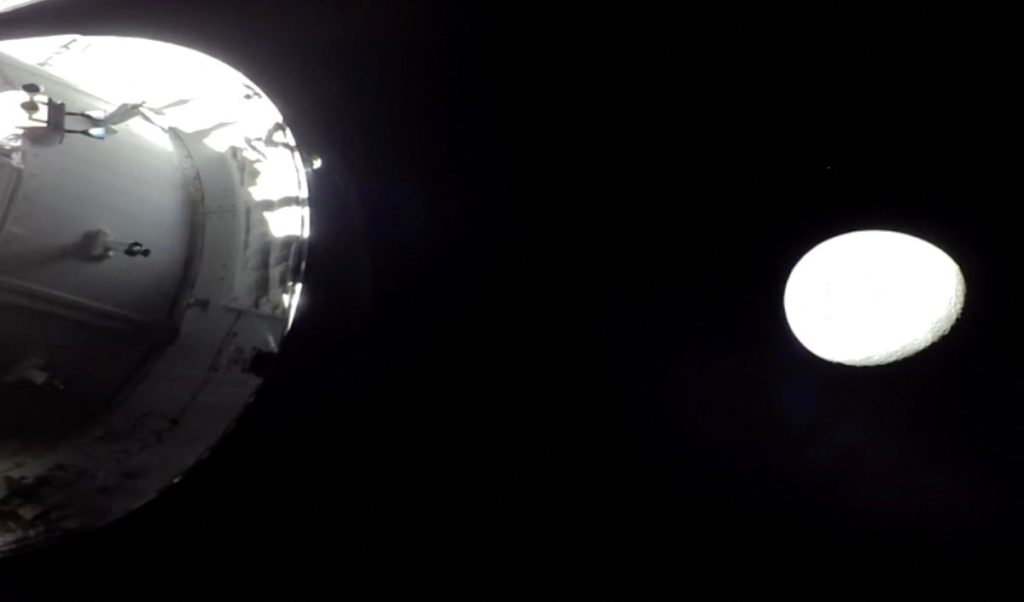
A NASA livestream screengrab from April 6, 2026, shows the Orion Spacecraft and the Moon, marking a critical juncture in the Artemis astronauts' journey as the Moon's gravity begins to exert a stronger pull on the spacecraft than Earth's.
nThe Orion capsule is now poised to whip around the Moon, setting the stage for the crew to travel farther from Earth than any human has before, a feat that will take them beyond the reach of our home planet.
nOn Monday, the US space agency NASA announced that the crew of the Artemis 2 lunar mission has broken the record for the farthest distance traveled from Earth, surpassing the previous mark set by the Apollo 13 mission in 1970.
nThe four astronauts - US astronauts Victor Glover, Christina Koch, and Reid Wiseman, and Canadian astronaut Jeremy Hansen - have traveled an impressive 406,711 kilometers from Earth, eclipsing the 400,171 km record that stood for over five decades.
nThe Artemis 2 crew launched on Wednesday evening from the Cape Canaveral spaceport in Florida aboard the Orion capsule on the Space Launch System rocket, marking the beginning of their historic journey.
nDuring their lunar flyby, the crew became the first humans to lay eyes on certain parts of the far side of the Moon, and they also witnessed a solar eclipse as the Moon passed in front of the Sun.
nA fleet of cameras captured stunning imagery of the Moon, including features that had never been directly seen by humans before, according to NASA.
nCanadian astronaut Jeremy Hansen described the lunar flyby as an "extraordinary" experience, saying that it felt like being transported to the far side of the Moon.
nHansen's crewmate, Christina Koch, expressed her reluctance to return to Earth, saying "I'm not ready to go home" and marveling at the fact that the cramped quarters of the spacecraft could still be enjoyable every minute.
nThe crew has also suggested naming two craters on the Moon, one in honor of their spacecraft, Integrity, and the other in memory of Reid Wiseman's late wife, Carroll.
nThese name proposals will be formally submitted to the International Astronomical Union, the governing body responsible for naming celestial bodies and their surface features, after the mission is complete.
nJeremy Hansen noted that the mission is also intended to pay tribute to the pioneers of human spaceflight, and he hopes that their achievement will inspire future generations to push beyond the current boundaries of space exploration.
nNASA announced earlier on Monday that the spacecraft had reached the Moon's sphere of gravitational influence, marking a significant milestone in the mission.
nFor Victor Glover, Christina Koch, and Reid Wiseman, this is their second spaceflight, while Jeremy Hansen is making his debut in space.
nChristina Koch is the first woman to be part of a NASA lunar mission, Victor Glover is the first non-white person, and Jeremy Hansen is the first Canadian to embark on such a journey.
nThe Artemis 2 flight path resembles a figure of eight around the Earth and the Moon, with the four astronauts set to cover a total distance of over 2.3 million kilometers before splashing down in the Pacific Ocean.
nThe crew is scheduled to return to Earth on Friday, with a planned splashdown off the coast of San Diego.
nNASA administrator Jared Isaacman took to social media to congratulate the crew on their journey home, saying that their mission will be remembered as a moment when people began to believe that America can once again achieve the impossible and change the world.
nIsaacman cautioned that the mission is not over yet, and the crew will not be safe until they are back on Earth, under the protection of their parachutes and splashing down into the Pacific.
nThe first person to set foot on the Moon was Neil Armstrong, who made history on July 20, 1969, as part of the Apollo 11 mission.
nThe last person to leave the Moon was NASA astronaut Eugene Cernan, who passed away in 2017, during the Apollo 17 mission in December 1972.
nIn total, the United States has sent 12 astronauts to the Moon between 1969 and 1972 as part of the Apollo missions, a feat that remains unmatched to this day.
Related Stories
 General News
CELEBRATING TWO YEARS OF TRANSFORMATIONAL LEADERSHIP IN THE PRESIDENTIAL AMNESTY PROGRAMME
Tomorrow, 14TH March 2026, as we look forward to the second anniversary, we reflect on the remarkable two years since the Administrator of the Preside
 General News
PRESIDENTIAL AMNESTY PROGRAMME PHASE 3: DISREGARD PURPORTED STATEMENT ON DELAYED ITA PAYMENTS — OFFICE OF NATIONAL CHAIRMAN
The Office of the National Chairman of the Presidential Amnesty Programme Phase 3, General Elaye ThankGod Dollar Slaboh, has called on beneficiaries a
 General News
RE: CLARIFICATION ON MY PERSONAL RELATIONSHIPS
PUBLIC NOTICErnrnRE: CLARIFICATION ON MY PERSONAL RELATIONSHIPSrnrnIt has become necessary to make this public clarification following the increasing