
Conflict in the Middle East: recent updates
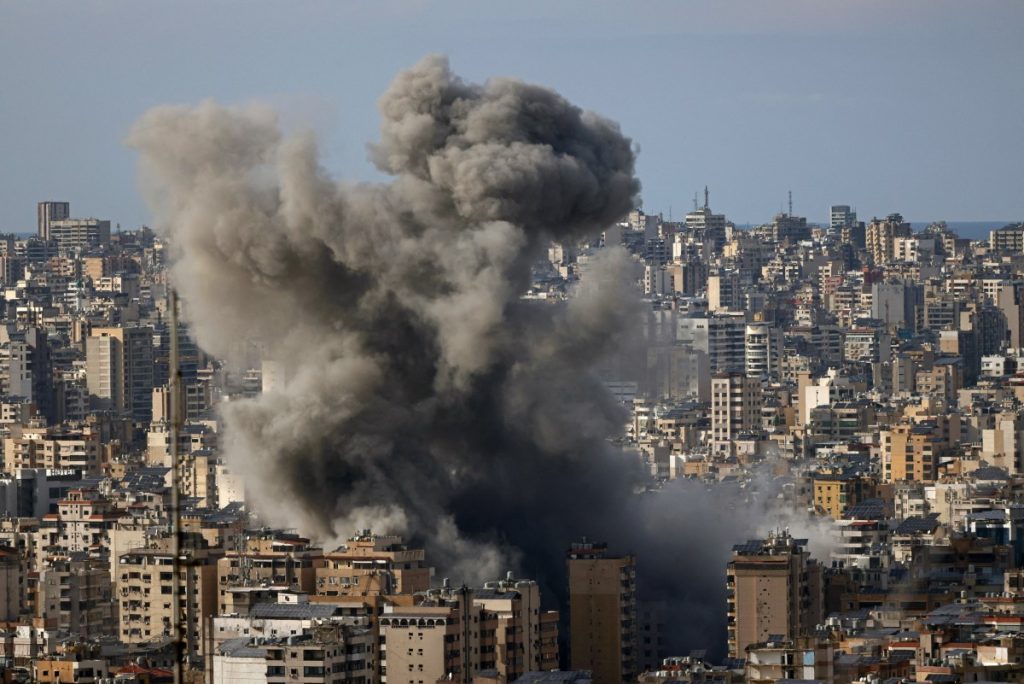
Smoke billowed from the site of an Israeli airstrike in Beirut's southern suburbs on March 6, 2026, as fresh strikes hit Iran and Lebanon, prompting Israel to vow escalation in the rapidly spiralling Middle East war.
nIsrael's vow to escalate came as the conflict continued to spread throughout the region and beyond, with the situation showing no signs of easing on March 6, 2026.
nSyrian President Ahmed al-Sharaa stated that he was working to keep his country out of the war, noting that Syria has historically been an arena of conflict and strife, but is now in harmony with all neighbouring countries regionally and internationally.
nAl-Sharaa added that Damascus stood in full solidarity with the Arab states, emphasizing the importance of maintaining regional stability.
nIran's foreign minister told his UK counterpart in a phone call that Tehran would view any US use of British bases as participation in aggression, with Iran's foreign ministry releasing a statement to this effect.
nThe statement from Iran's foreign ministry, quoting Abbas Araghchi, warned that such actions would be regarded as participation in aggression and would be recorded in the history of relations between the two countries.
nIran's Revolutionary Guards announced in a statement on their website that their spokesman, Ali Mohammad Naini, had been killed in US-Israeli strikes.
nPrior to his death, Naini had refuted remarks by Israeli Prime Minister Benjamin Netanyahu that Iran could no longer produce ballistic missiles, stating that there was no concern and that missile production continued even under wartime conditions.
nCrude prices dipped after US and Israeli leaders stated that Israel would no longer target Tehran's energy infrastructure, leading to a decrease in oil prices.
nSri Lankan President Anura Kumara Dissanayake told parliament that his country had refused permission to the United States to station two warplanes at an airport in the island's south in early March.
nSri Lanka's decision was likely influenced by its close ties with both the United States, its biggest export market, and Iran, a key buyer of tea, its main export commodity.
nDrone attacks hit Kuwait's Mina Al-Ahmadi oil refinery, causing several fires but no casualties, according to state media reports.
nKuwaiti and Emirati authorities had earlier reported that air defences were responding to missile and drone attacks, while Saudi Arabia's defence ministry said it had intercepted and destroyed over a dozen drones in the country's east and north.
nBahrain's interior ministry reported that shrapnel from an Iranian aggression caused a fire at a warehouse, which was brought under control without resulting in any injuries.
nUAE authorities arrested at least five members of a terrorist network linked to Iran and Lebanese militant group Hezbollah, according to state media reports.
nThe alleged network had sought to infiltrate the national economy as part of a pre-established strategic plan in coordination with external parties linked to Hezbollah and Iran, the official WAM news agency said.
nThe Israeli military launched a wave of strikes on Tehran, following Iranian missile fire at Israel overnight, with a military statement saying Israeli forces had begun targeting the infrastructure of the Iranian terror regime across Tehran.
nIsrael's military identified three rounds of missile fire in the hour and a half preceding midnight, and another a few hours later, with AFP reporters hearing several loud blasts over Jerusalem late Thursday night.
nThe Magen David Adom emergency services reported no casualties from the blasts, but police said there was damage in several locations in Jerusalem.
nEuropean Union leaders vowed to fully mobilise to prevent uncontrolled migratory movements towards the 27-nation bloc, amid concerns of a repeat of the 2015 migration crisis during Syria's civil war.
nQatar's energy minister, Saad Sherida Al-Kaabi, stated that attacks on the country's energy installations would slash its export capacity of liquefied natural gas by 17 percent and take three to five years to repair.
nAl-Kaabi added that Qatar would be compelled to declare force majeure for up to five years on some long-term LNG contracts, due to the damage caused by the attacks.
nIsraeli Prime Minister Benjamin Netanyahu said at a press conference that he saw the war ending a lot faster than people think, stating that Israel is winning and Iran is being decimated.
nNetanyahu also denied that Israel dragged the US into the war, saying that no one could tell President Trump what to do, and adding that Iran was no longer able to enrich uranium or build ballistic missiles.
Related Stories
 General News
CELEBRATING TWO YEARS OF TRANSFORMATIONAL LEADERSHIP IN THE PRESIDENTIAL AMNESTY PROGRAMME
Tomorrow, 14TH March 2026, as we look forward to the second anniversary, we reflect on the remarkable two years since the Administrator of the Preside
 General News
PRESIDENTIAL AMNESTY PROGRAMME PHASE 3: DISREGARD PURPORTED STATEMENT ON DELAYED ITA PAYMENTS — OFFICE OF NATIONAL CHAIRMAN
The Office of the National Chairman of the Presidential Amnesty Programme Phase 3, General Elaye ThankGod Dollar Slaboh, has called on beneficiaries a
 General News
RE: CLARIFICATION ON MY PERSONAL RELATIONSHIPS
PUBLIC NOTICErnrnRE: CLARIFICATION ON MY PERSONAL RELATIONSHIPSrnrnIt has become necessary to make this public clarification following the increasing