
BRICS nations call for ‘maximum restraint’ in Mid-East war
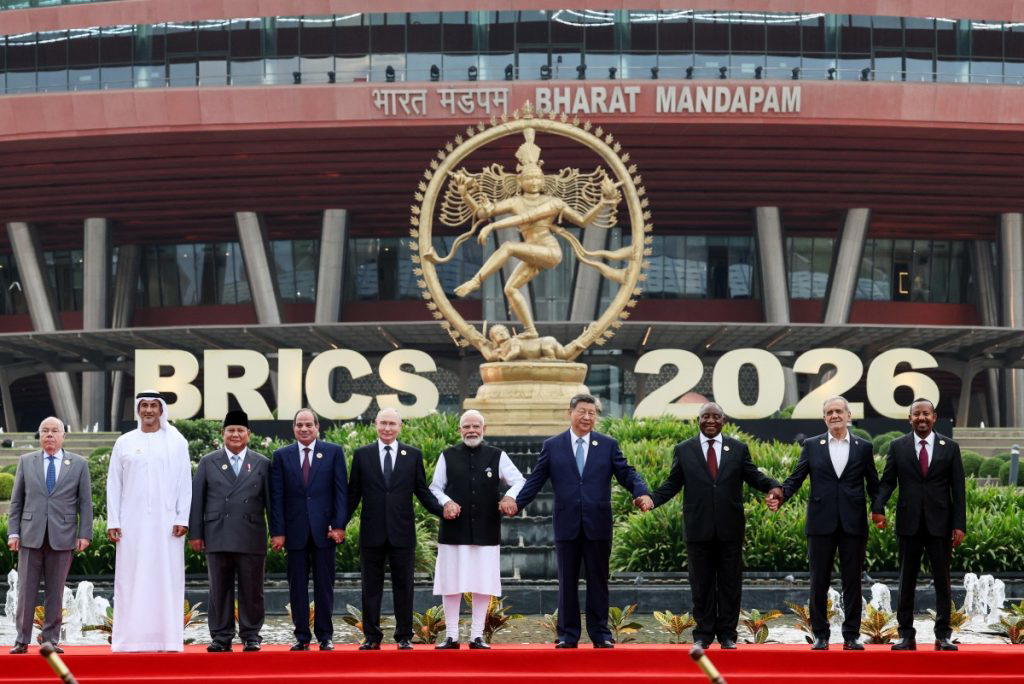
In this pool photograph distributed by the Russian state agency Sputnik, (L-R) Brazil’s Foreign Minister Mauro Vieira, UAE’s Supreme Council for National Security Secretary-General Ali Mohamed Hammad Al Shamsi, Indonesia’s President Prabowo Subianto, Egypt’s President Abdel Fattah al-Sisi, Russia’s President Vladimir Putin, India’s Prime Minister Narendra Modi, China’s President Xi Jinping, South Africa’s President Cyril Ramaphosa, Iran’s President Masoud Pezeshkian and Ethiopia’s Prime Minister Abiy Ahmed pose for a family photo during the 18th BRICS Summit in New Delhi. (Photo by Alexander KAZAKOV / POOL / AFP)
nMembers of the 11-nation BRICS group including China, Russia, Iran and India called for calm in the Middle East at a summit in New Delhi on Saturday, overcoming earlier divisions to issue a joint statement.
nChinese President Xi Jinping, who joined Russian, Iranian, Indian and other leaders in the Indian capital, told the summit that the Middle East war “does not serve the common interests of the international community”.
nForeign ministers of the BRICS grouping failed to agree on a joint statement when they met in New Delhi in May, with Iran, Saudi Arabia and the United Arab Emirates divided over the war that began with US-Israeli strikes on February 28.
nBut leaders issued a statement on Saturday after intense diplomatic efforts by host India, as the bloc seeks to bolster its global influence and address conflict, trade turbulence and energy security.
n“We express deep concern over the continued escalation of tensions in Middle East/West Asia,” the joint statement said, adding the countries “call for exercising maximum restraint, as well as avoiding actions that could further aggravate the situation”.
nBRICS was created in 2009 as a forum for major emerging economies seeking greater influence in institutions dominated by Western powers.
n“We have to transform this pyramid of privilege into a platform of partnership,” Indian Prime Minister Narendra Modi told Xi, Russian President Vladimir Putin, Iranian President Masoud Pezeshkian and other leaders.
nModi, opening the two-day summit, called for a system “where every country has a voice, every member has a stake and humanity’s development is at the centre of every effort”.
nHe told leaders that BRICS nations “represent 50 percent of the world’s population, 40 percent of global GDP and more than 25 percent of global trade”.
nBut finding balance in the bloc is a tough diplomatic task.
nIndia maintains cordial relations with Iran and Israel, but is also careful to strike a delicate balance in its ties with Washington.
nIran’s Pezeshkian attended the summit shortly after warning that the Middle East does not need the United States to be a “regional policeman”, with the two countries at war and tensions threatening the vital Strait of Hormuz.
nPezeshkian met with Abu Dhabi Crown Prince Khaled bin Mohamed bin Zayed on the summit sidelines.
nIndia has navigated the energy crisis caused by the US-Iran war in part by turning to Russia, despite Moscow’s war in Ukraine and pressure from Washington and other Western capitals.
nModi embraced Putin before talks on Friday. Putin, who last visited India in December 2025, is one of New Delhi’s most important strategic partners.
n– ‘Handling differences’ –
nBut the summit’s other major focus is China.
nXi’s visit is also being closely watched because it is his first to neighbouring India since 2019, and the biggest step yet in a cautious thaw between the nuclear-armed rivals.
nXi was given a red-carpet welcome, with an honour guard of soldiers and traditional dancers in colourful dresses, and greeted with a handshake by Modi at the summit venue.
nXi and Modi later met, Chinese state broadcaster CCTV reported, without providing further details.
nHis visit comes six years after a deadly military clash along their disputed Tibetan border, with ties gradually improving through restored flights, visas and high-level contacts.
nBeijing said ahead of his visit that it was “ready to work with India… by strengthening communication, enhancing cooperation, and properly handling differences”.
nThe underlying territorial dispute remains unresolved, and both sides retain heavy military deployments along their roughly 3,500-kilometre (2,175-mile) high-altitude border with Tibet.
n“They are looking for ‘early and substantial harvest’ when it comes to the border issue,” said Pradeep Taneja, a China-India expert at the University of Melbourne.
n“You cannot have a build-up of your forces on the border… but at the same time say ‘we should continue to have people-to-people relations and economic relationships’.”
nDeep mistrust remains, with their contested Himalayan frontier, a widening trade deficit and strategic rivalry continuing to complicate ties.
nDozens of Tibetans protested in New Delhi on Friday — exiles, like their Buddhist leader the Dalai Lama, who has lived in India since fleeing a Chinese crackdown in 1959 — waving placards against Xi’s visit.
nAFP
n nRelated Stories
 General News
CELEBRATING TWO YEARS OF TRANSFORMATIONAL LEADERSHIP IN THE PRESIDENTIAL AMNESTY PROGRAMME
Tomorrow, 14TH March 2026, as we look forward to the second anniversary, we reflect on the remarkable two years since the Administrator of the Preside
 General News
PRESIDENTIAL AMNESTY PROGRAMME PHASE 3: DISREGARD PURPORTED STATEMENT ON DELAYED ITA PAYMENTS — OFFICE OF NATIONAL CHAIRMAN
The Office of the National Chairman of the Presidential Amnesty Programme Phase 3, General Elaye ThankGod Dollar Slaboh, has called on beneficiaries a
 General News
RE: CLARIFICATION ON MY PERSONAL RELATIONSHIPS
PUBLIC NOTICErnrnRE: CLARIFICATION ON MY PERSONAL RELATIONSHIPSrnrnIt has become necessary to make this public clarification following the increasing