
Binance Dominates Rivals: January Trading Activity Surpasses Combined Total of Next Three Largest Competitors
The cryptocurrency market's combined capitalization declined by 9.7% throughout 2025, ultimately settling at $3.07 trillion, yet the underlying market dynamics have maintained their momentum, with trading activity intensifying in a manner that is no longer evenly distributed across the ecosystem.
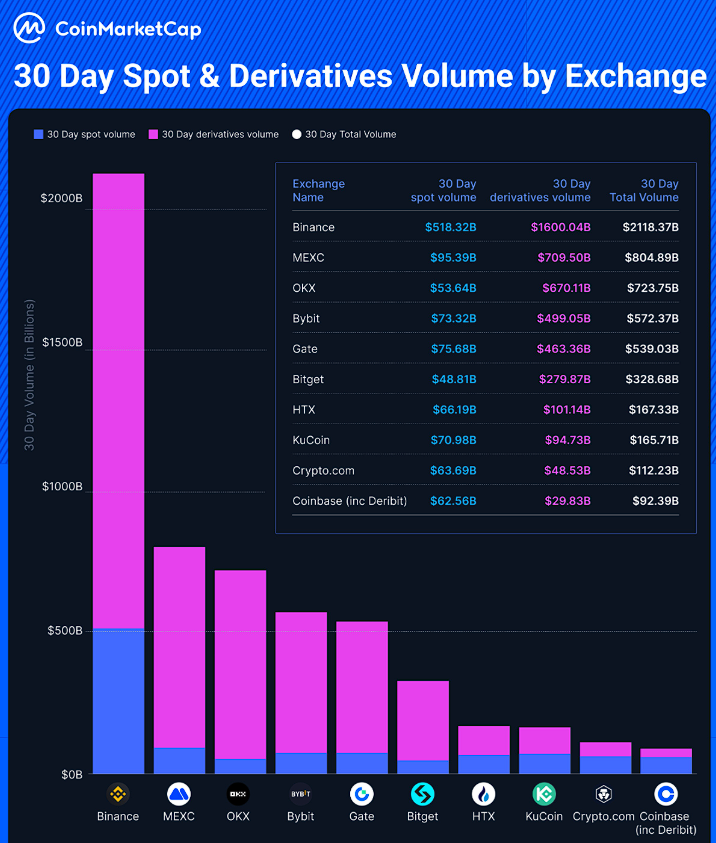
nNew data from CoinMarketCap regarding January 2026 exchange activities reveals a significant consolidation of liquidity, characterized by a notable "flight to depth," where the volume processed by the market's leading exchange, Binance, is now effectively equivalent to the combined output of its three closest global competitors.
nTo understand the current hierarchy, one must examine the broader market structure, which, according to January data, is overwhelmingly driven by hedging and institutional speculation rather than simple spot accumulation, with derivatives accounting for a staggering 81% of the total market volume of approximately $6.84 trillion recorded over the 30-day period.
nSpot trading, on the other hand, represented just 20.5% of the market volume, indicating that price discovery is increasingly occurring in futures and perpetual contracts rather than on immediate order books, with MEXC, Gate, and OKX emerging as key players in the spot and derivatives markets.
nMEXC has secured second place in spot volume with $95.39 billion, followed closely by Gate at $75.68 billion, while OKX processed $53.64 billion in spot volume but retained a stronghold in the derivatives market with $670 billion in volume, and Bybit remains a consistent top-tier player with $572 billion in total volume.
nBinance Co-CEO Richard Teng noted in a recent media appearance that the foundation of the industry often tells a different story than the market cap alone, stating, "If you look at the underlying, the foundation is extremely strong," and pointing to the disparity between asset prices and utility.
nTeng observed that the momentum in which all asset classes are moving on-chain now indicates a bright future in terms of the usage of blockchain technology, and the gap between price action and actual network utility helps explain why trading volumes haven't dropped off, as market participants are actively using blockchain infrastructure.
nThe January report highlights a massive gap between the market leader and competitors, with Binance posting a 30-day volume of $2.12 trillion, which is roughly equivalent to the combined volumes of the next three largest platforms, including MEXC ($804 billion), OKX ($723 billion), and Bybit ($572 billion).
nThis volume gap appears in both spot and derivatives markets, with Binance leading spot trading with $518 billion and its derivatives desk processing $1.6 trillion, tracking with analysis from liquidity providers such as Wintermute, which observed capital clustering in major assets like Bitcoin and Ethereum.
nUS spot Bitcoin ETFs pulled in $16.11 billion in net inflows during 2025, and institutional capital is gravitating toward the deepest order books to avoid slippage, as Binance's 2025 year-end report notes the platform crossed 300 million users and handled $34 trillion in total trading value last year.
nWhen liquidity concentrates to this degree, it creates a gravitational pull, with the depth of the market itself becoming the primary product attracting further flow, and compliance has become a key driver of this consolidation, extending beyond simple market mechanics.
nAs institutional capital enters the market, regulatory certainty has shifted from a "nice-to-have" to a strict requirement, with large-scale participants unable to risk capital on unregulated infrastructure, and Binance recently became the first global exchange to secure full authorization under the Abu Dhabi Global Market (ADGM) framework.
nThis move signals a pivot toward traditional financial standards, and trust is also a function of security, as Binance disclosed that it prevented $6.69 billion in potential losses from fraud and scams in 2025, while reducing direct exposure to illicit funds by 96%.
nYi He, Co-Founder of Binance, addressed this evolution in the company's annual review, stating that "the definition of 'trading on Binance' has changed from 'placing orders on an order book' to discovering new ecosystems," and emphasizing that this exploration occurs "without losing the benefits of regulated infrastructure and deep liquidity that our platform offers."
nThe January data signals that the crypto market has moved past its fragmentation phase, with liquidity begetting liquidity and creating a tiered system where the gap between the market leader and the mid-market challengers is widening rather than shrinking.
nAs 2026 unfolds, likely to be a year characterized by a "risk reboot," the winners will not necessarily be those with the most aggressive marketing, but those who can offer the depth and regulatory moat required by an increasingly sophisticated class of traders.
Related Stories
 General News
CELEBRATING TWO YEARS OF TRANSFORMATIONAL LEADERSHIP IN THE PRESIDENTIAL AMNESTY PROGRAMME
Tomorrow, 14TH March 2026, as we look forward to the second anniversary, we reflect on the remarkable two years since the Administrator of the Preside
 General News
PRESIDENTIAL AMNESTY PROGRAMME PHASE 3: DISREGARD PURPORTED STATEMENT ON DELAYED ITA PAYMENTS — OFFICE OF NATIONAL CHAIRMAN
The Office of the National Chairman of the Presidential Amnesty Programme Phase 3, General Elaye ThankGod Dollar Slaboh, has called on beneficiaries a
 General News
RE: CLARIFICATION ON MY PERSONAL RELATIONSHIPS
PUBLIC NOTICErnrnRE: CLARIFICATION ON MY PERSONAL RELATIONSHIPSrnrnIt has become necessary to make this public clarification following the increasing