
Battlefield fortitude: Soldiers thwart assaults, hold strategic positions
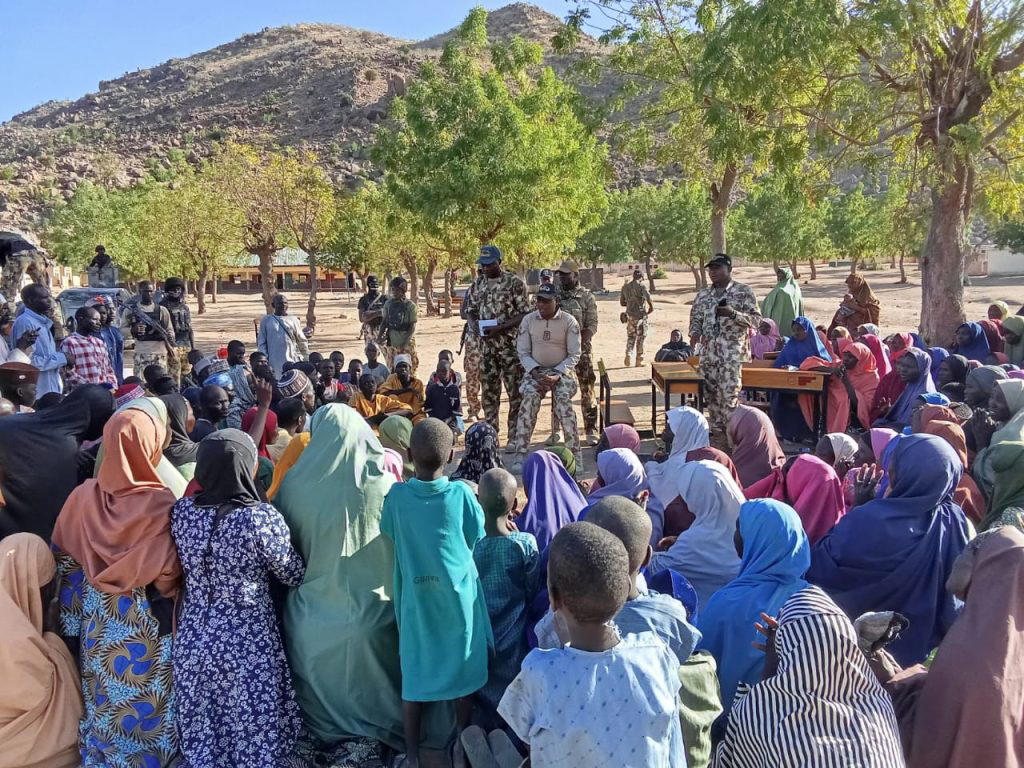
Nigeria's war against terror has become a multifaceted effort, extending beyond the use of bullets and bombs to encompass fighter jets patrolling the skies over Maiduguri, intelligence partnerships in Cairo, Egypt, and training exchanges in Pretoria, South Africa, as well as royal collaborations in Benue, all aimed at ensuring the safety of millions of citizens.
nMarch 2026 was a defining month for the Nigerian Army, as troops celebrated Eid-el-Fitr with residents of Ngoshe, Borno State, after securing a Forward Operating Base, while also retrieving fallen comrades from Goniri, Yobe State, and Malam Fatori, Borno State, in the face of relentless attacks.
nFor years, Ngoshe was a ghost town, emptied by Boko Haram violence, but during the recent Eid-el-Fitr, life returned to the area, with streets once deserted coming alive with the sound of children's laughter and worshippers gathering freely.
nTroops of Operation HADIN KAI joined residents at the Central Mosque and walked openly through the community, marking a significant shift in the town's fortunes, just days after insurgents had threatened to overrun Ngoshe and impose their presence.
nThe military responded with precision, reinforcing positions and repelling an attempted incursion on March 4, with Brigadier General NI Abdullahi, Commander of the 26 Task Force Brigade, declaring, "The era of fear is over, we are not passing through, we are staying."
nPrayers were offered for victims of insurgency, while residents expressed gratitude and called for sustained support and reconstruction, as the town began to rebuild and heal.
nIf Ngoshe symbolised hope, the wider North-East told a story of fierce confrontation, with troops of Operation HADIN KAI intensifying operations across key flashpoints between March 9 and 28.
nIn Goniri, Yobe State, ISWAP fighters launched a coordinated night attack, advancing from multiple directions in a bid to overwhelm troops, but soldiers held their ground, backed by surveillance and air support.
nBy morning, over 20 terrorists lay dead, including a senior commander, Abu Yusu, with weapons recovered including machine guns, AK-47 rifles, IEDs, and explosives.
nDays later, in Malam Fatori, Borno State, another attempted assault was repelled, with over 80 insurgents neutralised, and on March 28, troops again foiled an attack on a Forward Operating Base in Mandaragirau, Borno State, killing at least 38 fighters.
nIn total, no fewer than 145 terrorists were neutralised within the month, with a senior military officer noting that over 1,000 insurgents and their families surrendered, signalling the weakening of terrorist propaganda.
nEvery gain came with sacrifice, as several soldiers sustained injuries, while others paid the supreme price, their stories carried quietly in barracks and homes where families now live with absence.
nNigeria's counter-terrorism strategy is no longer confined within its borders, with high-level military engagements on Tuesday, March 10, emphasizing a growing continental approach.
nThe South African Army Chief, Lieutenant General Lawrence Khulekani Mbatha, visited Abuja, followed by Egyptian Defence Attaché, Colonel Mohammed Ibrahim, two days later, as the Chief of Army Staff, Lieutenant General Waidi Shaibu, emphasized the need for Africa to build its own capacity.
nLieutenant General Shaibu noted that the Nigerian Army has continued to develop robust training frameworks aimed at equipping troops with the necessary skills to combat modern threats, such as the use of Improvised Explosive Devices (IEDs) by terrorist groups and the employment of air assets.
nHe explained that the Nigerian Army has placed significant emphasis on specialised training in IED detection, counter-IED operations, and battlefield survivability as part of its counter-terrorism offensive operations.
nAccording to him, enhanced cooperation with the South African Army would further strengthen these training programmes and contribute to building a more capable regional security architecture.
nLieutenant General Mbatha stated that his visit provided an opportunity for the South African Army to study Nigeria's operational experiences in tackling terrorism and other asymmetric threats, acknowledging the extensive battlefield experience of the Nigerian Army.
nBoth leaders explored opportunities for expanding technical cooperation in specialised areas, including aviation, with the South African Army Chief noting that stronger collaboration in this domain could assist the Nigerian Army in further developing its aviation capabilities.
nNigeria is strengthening counter-IED capabilities, aviation maintenance, and battlefield survivability through cooperation with South Africa, while also deepening operational ties with Egypt under a 2024 Memorandum of Understanding.
nOn March 4, the COAS visited the Tor Tiv, Professor James Ortese Iorzua Ayatse, in Benue State, emphasizing that beyond kinetic operations, the support of traditional institutions remains pivotal to achieving sustainable peace.
nLt Gen Shaibu called on the Tor Tiv and other traditional rulers to lend their moral authority and grassroots influence toward mobilising communities against criminality, stating that traditional leaders play a critical role in shaping public perception and promoting peaceful messaging.
nThe Army Chief announced an increase in troop density along vulnerable corridors, particularly the Benue–Taraba axis, including the deployment of an additional battalion, as well as enhanced logistics support, surveillance assets, and rapid response capabilities.
nAt the 4 Special Forces Command in Doma, Nasarawa State, the COAS declared, "The era of reactive engagements is over," charging troops to adopt precision-driven, intelligence-led operations, with new facilities approved to boost training and welfare.
nThe philosophy is simple: a well-prepared soldier is a decisive advantage, with symbolism mattering, as trees were planted as a reminder of sustainability and growth amid conflict.
Related Stories
 General News
CELEBRATING TWO YEARS OF TRANSFORMATIONAL LEADERSHIP IN THE PRESIDENTIAL AMNESTY PROGRAMME
Tomorrow, 14TH March 2026, as we look forward to the second anniversary, we reflect on the remarkable two years since the Administrator of the Preside
 General News
PRESIDENTIAL AMNESTY PROGRAMME PHASE 3: DISREGARD PURPORTED STATEMENT ON DELAYED ITA PAYMENTS — OFFICE OF NATIONAL CHAIRMAN
The Office of the National Chairman of the Presidential Amnesty Programme Phase 3, General Elaye ThankGod Dollar Slaboh, has called on beneficiaries a
 General News
RE: CLARIFICATION ON MY PERSONAL RELATIONSHIPS
PUBLIC NOTICErnrnRE: CLARIFICATION ON MY PERSONAL RELATIONSHIPSrnrnIt has become necessary to make this public clarification following the increasing