
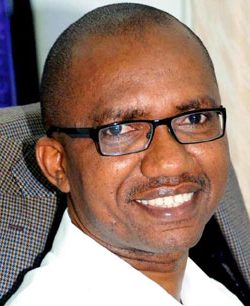
Azu Ishiekwene weighs in on the lighthearted exchange between Tinubu and Ruto as a subject for reflection
Kenyan President William Ruto's recent remarks about Nigerians, made with a smile from Italy, seemed to draw inspiration from Amos Tutuola's The Palm-Wine Drinkard, a story rooted in Yoruba mythology.
nRuto's comments implied that Nigerians speak a unique variety of English, distinct from the conventional language used by renowned authors like Ngugi wa Thiong'o and Wole Soyinka.
nHowever, it can be argued that Tutuola's storytelling style, similar to Mark Twain's The Adventures of Huckleberry Finn, was unapologetically raw and unbound, reflecting the Nigerian spirit.
nRuto's jab at Nigerian English was likely an attempt to distract from the protests about the cost of living and economic difficulties in Nairobi, but his message was met with resistance.
nWhile Ruto was making light of Nigerian English, Kenyan content creators were busy online, baiting Nigerians for traffic and attention.
nThe Kenyan high commissioner in Nigeria must have overheard many Nigerians asking, "Who English epp?", a phrase that highlights the perceived vanity of prioritizing Queen's English.
nKenyans may pride themselves on speaking good English, but the economic challenges they face, as acknowledged by Nigerian President Bola Ahmed Tinubu, are very real and require urgent attention.
nThe problems plaguing Kenya's economy, driven largely by tourism and agriculture, will not be solved by speaking impeccable English, but rather by addressing the underlying issues.
nKenya's GDP per capita, at $2,132, may seem more impressive than Nigeria's $1,378, but the reality is that Kenyans are often more prone to protesting and rioting.
nOn April 10, President Tinubu visited Bayelsa, an oil-producing state in the Niger Delta region, and remarked that despite economic hardships, Nigerians were "better off" than citizens in other African countries, citing Kenya as an example.
nTinubu's comment was likely an attempt to contextualize Nigeria's economic situation, but it was met with criticism, and Kenya's own struggles with protests, public outrage, and police killings since September 2022 were highlighted in response.
nThe ongoing war between the US, Israel, and Iran has disrupted global oil supplies, leading to increased fuel costs and further exacerbating Kenya's economic difficulties, with inflation rising to 4.4 percent in March 2026.
nNigeria faces a similar economic situation, and Tinubu's analogy was seen as an attempt to downplay the country's struggles, much like a parent trying to convince their children that they are not the only ones struggling to pay school fees.
nThe exchange between Tinubu and Ruto has made headlines, but the reality is that both countries are facing significant economic challenges that require serious attention and action.
nNigeria's large population, with one out of every six Africans being Nigerian, makes the country a significant presence on the continent, with about 15.4 percent of the population, approximately 63 percent of which is under the age of 25.
nThe country's huge population is equivalent to the combined population of 25 other African countries, making Nigerians highly visible and influential, both online and offline.
nThe debate over who has the best jollof rice, a popular West African dish, is a lighthearted example of the friendly rivalry between Nigeria, Ghana, and Senegal, with each country having its own unique recipe and claims to the dish.
nHowever, the reality is that English, a colonial legacy, is not a measure of intelligence or national progress, and both Kenya and Nigeria have developed distinct spoken varieties of the language, shaped by their unique cultural and linguistic contexts.
nAs Nigerian civil rights activist Shehu Sani pointed out, Ruto's mocking of Nigerian English is ironic, given that Nigeria is home to Nobel Prize winners like Wole Soyinka and renowned authors like Chimamanda Ngozi Adichie.
nIn 2025, a 17-year-old Nigerian student, Nafisa Abdullahi, won an international English language competition, beating over 20,000 competitors from 69 countries, including Kenya.
nNigeria has the most English speakers in Africa, and the language has evolved into a distinct and widely recognized variety, shaped by the country's history, cultures, and everyday usage, with Nigerian expressions increasingly influencing global English.
nThe real issue, however, is that the economic struggles faced by both Kenyans and Nigerians are far more pressing than the debate over English language skills, and it is this reality that Tinubu and Ruto should be addressing, rather than exchanging jabs about language.
Related Stories
 General News
CELEBRATING TWO YEARS OF TRANSFORMATIONAL LEADERSHIP IN THE PRESIDENTIAL AMNESTY PROGRAMME
Tomorrow, 14TH March 2026, as we look forward to the second anniversary, we reflect on the remarkable two years since the Administrator of the Preside
 General News
PRESIDENTIAL AMNESTY PROGRAMME PHASE 3: DISREGARD PURPORTED STATEMENT ON DELAYED ITA PAYMENTS — OFFICE OF NATIONAL CHAIRMAN
The Office of the National Chairman of the Presidential Amnesty Programme Phase 3, General Elaye ThankGod Dollar Slaboh, has called on beneficiaries a
 General News
RE: CLARIFICATION ON MY PERSONAL RELATIONSHIPS
PUBLIC NOTICErnrnRE: CLARIFICATION ON MY PERSONAL RELATIONSHIPSrnrnIt has become necessary to make this public clarification following the increasing