
Awka metalworkers lament being overlooked by authorities and local residents
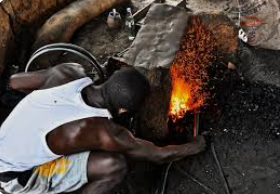
In the heart of Anambra State, the legendary Awka blacksmiths are struggling to preserve their ancient craft, which has been exploited for personal gains by various individuals and organizations.
nFor generations, the rhythmic clang of hammers in Awka was the heartbeat of a craft that could mold iron into anything the mind could imagine, but today, that sound is fading into a bitter silence.
nObiorah Okafor, the chairman of Awka Blacksmiths Association, stated that they are not encouraged by the government or organizations to better their skills, and as a result, they have decided to charge those who seek information about Uzu Awka N50,000.
nOkafor described the blacksmiths' organization as a spiritual body, with members well grounded in tradition, and lamented the government and people's neglect of blacksmith, which Awka is known for.
nThe association calls for the establishment of Uzu Oka Center, where everything pertaining to the Awka blacksmiths will be located, and is demanding N50,000 from anyone who seeks information from them, whether it's a TV station or a newspaper house.
nOkafor explained that they took this decision because they have been deceived for too long by people who tapped their knowledge for personal gain, and now, only the oldest man in Awka, who is a member of the association, can provide information after payment of N50,000.
nThe blacksmiths make metallic musical instruments, iron pots, and other items, with customers coming from different states to place orders, and Okafor's greatest worry is that prominent people in Awka have not been supporting blacksmiths, but only attach the prefix "Uzu" to their names.
nAccording to Okafor, people come to learn blacksmithing, after which they go to other towns to practice, and many people in the business say they are still in the trade because they could not find an alternative job to do.
nThere are stringent rules governing the blacksmith business, the most important being that guns are no longer made, as it used to be the major product but was stopped after the Nigerian civil war to control arms circulation in the country.
nThe place where the blacksmiths occupy in Awka used to be a beehive of activities, and customers used to come from many parts of the country and even beyond to buy short guns that were synonymous with Awka.
nHowever, after the Nigerian civil war, production of guns became illegal, and security operatives often carried out raids in the area, causing many blacksmiths to withdraw and learn other trades.
nOver the years, those who endured adjusted and concentrated on making items other than guns, but gradually, many of them began to lose interest in the job and finally withdrew.
nWhen visited in 2019, not more than 20 people were seen at the blacksmith center, and most of them were men above 60 years old, but during a recent visit, many youths were seen, with the chairman explaining that many of them have discovered that the blacksmith business is very lucrative.
nLittered at the center were traditional blacksmith tools like tongs, anvils, chisels, a hammer, and charcoal, and despite the center's ramshackle appearance, many tertiary institutions use it for their scientific research.
nThe Awka blacksmiths still use traditional tools due to a lack of financial support to acquire modern equipment, and because of their ugly experiences with some people who pretended to connect them with the government for assistance, they decided to register Awka Blacksmiths Association with the Corporate Affairs Commission, CAC.
nOkafor, whose late father introduced him into the business at the age of nine, said the most worrisome aspect of their plight was that all those who came in the name of helping them to modernize the business were only there for their personal interests.
nBefore the civil war, blacksmithing was a thriving business in Awka, and buyers were coming for the popular Awka short gun, but after the war, there was an embargo on the manufacturing of guns, and they concentrated on making other items.
nOkafor regretted that many of the items are no longer produced because of a lack of encouragement, and many youths are not interested in learning and continuing this profession, which Awka is known for.
nAt one time, someone promised to assist them, and he suggested that they should mount an exhibition to let the world know what they are doing, but he didn't get back to them after the exhibition, and they later discovered that his intention was to take over their business.
nOkafor said that even their traditional ruler, known as Eze Uzu, which is a title derived from blacksmith, has not been to the blacksmith center to see how blacksmithing works, and has not done anything to encourage them.
nHe admitted that there is a ready market for their products, and they do not even meet the demands of their customers, but despite the complaints and difficulties associated with the business, some of the blacksmiths said they cannot fit into any other trade.
nOkafor, who has been in the business for over 45 years, said it is a lucrative venture, and from it, he got married, built a three-storey house, bought cars, and trained his children, and he has not done any other business in his life.
Related Stories
 General News
CELEBRATING TWO YEARS OF TRANSFORMATIONAL LEADERSHIP IN THE PRESIDENTIAL AMNESTY PROGRAMME
Tomorrow, 14TH March 2026, as we look forward to the second anniversary, we reflect on the remarkable two years since the Administrator of the Preside
 General News
PRESIDENTIAL AMNESTY PROGRAMME PHASE 3: DISREGARD PURPORTED STATEMENT ON DELAYED ITA PAYMENTS — OFFICE OF NATIONAL CHAIRMAN
The Office of the National Chairman of the Presidential Amnesty Programme Phase 3, General Elaye ThankGod Dollar Slaboh, has called on beneficiaries a
 General News
RE: CLARIFICATION ON MY PERSONAL RELATIONSHIPS
PUBLIC NOTICErnrnRE: CLARIFICATION ON MY PERSONAL RELATIONSHIPSrnrnIt has become necessary to make this public clarification following the increasing