
America launches fresh attacks on Iran, even as negotiations to halt conflict continue
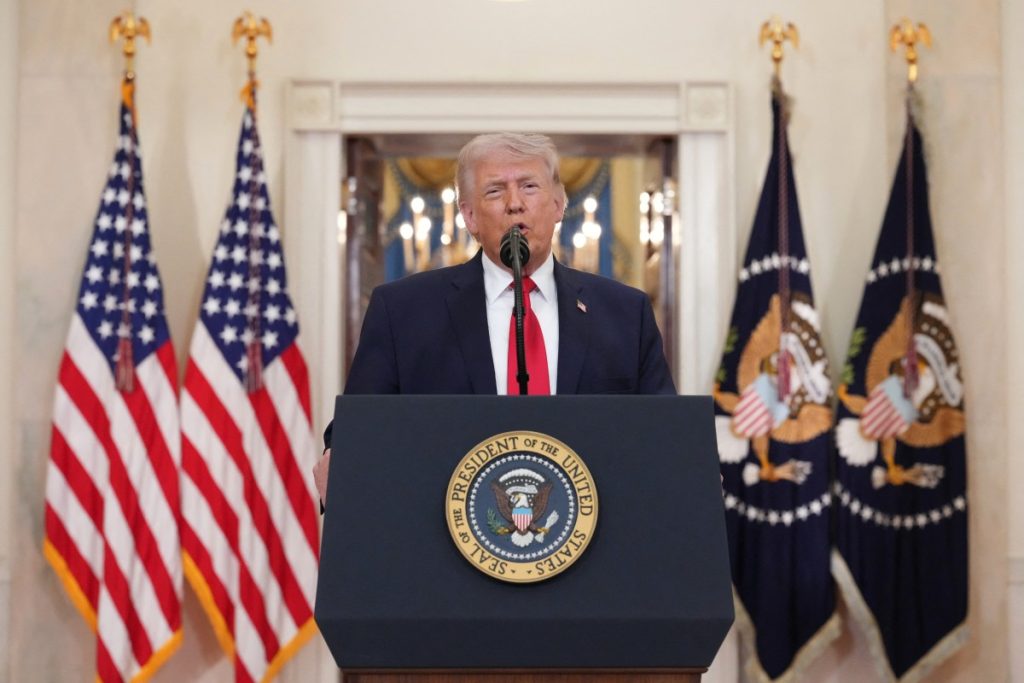
US President Donald Trump speaks during a televised address on the conflict in the Middle East from the Cross Hall of the White House in Washington, DC on April 1, 2026. President Donald Trump made his case for attacking Iran in his first nationwide address more than a month into the war, insisting the United States was close to victory as his approval rating sinks. In an evening speech from the White House, Trump broke little new ground on how the war would end and vowed two to three weeks further of “extremely hard” strikes against Iran. (Photo by Alex Brandon / POOL / AFP)
nUS forces attacked missile sites in southern Iran and boats trying to lay mines on Monday, US Central Command said, imperiling a fragile ceasefire and casting new doubt on a deal to end the Middle East war.
nThe strikes came as top Iranian negotiators arrived in Doha for the latest round of talks to end the months-long conflict, and as the Israeli military stepped up hostilities with Iran-backed Hezbollah in southern Lebanon.
nOil prices fluctuated in the wake of the US strikes, which may threaten any agreement to reopen the Strait of Hormuz, where an Iranian blockade has throttled global fuel supplies.
n“US forces conducted self-defense strikes in southern Iran today to protect our troops from threats posed by Iranian forces,” Tim Hawkins, a Central Command spokesman, said in a statement.
nIt gave no details of the attacks and said only that the targets included missile launch sites and boats trying to “emplace mines.”
nDespite the strikes, Secretary of State Marco Rubio said Tuesday a deal remained within reach but struck a firm note on the Hormuz strait.
n“There were some talks going on in Qatar today, so we’ll see if we can make progress. I think it’s a lot of talking back and forth going on about specific language in the initial document, so it’ll take a few days,” Rubio told reporters during a visit to India, without commenting about the impact of the strikes.
nHe said the strait was “going to be open one way or the other,” adding: “What’s happening there is unlawful, it’s illegal, it’s unsustainable for the world, it’s unacceptable.”
nIran’s state-run broadcaster IRIB reported several loud explosions were heard in the vicinity of Bandar Abbas at around midnight local time (2030 GMT Monday).
nIt added the situation in the southern port city was normal and local authorities were investigating the cause of the blasts.
nThe strikes threatened a ceasefire that began April 8 as the United States and Iran struggle to reach an accord to end a war that has rattled the global economy with a severe disruption of energy flows.
nOil prices fluctuated on Tuesday morning but remained below $100, with West Texas Intermediate dropping more than five percent while international benchmark Brent crude was up.
nHopes of an accord took another blow when Israeli Prime Minister Benjamin Netanyahu vowed to “crush” Hezbollah in Lebanon. Iran has demanded that any peace accord apply to the fighting in Lebanon as well.
n– Nuclear fuel disposal –
nTrump also said in a social media post he expected Iran to hand over its enriched uranium to the United States to be destroyed, or have it destroyed in Iran with an international witness.
nThe nuclear fuel “will either be immediately turned over to the United States to be brought home and destroyed or, preferably, in conjunction and coordination with the Islamic Republic of Iran, destroyed in place or, at another acceptable location, with the Atomic Energy Commission, or its equivalent, being witness to this process and event,” Trump wrote.
nIt was not clear whether he meant this would be part of a potential accord with Iran, and the commission he cited was abolished in 1974.
nEarlier Monday, Trump said it should be mandatory for Saudi Arabia, the United Arab Emirates, Qatar, Pakistan, Egypt, Turkey, Bahrain and Jordan to join the Abraham Accords, a set of agreements brokered in 2020 with nations historically hostile to Israel, as part of a peace deal with Iran.
nTrump said he had spoken to the leaders of those countries Saturday about efforts to end the war. Bahrain and the UAE have already signed the accords, along with Morocco and Sudan.
nWhile the Abraham Accords were welcomed by some, they remain deeply unpopular in many parts of the Middle East — in part because they fail to address the Israeli-Palestinian conflict.
nGulf states such as Saudi Arabia and Qatar have said normalization with Israel depends on the creation of a Palestinian state.
n– No imminent deal –
nAnna Jacobs of the Arab Gulf States Institute in Washington said Gulf nations were unlikely to accept Trump’s maximalist demand.
n“The national security of the Gulf states has been threatened more than ever before because of President Trump’s reckless decisions, and he expects Arab states to thank him and to normalize relations with Israel, which they will not do at this stage,” she said.
nBefore the strikes on Iran, Rubio had suggested a deal could be reached by the end of Monday.
nIran’s foreign ministry spokesman Esmaeil Baqaei said both sides had “reached a conclusion on a large portion of the issues” but that it did not mean an agreement was “imminent”.
nNetanyahu said Monday he had ordered an “even greater acceleration” of the Israeli offensive in Lebanon following Hezbollah drone attacks on Israeli forces.
nHe said any final deal with Iran “must eliminate the nuclear threat entirely,” a position echoed by Washington.
nIranian officials have stressed that, despite the longstanding US demand for an end to its uranium enrichment, talks on its nuclear program have been deferred until after an initial agreement.
n nRelated Stories
 General News
CELEBRATING TWO YEARS OF TRANSFORMATIONAL LEADERSHIP IN THE PRESIDENTIAL AMNESTY PROGRAMME
Tomorrow, 14TH March 2026, as we look forward to the second anniversary, we reflect on the remarkable two years since the Administrator of the Preside
 General News
PRESIDENTIAL AMNESTY PROGRAMME PHASE 3: DISREGARD PURPORTED STATEMENT ON DELAYED ITA PAYMENTS — OFFICE OF NATIONAL CHAIRMAN
The Office of the National Chairman of the Presidential Amnesty Programme Phase 3, General Elaye ThankGod Dollar Slaboh, has called on beneficiaries a
 General News
RE: CLARIFICATION ON MY PERSONAL RELATIONSHIPS
PUBLIC NOTICErnrnRE: CLARIFICATION ON MY PERSONAL RELATIONSHIPSrnrnIt has become necessary to make this public clarification following the increasing