
America launches attack on Iran, pledges to restore maritime embargo
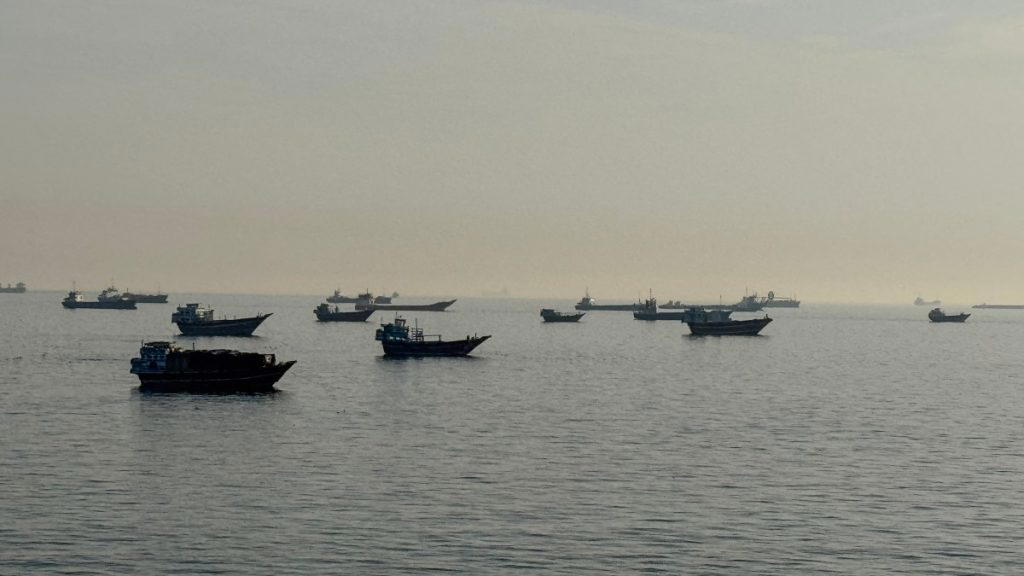
Vessels are anchored in the Strait of Hormuz, off the port city of Khasab on Oman’s northern Musandam Peninsula, as of May 17, 2026, a scene that has become increasingly tense in recent weeks.
nTehran announced the closure of the Strait of Hormuz on July 12, and in a retaliatory move, launched missiles and drones at its Gulf neighbours, following new US strikes after an Iranian forces' attack on a merchant vessel that was abandoned in flames by its crew.
nThe United States launched a fresh wave of strikes on Iran on Tuesday, with President Donald Trump vowing to reimpose a naval blockade, prompting Tehran to respond with attacks on countries in the region, including targeting two ships in the strategic waterway and killing one crew member.
nThe UK maritime security agency UKMTO reported that yet another tanker was struck by a missile while transiting Hormuz near Oman’s coast on Tuesday, as the conflict continues to escalate.
nThe US military said its five-hour mission hit targets across Iran, including coastal Bushehr and Bandar Abbas, aiming to “degrade Iran’s ability to attack commercial shipping”, with renewed US attacks since last week killing at least 28 people in Iran.
nIran’s Revolutionary Guards announced they had fired missiles and drones on Bahrain, targeting a residential building for US forces and other facilities, after the US strikes, with Bahrain intercepting “several treacherous aerial attacks launched by Iran” and accusing Tehran of targeting civilians.
nTrump’s declaration on the Hormuz blockade and the scale of the renewed fighting have raised questions about efforts to bring a permanent end to the war, which started after US-Israel attacks in February, prompting Washington’s blockade on Tehran’s ports, with restrictions easing after a preliminary deal in June.
nTrump said the United States was “taking over” the strait and would slap a levy of 20 percent on all cargo shipped through it, drawing mockery from Iran and accusations of “piracy”, with US Central Command saying Iran’s ports on the waterway would be blockaded from 2000 GMT on Tuesday.
nOil prices shot up more than nine percent on Monday over fears of renewed conflict and rose again on Tuesday, piling on more than one percent, as the situation in the region continues to deteriorate.
nTehran launched attacks on other US allies in the region, including Jordan, which said it had shot down four missiles from Iran, with Iran’s Revolutionary Guards saying their strikes targeted US forces at an air base and urging Jordanians to demand the removal of US bases from the region.
nIran’s military command spokesman said any collaboration by Gulf countries with the United States would be considered “an act of war”, as the conflict escalates, with Trump formally notifying Congress that the United States had resumed military conflict against Iran, giving the Pentagon an additional 60 days to operate in the region.
nTrump also threatened to destroy Pickaxe Mountain, a deeply buried nuclear site near Natanz, where Western intelligence suspects Iran is building an undeclared enrichment facility, saying “Tell the Iranians to be ready, let them know we’re coming and there’s not a damn thing they can do about it”.
nTrump declared that the United States would be “known as ‘THE GUARDIAN OF THE HORMUZ STRAIT'” and levy a 20 percent fee on all cargo shipped through the waterway, while Iranian Foreign Minister Abbas Araghchi responded mockingly, saying Tehran would charge less, noting that “20% is of course too much”.
nIran’s parliament has begun work on a bill on “the management of the Strait of Hormuz”, according to the head of the security committee, as Washington vehemently opposes Tehran’s desire to charge tolls in the strait, which international law generally forbids.
nDespite the escalating conflict, Trump said a deal with Tehran to end the war was still possible, while Iran’s Foreign Ministry spokesman Esmaeil Baqaei said the June memorandum of understanding was “in crisis”, with Iran ignoring its obligations if Washington did the same.
nBaqaei added that Tehran was continuing talks with mediators from Qatar, Pakistan, and Oman to prevent further escalation, but Bader Al-Saif, an associate fellow at Chatham House, said the escalating attacks would merely delay a permanent agreement, as both sides want to end the impasse on their own terms.
Related Stories
 General News
CELEBRATING TWO YEARS OF TRANSFORMATIONAL LEADERSHIP IN THE PRESIDENTIAL AMNESTY PROGRAMME
Tomorrow, 14TH March 2026, as we look forward to the second anniversary, we reflect on the remarkable two years since the Administrator of the Preside
 General News
PRESIDENTIAL AMNESTY PROGRAMME PHASE 3: DISREGARD PURPORTED STATEMENT ON DELAYED ITA PAYMENTS — OFFICE OF NATIONAL CHAIRMAN
The Office of the National Chairman of the Presidential Amnesty Programme Phase 3, General Elaye ThankGod Dollar Slaboh, has called on beneficiaries a
 General News
RE: CLARIFICATION ON MY PERSONAL RELATIONSHIPS
PUBLIC NOTICErnrnRE: CLARIFICATION ON MY PERSONAL RELATIONSHIPSrnrnIt has become necessary to make this public clarification following the increasing