
America broadens economic penalties to hit Iran's petroleum and digital currency industries
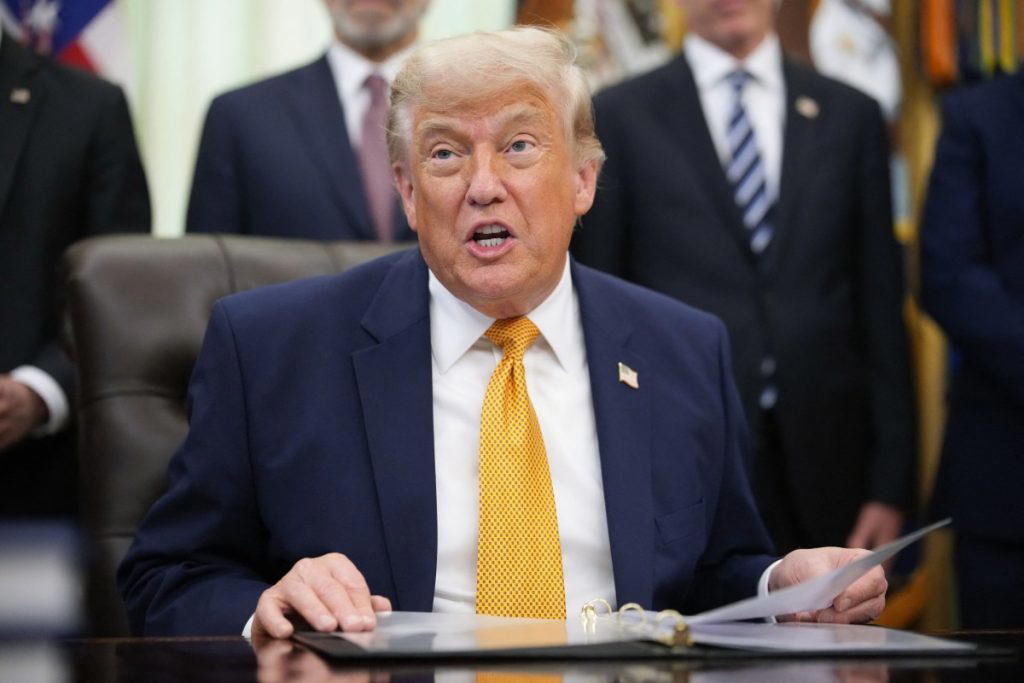
On June 22, 2026, in Washington, DC, U.S. President Donald Trump delivered remarks before signing an executive order in the Oval Office of the White House, an event that took place as the US expanded its sanctions targeting Iran's oil sector.
nThe Treasury Department announced that the expanded sanctions aimed to further target the network of petroleum shipping magnate Mohammad Hossein Shamkhani, with Treasury Secretary Scott Bessent playing a key role in the department's actions.
nThe department froze $130 million held in digital wallets linked to Iran's central bank, a move that targeted a sector that has seen increased activity since the start of the war, according to the Treasury Department.
nThe US move came after US forces carried out a fourth straight day of strikes against Iran and reimposed a naval blockade, while Iran retaliated by hitting ships in the Strait of Hormuz, as reported by the International Maritime Organization.
nIran had started blocking the strait, a key waterway for energy transit, after US-Israel attacks in February, and Washington had previously imposed an initial blockade on Tehran's ports from mid-April to mid-June.
nThe Treasury Department stated that the action was part of its ongoing efforts to ramp up economic pressure on the Iranian regime after it resumed destabilizing attacks in the Strait of Hormuz, as outlined in a notice on Tuesday.
nThe department charged that the Shamkhani network remains a key force behind Iran's oil exports and has expanded into global commodities trading, prompting the latest move to target over 50 individuals, entities, and vessels that enabled Iranian authorities to reap profit.
nThe Treasury Department has now imposed sanctions on over 200 individuals, entities, and vessels operating under Shamkhani's patronage, further increasing the pressure on the Iranian regime.
nShamkhani is the son of security official Ali Shamkhani, an advisor to Iranian supreme leader Ali Khamenei, and both were killed on February 28, the first day of US-Israeli attacks and the start of the Middle East war.
nTreasury Secretary Scott Bessent announced that the department "sanctioned multiple wallets tied to the Central Bank of Iran, resulting in the freeze of over $130 million," and vowed to continue aggressively following the money to deny the Iranian regime access to its illicit revenue schemes.
nExperts note that digital asset platforms have been used to circumvent sanctions placed on Iran's Revolutionary Guards and as a financial safe haven for civilians hit by soaring inflation, as Iran has largely been cut off from the global financial system due to US and European sanctions in place for years before the war.
nCryptocurrency has offered a path for citizens and businesses to transact with the rest of the world, despite the sanctions, and the latest move by the Treasury Department aims to curb this activity and increase pressure on the Iranian regime.
Related Stories
 General News
CELEBRATING TWO YEARS OF TRANSFORMATIONAL LEADERSHIP IN THE PRESIDENTIAL AMNESTY PROGRAMME
Tomorrow, 14TH March 2026, as we look forward to the second anniversary, we reflect on the remarkable two years since the Administrator of the Preside
 General News
PRESIDENTIAL AMNESTY PROGRAMME PHASE 3: DISREGARD PURPORTED STATEMENT ON DELAYED ITA PAYMENTS — OFFICE OF NATIONAL CHAIRMAN
The Office of the National Chairman of the Presidential Amnesty Programme Phase 3, General Elaye ThankGod Dollar Slaboh, has called on beneficiaries a
 General News
RE: CLARIFICATION ON MY PERSONAL RELATIONSHIPS
PUBLIC NOTICErnrnRE: CLARIFICATION ON MY PERSONAL RELATIONSHIPSrnrnIt has become necessary to make this public clarification following the increasing