
Agricultural shipments plummet 31% amid prolonged port congestion and chemical contamination sparking widespread international rejections
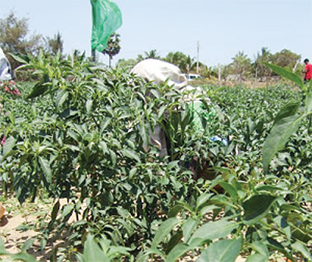
Nigeria's agricultural exports have experienced a significant decline of 31.2 per cent in the first quarter of 2026, primarily due to prolonged port delays, excessive pesticide application, and failure to obtain required phytosanitary certification, resulting in increased rejection of the country's farm produce in international markets.
nAccording to the National Bureau of Statistics, agricultural exports decreased to N1.172 trillion in the first quarter of 2026 from N1.704 trillion in the corresponding period of 2025, and also represented an 11.39 per cent decline from N1.323 trillion recorded in the fourth quarter of 2025.
nAgricultural value chain experts warn that systemic failures, worsened by poor post-harvest handling, are rapidly eroding the competitiveness of the 'Made-in-Nigeria' agro brand and threatening the country's access to premium global markets.
nThe top agricultural exports remained Superior Quality Cocoa Beans valued at N596.90 billion, Sesame Seeds worth N153.78 billion, Soya Beans at N129.27 billion, Cashew Nuts in Shell valued at N119.76 billion, and Flours and Meals of Soya Beans worth N53.20 billion.
nAsia remained Nigeria's biggest destination for agricultural exports, accounting for N529.45 billion, followed by Europe with N500.34 billion, while the Netherlands, Belgium, India, and Canada also ranked among major export destinations.
nThe decline in Nigeria's agricultural exports mirrors a broader global push for stricter compliance with international food safety standards, as emphasized by Director-General of the Food and Agriculture Organisation, Qu Dongyu, during the 49th Session of the Codex Alimentarius Commission in Geneva on July 6, 2026.
nQu Dongyu announced an additional USD500,000 allocation to strengthen digital infrastructure and capacity building for developing countries implementing international food safety standards, warning that confidence in global food trade depends largely on effective implementation of food safety standards.
nMinister of Agriculture and Food Security, Abubakar Kyari, recently inaugurated a Technical Working Group to investigate the recurring rejection of Nigeria's agricultural exports and submit its findings within two months, citing significant economic losses for stakeholders across the agricultural value chain.
nA shipment of 15 containers of Hibiscus flower was rejected at the Mexican border after laboratory tests detected residues of outdated chemical preservatives, according to Dr. Queen Okpa, Founder of Women in Agribusiness, Trade and Export.
nDr. Okpa emphasized that lack of standardized post-harvest handling remains a critical loophole, particularly regarding high toxin levels in local commodities, and called for government and stakeholders to provide infrastructure like solar-powered dehydrators to reduce contamination levels.
nManaging Consultant at Bdelium Limited, Dr. Adelaja Adesina, singled out port inefficiencies as a critical threat to the shelf life and competitiveness of Nigeria's agricultural exports, citing cargo processing delays of two to three weeks at Nigerian ports.
nProgramme Director of Health of Mother Earth Foundation, Joyce Brown, raised alarm over indiscriminate use of chemicals by farmers, warning that the practice is directly responsible for a significant proportion of Nigeria's export rejections, with 65 per cent of active ingredients in chemicals used by Nigerian farmers classified as highly hazardous pesticides.
nMolecular biologist, Ifeanyi Casmir, noted that unrestricted circulation of outlawed pesticides within Nigeria directly sabotages international trade regulations, allowing these chemicals to remain easily accessible to farmers and eventually turning up as toxic residues on export commodities.
nNational President of the Cocoa and Coffee Farmers Alliance, Comrade Adeola Adegoke, attributed the lack of National Quarantine certification and poor compliance with Good Agricultural Practices as major systemic gaps undermining Nigeria's export competitiveness.
nTrade Representative of the Federal Republic of Uganda to Nigeria and Ghana, Mr. Ani Charles Bassey-Eyo, warned that recurring rejection of Nigerian agricultural exports poses a long-term threat to the country's reputation in global agricultural trade, reducing confidence in the 'Made-in-Nigeria' brand and limiting access to high-value export markets.
nBassey-Eyo urged the Federal Government to implement end-to-end reforms covering traceability systems, grassroots compliance awareness, expanded access to quality assurance infrastructure, and standardized inspection processes to address the issue of recurring export rejections.
Related Stories
 General News
CELEBRATING TWO YEARS OF TRANSFORMATIONAL LEADERSHIP IN THE PRESIDENTIAL AMNESTY PROGRAMME
Tomorrow, 14TH March 2026, as we look forward to the second anniversary, we reflect on the remarkable two years since the Administrator of the Preside
 General News
PRESIDENTIAL AMNESTY PROGRAMME PHASE 3: DISREGARD PURPORTED STATEMENT ON DELAYED ITA PAYMENTS — OFFICE OF NATIONAL CHAIRMAN
The Office of the National Chairman of the Presidential Amnesty Programme Phase 3, General Elaye ThankGod Dollar Slaboh, has called on beneficiaries a
 General News
RE: CLARIFICATION ON MY PERSONAL RELATIONSHIPS
PUBLIC NOTICErnrnRE: CLARIFICATION ON MY PERSONAL RELATIONSHIPSrnrnIt has become necessary to make this public clarification following the increasing