
ABUJA SUBMERGED:‘We have not seen anything like this before’
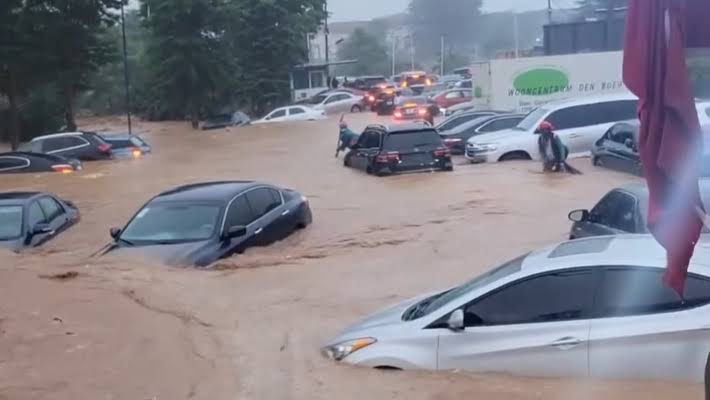
… One night, rain erases line between Asokoro and FCT suburbs, Maitama bleeds
nBy John Alechenu, ABUJA
nThe rain started in trickles, small drops at a time. Abuja, Nigeria’s capital city, is not immune to rainfall.
nBut by 10pm last Tuesday, it was no longer raindrops. It was a flood — the first of its kind in recent history. By the time the rains eased, it had caused serious upset in the city’s prime towns-Asokoro, Maitama, Guzape, Lokogoma, Garki and Wuse.
nThe tears arising from the flooding are still reverberating in the city and environs.
nNobody ever saw it coming, but it did with audacity; and atrocities followed.
nMallam Umar Abdullahi, who occupies a security house in one of the posh buildings in Asokoro, first heard the sound of rain on his roof.
nHe dismissed it and went about his routine.
nBut he was forced to leave his bed when he heard his daughter screaming, “Mummy, water is coming in.”
nHe got up and switched on his torchlight to see what was amiss.
nBy the time he reached the door, water had overtaken the entire compound and was already pushing in under the door.
nFour streets away, a government official’s SUV was stuck halfway up the road.
nThe driver had thought it was a shallow puddle. It wasn’t.
nIn Maitama, Kuzape and Guzape, the story was no different.
nHouses had been sunk, many gates removed and fences to mighty buildings removed with ease by the rampaging floods that rose from the rainfall.
n“This is the first time since I came to Abuja over a decade ago that I’m experiencing this,” Nasir Tanko said.
nThat Tuesday night, Abuja’s flood story changed.
nIt stopped being about Kubwa, Lokogoma and Galadima.
nThe water came for the hills.
nIt came for Asokoro, Maitama and Guzape and Katampe.
n‘We have never seen this before’
nMr. Emmanuel Okoro has lived on the same Asokoro Street since 2008. He retired from the civil service. He keeps a clean compound and pays his bills.
n“14 years,” he said on Wednesday morning, pointing at a brown line on his wall, “water has never come this high.”
nBy 12:30am, the water was in his boys’ quarters.
nHe and his wife spent the night moving things to the top of wardrobes. His rug from Dubai is ruined.
nThe bookshelf in his study tilted and fell.
n“I kept thinking this is Asokoro. This doesn’t happen here,” he said. “But water doesn’t know Asokoro from anywhere else.”
nAcross the road, an embassy car was being towed out. Water was still dripping from the exhaust. The driver, a young man in his 30s, sat on the curb looking tired.
n“Oga said I should try to pass. Now look.”
nIn Maitama, the damage was not just to properties alone. It disrupted the pride of Maitama, where the high and the influential in Nigeria, reside with lush.
nZainab, 34, who works in a bank in the CBD, got home at 8pm. By 11pm she was moving her mother and the children upstairs. Her husband was out of town.
n“I looked down and saw the kitchen under water. The fridge had fallen. The smell the next day… mud, diesel, sewage. You can’t wash that out in one day.”
nHer househelp, Amina, also slept upstairs with the rest of the family. “Her room was gone: Mattress, clothes, everything. She was crying. She said, ‘Aunty, my salary is in that bag.’”
nGuzape takes the worst hit
nGuzape is where Abuja is building mansions: Big gates, hillside views, duplexes that cost hundreds of millions of naira. Call it the FCT’s version of Lekki in Lagos and you may not be wrong. The area was washed up and its residents cannot still understand what hit them.
nFor the past five years, the place has been one big construction site. On Tuesday, all that construction collided with water.
n“Water was coming from three places,” Tunde said. He’s a site engineer. “From the hill behind us, from the road they are still doing, and from the next estate. We did sandbags. The water just pushed them.”
nHe lost bags of cement, rods and tiles worth over N2 million. His client called him Wednesday morning. “Tunde, is this what we paid for?”
n“What do I say?” Tunde asked. “That the hill decided to cry?”
nDown the road, a newly completed duplex had its fence crushed by the water. The owner, a businessman based in Lagos, flew in on Thursday. He stood in his compound and didn’t say anything for a long time.
nMorning after: Mud and questions
nBy Wednesday, the sun was out. It felt like a mockery. Men were outside with brooms and wheelbarrows. FEMA trucks were moving around. Some roads were still closed. The road linking part of Guzape to the expressway was cut off.
nIn a WhatsApp group for one Asokoro Street, someone posted a video of a man “kayaking” with a plastic chair. People laughed. Then someone posted a photo of a collapsed wall. The chat went quiet.
nMrs. Aisha Dogo sells provisions in Maitama. She lost a deep freezer and bags of rice.
n“We pay ground rent. We pay tax. The drainage here has not been cleared in years. Now look,” Mrs. Dogo lamented.
nThe anger was the same everywhere. “We were told these areas have a master plan,” said a diplomat whose two official cars were submerged in Asokoro.
nHe didn’t want his name in print. “So where did the water go?”
nAs residents and businesses tried to assess the damage, news began to make the rounds that demolition squads were about to be unleashed.
nMany agree the flood was not a natural disaster. It was the product of years of abuse of the Abuja master plan. Structures were built on waterways. Drainages were sand-filled and allotted to powerful individuals and developers. Green areas were destroyed and, in their places, new high-rise buildings for private and commercial use, sprang up.
nWhat went wrong
nEngineers and planners say it wasn’t just one thing.
nFirst, the rain. NiMet data showed over 90mm fell in less than four hours that night.
nThat’s the kind of downpour Abuja gets once in several years.
nSecond, the drains. Most of the drainage in the city centre is outdated and silted.
nIt was built for a smaller Abuja, with more trees and fewer houses. Over the years, silt and refuse have reduced their capacity.
nThird, Guzape. The hills have been cut and built on.
nNatural water paths are now roads and houses. When rain falls on a hill with concrete, it runs faster.
nA contractor working in Guzape put it simply: “When you build on a water path, water will find another path. Sometimes that path is through your parlour.”
nHe didn’t want his name published. “We keep telling clients, leave setbacks. Leave drainage. But everybody wants to use the whole land.”
nAn FCDA official, who also asked not to be named, said the authority had started desilting some channels last month.
n“But you can’t clear 30 years of blockage in one month. And people still dump refuse in drains.”
nThe small stories
nThe big damage makes the news. The small damage is what people remember.
nA five-year-old girl in Maitama thought the flood was fun until she saw her toys floating.
nHer mother had to fish a teddy bear out of the gutter.
nChinedu manages a restaurant on a Maitama corner.
nHe threw away food worth N800, 000. “Three days closed. Staff at home. Landlord is still asking for rent. I don’t know what to do”, he told Sunday Vanguard.
nFor domestic staff, it was worse. Many sleep in boys’ quarters that are usually the lowest part of a compound.
n“My gateman’s room was full,” Mr. Okoro said. “We had to bring him to sleep in our store. He lost everything.”
nIn Guzape, labourers lost a week’s wages because the site was underwater. “No work, no pay,” one of them said as he carried cement bags to dry them.
nHow did we get here?
nFormer FCT Council Chairman of the Nigeria Union of Journalists, Emmanuel Ogbeche, said the flood was long in coming.
n“For a long time, some of us have voiced our concerns over the indiscretion of the FCT Minister in allocating green areas, gardens and open spaces,” he said.
n“If anyone cares to remember, I raised alarm over the narrowing of the canal at Gudu/Apo just opposite Bakangizo Supermarket. The flash flood that overwhelmed the garden there can’t be separated from the building of the estate ongoing there.
n“In Maitama, most open spaces have been cannibalised by the government that is supposed to protect and defend its master plan at all costs.
n“Would areas he allocated and took over, like those meant for public hospitals in Guzape and Wuye, be revoked to their original intent?
n“Would the vexatious logging of wood in the city be halted? Abuja can’t thrive as a city of concrete and steel. Let the trees breathe.”
nGovernment response
nBy Tuesday afternoon, officials from FEMA and FCDA were going around with trucks and pumping machines.
nThe Director of FEMA, in a short briefing, said the agency was “assessing the extent of damage” and would “engage relevant departments to address drainage issues.” He also appealed to residents to stop dumping refuse.
nThe Minister of the FCT, Nyesom Wike, was on ground to assess the damage as soon as the rains stopped. He acknowledged the abuse of water channels by individuals and groups and promised action.
nWithin hours, he ordered demolitions. Cranes, bulldozers, tippers and armed security forces stormed Mississippi Street and surrounding areas in Maitama and began pulling down homes, fences and businesses. There was no room to plead for mercy.
nBusiness owners in parts of Maitama Extension and around the old WAEC building were caught off guard.
nOwner of popular business venture Xpressor, Mustapha Onimisi, told reporters: “We were told yesterday by a Director in FCDA that they would mark our property and give us two weeks to move valuables.
n“But to our shock, we woke up this morning and heard Wike was here himself and ordered the demolitions. It is sad. This should have been better handled.”
nOther residents say they need more than statements. “We need to see action,” said a residents’ association chairman in Asokoro.
n“Let them come and open the drains. Let them tell us if we need to do anything differently.”
n‘Tell us the truth’
nBy Wednesday, people were sweeping. But they were also asking questions.
n“Government should tell us the truth,” Mr. Okoro said. “If this place can flood again, let us know. We can’t be living in fear every time it rains.”
nMrs. Dogo was more direct. “We don’t dump in the drain. But when rain falls like that for four hours, where should it go? We need bigger drains. We need maintenance every year, not once in five years.”
nIn Guzape, estate developers held a meeting on Thursday. The agenda: Drainage and retention basins. “People are scared,” said one developer. “They’re asking if their investment is safe. We have to answer them.”
nA new fear
nThe biggest change is in people’s heads. Before, when it rained, people in Asokoro worried about traffic. Now they check weather apps.
nOn Wednesday night, the message in estate groups was the same: “Clouds are gathering. Park on high ground. Charge your phone. Move documents upstairs.”
nKids have found a new game. They’re racing paper boats in the gutters. Parents are shouting.
nTunde is back on site, trying to salvage what’s left: “This is Nigeria. You build, rain falls, you build again. But I didn’t expect to be rebuilding in Guzape.”
nZainab bought rubber boots on Wednesday. “For next time,” she said. “Because there will be a next time.”
nThe line has blurred
nFor years, Abuja people had a way of talking about flooding. “That one is for Kubwa people.” “That one is for Lokogoma.”
nBut on Tuesday night, the flood hit the high and the mighty in Asokoro and erased their pride and safety. For a few hours, it didn’t matter if one was a minister or a trader. Everyone in Asokoro, Maitama or Guzape were knee-deep in the same water.
nIt also raised a bigger question about Abuja’s growth. The city was planned for a little over three million people. It now has close to 10 million. The infrastructure is stretched.
n“You can’t have a capital city where the centre floods and we call it normal,” said an urban planner. “We need to retrofit the old drainage. And we need to enforce planning rules in new areas like Guzape.”
nMrs. Yusuf is drying her books in the sun. Some will survive. Some won’t.
n“I love this house,” she said. “But next time they say ‘heavy rain’, I’m sleeping upstairs with my documents in a Ghana-must-go bag.”
nThe hills are still standing. The houses are still standing. But after Tuesday night, no one in Abuja’s power corridor is taking the rain for granted again.
nAnd everyone is watching the sky.
nWike is really upset with the flooding of the city and the destruction it caused. He does not want a repeat of the flooding anymore.
nFirst, he has ordered the demolition of any structure standing on a water channel irrespective of the owner.
nThe FCT Minister has also banned the conversion of green spaces, parks and gardens into commercial car dealership lots across Abuja.
nThe directive is part of measures by the FCT Administration to curb worsening flood incidents across the capital city, where the loss of designated absorption zones and recreational spaces has disrupted urban drainage systems.
nSenior Special Assistant on Public Communications and Social Media to the FCT Minister, Lere Olayinka, disclosed this in a statement Wednesday in Abuja.
nTo ensure total compliance, the FCT Administration has established a dedicated Task Force tasked with monitoring affected areas and enforcing the immediate clearance of illegal car lots.
nIn addition to the operational ban, the Minister has initiated an administrative probe into officials suspected of issuing illegal approvals for the commercial use of these protected areas.
nHow far these measures would be implemented and sustained, remains to be seen as terrified residents continue to watch the sky of Abuja.
n nRelated Stories
 General News
CELEBRATING TWO YEARS OF TRANSFORMATIONAL LEADERSHIP IN THE PRESIDENTIAL AMNESTY PROGRAMME
Tomorrow, 14TH March 2026, as we look forward to the second anniversary, we reflect on the remarkable two years since the Administrator of the Preside
 General News
PRESIDENTIAL AMNESTY PROGRAMME PHASE 3: DISREGARD PURPORTED STATEMENT ON DELAYED ITA PAYMENTS — OFFICE OF NATIONAL CHAIRMAN
The Office of the National Chairman of the Presidential Amnesty Programme Phase 3, General Elaye ThankGod Dollar Slaboh, has called on beneficiaries a
 General News
RE: CLARIFICATION ON MY PERSONAL RELATIONSHIPS
PUBLIC NOTICErnrnRE: CLARIFICATION ON MY PERSONAL RELATIONSHIPSrnrnIt has become necessary to make this public clarification following the increasing