
A dozen rivals and surprise challengers set sights on Tinubu's position
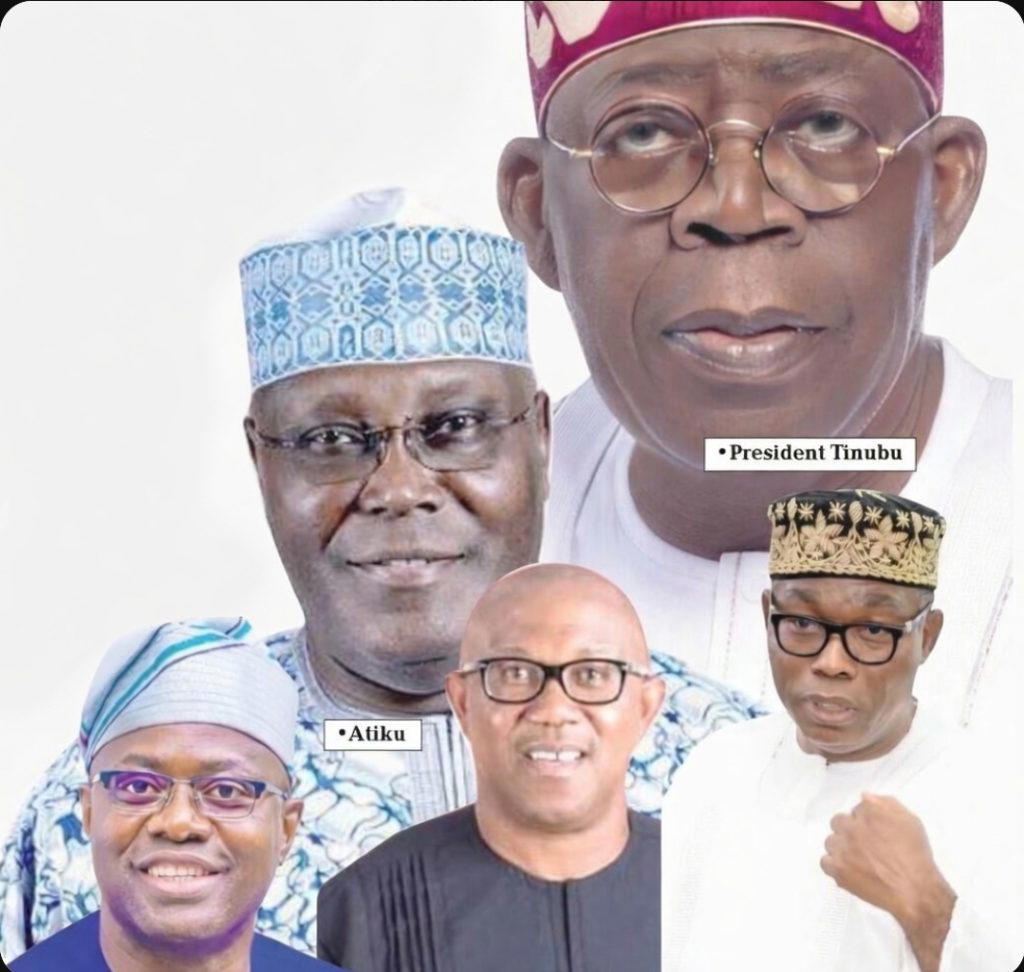
With exactly 237 days left until the January 16, 2027 presidential elections, the landscape of the race is gradually taking shape, but the outcome is still uncertain due to a recent court verdict that may extend the deadline for party primaries and other processes.
nAs of now, only 13 aspirants, including President Bola Tinubu, have expressed interest in the presidential election and have paid millions of naira to obtain nomination forms, with no female candidates among them, and Governor Seyi Makinde of Oyo State being the only governor in the running.
nThe list of aspirants includes Atiku Abubakar, Mohammed Hayatu-Deen, and Rotimi Amaechi from the African Democratic Congress, Bola Tinubu and Osifo Stanley from the All Progressives Congress, Peter Agada and Samuel Nwaigwe from the Labour Party, and Goodluck Jonathan, Seyi Makinde, and Sandy Onor from the Peoples Democratic Party, among others.
nNigeria's political landscape is witnessing intense maneuvering as established heavyweights, former office holders, technocrats, and newcomers position themselves for a shot at President Tinubu's job, with the ruling APC insisting that President Tinubu remains its undisputed candidate for 2027.
nThe party has scheduled its presidential primaries in 8,809 wards across the country, while opposition parties and emerging coalitions are intensifying strategic moves to unseat the ruling APC, with at least 12 aspirants indicating interest in the presidency across various parties.
nProminent names in the race include former Vice President Atiku Abubakar, former President Goodluck Jonathan, former Rivers State Governor Rotimi Amaechi, and Oyo State Governor Seyi Makinde, among others, with analysts saying the contest may boil down to coalition politics, regional calculations, and the ability to build broad national alliances.
nAtiku Abubakar remains the most persistent presidential aspirant in Nigeria's democratic history, having contested for the presidency six times since 1993, and appears set for a seventh attempt in 2027, which he says will be his last attempt.
nAtiku's political journey began in the late 1980s under the late Shehu Musa Yar'Adua's political machine, and he has since then remained a recurring figure in Nigeria's presidential politics, with supporters seeing him as one of the few opposition figures with national spread, financial strength, and political structure.
nFormer President Goodluck Jonathan has also returned to the center of political calculations, with the Tanimu Turaki-led PDP granting him a waiver from screening and endorsing him as a presidential aspirant, despite a court case challenging his eligibility due to a constitutional amendment.
nJonathan's supporters argue that he is not affected by the law, which came into being after he left office, and that his return is in tandem with power rotation between North and South, as he can only serve a term of four years and allow power to rotate to the North after President Tinubu's term.
nDespite economic hardship, rising inflation, and public discontent, APC leaders insist that President Tinubu remains firmly in control of the political structure, with party governors and stakeholders repeatedly endorsing him for a second term.
nFormer Vice Presidential candidate Peter Obi remains one of the biggest opposition figures, now linked with the Nigeria Democratic Congress, and continues to command significant support among urban youths and sections of the middle class, but faces the challenge of converting social media popularity into nationwide political structures.
nFormer Transportation Minister Rotimi Amaechi is positioning himself within the ADC coalition, retaining strong networks from his years as governor and minister, but his strategy may depend on whether the opposition settles for a consensus candidate or open primaries.
nThe Social Democratic Party has presented Adewole Adebayo as its consensus presidential candidate, while a rival faction chose Abimbola Atanda, with Adebayo saying Nigeria urgently needs an inclusive government focused on poverty reduction, industrial revival, and job creation.
nBeyond established heavyweights, a number of lesser-known politicians, technocrats, and businessmen are also positioning for the 2027 presidential race, including Stanley Osifo of the APC, Sandy Onor of the PDP, economist Mohammed Hayatu-Deen of the ADC, and Labour Party aspirants Peter Agada and Samuel Nwaigwe.
nStanley Osifo, a businessman from Edo State, has stirred political interest after purchasing the APC presidential nomination and expression of interest forms, despite President Tinubu's overwhelming control of the ruling party structure, and is arguing that every qualified Nigerian has the constitutional right to contest for the presidency.
nFormer senator and academic Professor Sandy Onor has joined the presidential race on the PDP platform, belonging to the FCT Minister Nyesom-Wike backed PDP, and has served in various roles, including as chairman of Etung Local Government Area and commissioner for agriculture.
nEconomist and banker Mohammed Hayatu-Deen is projecting himself as a technocratic alternative in the 2027 contest, with a reputation built in banking, development economics, and public policy, but faces the challenge of limited grassroots structures and weak electoral machinery.
nPeter Agada, a businessman and architect, has become the first aspirant to purchase the Labour Party's presidential nomination forms, proposing community-based intelligence systems to tackle insecurity and promising industrial hubs across geopolitical zones to create jobs.
nSamuel Nwaigwe, a businessman and philanthropist from Ebonyi State, has also entered the Labour Party presidential race, known for philanthropic activities and grassroots support initiatives in Ebonyi State and parts of the South-East, but is not yet a major national political figure.
nOyo State Governor Seyi Makinde has joined the presidential race on the platform of an alliance between the PDP and the Allies People's Movement, with his decision followed by pressure from party stakeholders and his conviction that Nigeria requires purposeful leadership.
Related Stories
 General News
CELEBRATING TWO YEARS OF TRANSFORMATIONAL LEADERSHIP IN THE PRESIDENTIAL AMNESTY PROGRAMME
Tomorrow, 14TH March 2026, as we look forward to the second anniversary, we reflect on the remarkable two years since the Administrator of the Preside
 General News
PRESIDENTIAL AMNESTY PROGRAMME PHASE 3: DISREGARD PURPORTED STATEMENT ON DELAYED ITA PAYMENTS — OFFICE OF NATIONAL CHAIRMAN
The Office of the National Chairman of the Presidential Amnesty Programme Phase 3, General Elaye ThankGod Dollar Slaboh, has called on beneficiaries a
 General News
RE: CLARIFICATION ON MY PERSONAL RELATIONSHIPS
PUBLIC NOTICErnrnRE: CLARIFICATION ON MY PERSONAL RELATIONSHIPSrnrnIt has become necessary to make this public clarification following the increasing