
72% of world trade still goes on under WTO – Okonjo-Iweala
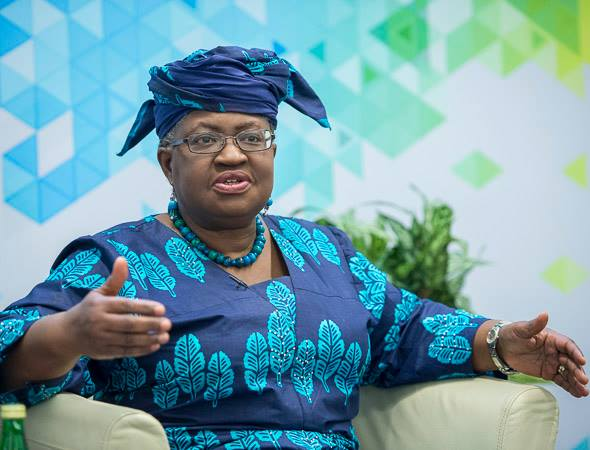
Ngozi Okonjo-Iweala
nThe Director-General of the World Trade Organisation (WTO), Dr Ngozi Okonjo-Iweala, says in spite of certain policy uncertainties, 72 per cent of world trade still goes on under the organisation.
nOkonjo-Iweala said this in Abuja at the ongoing 7th Africa Emerging Markets Forum.
nThe forum was jointly organised by the Central Bank of Nigeria (CBN), Emerging Markets Forum (EMF) and the Centre for the Study of Economies of Africa (CSEA).
nAccording to Okonjo-Iweala, in modern terms, world merchandise trade grew by 4.6 per cent as surging demand for AI-related goods offset weaknesses linked to tariff increases and trade policy uncertainty.
n“Services trade grew by 5.3 per cent again in modern terms, and within that, trading digitally delivered services grew even faster, at almost six per cent.
n“Most countries continue to trade on rules-based WTO terms. Around 72 per cent of global goods trade continues to flow on core WTO most-favoured-nation tariffs,” she said.
n“Additional 16 per cent goes on terms within the wider WTO framework, mostly tariff preferences arising from bilateral and regional trade agreements that are built on WTO foundations,” she said.
nShe said that global goods trade volumes in 2025 were over 12 per cent higher than in 2019, the year before the COVID-19 pandemic, while services trade volumes were 31 per cent higher.
nAccording to her, countries are responding to the Strait of Hormuz crisis with more trade facilitating than trade-restrictive measures.
n“They are lifting trade restrictions, facilitating trade in oil and gas products, and finding alternative routes to get oil and fertiliser out of the region.
n“These measures have not been enough to compensate for the closure of the strait, which has hit the world, and especially vulnerable African countries, with higher energy, fertiliser and food prices.
n“They have not built resilience and prevented a situation that could have been considerably worse for the global economy.
n“On the whole, while active strategic competition is affecting some sensitive products and bilateral relationships, the repeal practice of most countries seems to be for continued interdependence, albeit within concentric circles of relatively closer or looser integration.”
nShe said that the Global South offered a case in point, adding that the share of South-South trade in the global total had increased from under one-tenth in 1995 to about a quarter today.
n“They are keeping their trade diplomats busy. Of the 384 existing regional trade agreements that have been formally notified to the WTO, 49 per cent are among developing countries.
n“Among the eight additional agreements that have not been notified, the South-South share appears to be even higher, and 22 economies still outside the 166 from the WTO are working hard to accede to it,” she said. (NAN)
n nRelated Stories
 General News
CELEBRATING TWO YEARS OF TRANSFORMATIONAL LEADERSHIP IN THE PRESIDENTIAL AMNESTY PROGRAMME
Tomorrow, 14TH March 2026, as we look forward to the second anniversary, we reflect on the remarkable two years since the Administrator of the Preside
 General News
PRESIDENTIAL AMNESTY PROGRAMME PHASE 3: DISREGARD PURPORTED STATEMENT ON DELAYED ITA PAYMENTS — OFFICE OF NATIONAL CHAIRMAN
The Office of the National Chairman of the Presidential Amnesty Programme Phase 3, General Elaye ThankGod Dollar Slaboh, has called on beneficiaries a
 General News
RE: CLARIFICATION ON MY PERSONAL RELATIONSHIPS
PUBLIC NOTICErnrnRE: CLARIFICATION ON MY PERSONAL RELATIONSHIPSrnrnIt has become necessary to make this public clarification following the increasing