
2027 Presidential Election: Personal Ambitions, Factional Divisions, and Infighting Could Undermine ADC's Chances
By Luminous Jannamike, ABUJA
nThe African Democratic Congress,, ADC, is facing ego battles, tribal undercurrents and a bitter power struggle that may wreck its 2027 presidential ambition just as it begins to take shape.
nWhat should have been a moment of consolidation is fast turning into a test of survival. Insiders say the real threat is not external pressure, but a deepening internal clash of personalities, interests and long-held suspicions now spilling into the open.
nMultiple high-level sources familiar with the development told *Saturday Vanguard* that the crisis is being driven largely from within, as competing ambitions and mistrust among key figures continue to deny the party the unity it needs to fight the the ruling party.
n“These are the real issues. It’s ego, it’s power, and it’s also about where the ticket should go. That’s what is tearing them (leading presidential aspirants) apart,” a senior insider said.
nTwo Ex-Governors, One Defining Battle
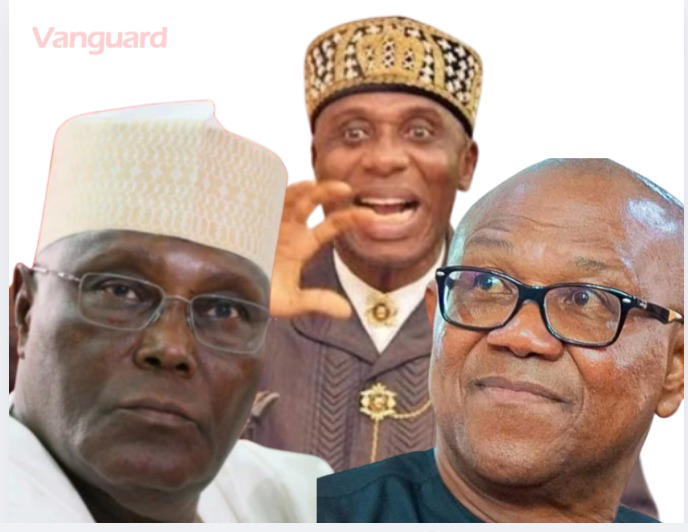
nTwo influential former governors are said to have emerged as central figures in the unfolding crisis; powerful, calculating, and increasingly at odds over who controls the party’s future.
nTheir silent rivalry, insiders say, has hardened divisions and repeatedly stalled efforts to build consensus around both leadership structure and the presidential ticket.
nOne of them, according to sources, holds long-standing reservations about a Southeast candidate emerging as the party’s flagbearer. While often framed as political calculation, that stance has fuelled quiet accusations of ethnic bias and heightened regional sensitivities within the party.
n“He (the ex-governor) has never hidden it. He believes certain regions should not produce the president at this time, and that has become a serious issue,” a source said.
nThe second ex-governor is widely seen as driven by strong personal ambition, positioning himself as the most viable candidate capable of securing northern backing, a claim that continues to divide opinion within the party.
n“He presumes everything is about him. He believes he is the only one who can win, and that the North will rally behind him more than anyone else,” another insider said, adding that the man overrates himself all the time.
nEgo vs Strategy
nTogether, these competing positions have triggered a volatile standoff, one where personal ambition and regional calculations are colliding, leaving little room for compromise.
n“They are not thinking about victory; they are thinking about themselves,” a source complained bluntly.
nBehind closed doors, insiders say the struggle is no longer about building a winning coalition. It is about the presidential ticket.
nOld Guard vs New Power Bloc
nThe tension runs deeper than the top-tier rivalry. Within the ranks, frustration is mounting among long-standing members who feel sidelined by newer, high-profile entrants reshaping the party’s internal balance.
n“Some members are asking: ‘We built this structure, how do people just come in at the last minute and take over?’” a source said.
nThe resentment reflects a widening divide between legacy stakeholders and incoming political heavyweights seeking influence.
n“This is not just about individual. It’s about ownership of the party and who controls its future,” another insider said, noting that this is no longer just a struggle for relevance. It is a fight for control.
nPopularity Outside, Resistance Inside
nAnother fault line is widening, the gap between public popularity and internal acceptance.
nSeveral aspirants command strong support in the public space, but insiders say that influence does not always translate into backing within the party’s structure.
n“Popularity outside is not the same as acceptance inside. What you see in the public space is different from what is happening within the party,” one source said.
nThe disconnect is emerging as a critical risk ahead of the primaries.
nTime Is Running Out
nAll of this is unfolding against tightening electoral timelines. Instead of consolidating, the party remains locked in internal battles, raising serious concerns about its readiness for the contest ahead.
n“There is no time. They are still fighting among themselves when they should be consolidating,” a source said, adding that every delay now carries a cost.
nWarnings From Within
nSenator Victor Umeh did not mince words.
n“I was thinking he (Atiku) would be at the point where he would be considering leaving the stage for younger people, but he said he is contesting.
n“He has been running since 2003. We respect him, he is a strong politician with influence. But there is a time you say, ‘I’ve done it, let me prop up others’,” Umeh said.
nHe warned that unchecked ambition could leave lasting damage.
n“If they go all out to wrestle, it may get to a point where some people will have a bloody nose, and the party will suffer,” he said.
nOn reported talks among aspirants, he dismissed suggestions of withdrawals or backroom deals.
n“This is a season for consultations. It is normal for people aspiring for the same office to talk to each other. Obi’s visit (to Amaechi) was a noble one with good intentions. They were not discussing stepping down,” he said.
nA Familiar Lesson From History
nPolitical analyst Kenny Okolugbo said the ADC’s fate will depend on how it manages competing ambitions, pointing to lessons from past political mergers.
n“The ADC should learn from what the APC did with the merger, a merger many thought was impossible.
n“But you have to give it to President Tinubu: he sacrificed his vice-presidential ambition because he realised that if he didn’t, they would not be able to go into those elections and defeat Goodluck Jonathan,” Okolugbo said.
nHe warned that failure to manage internal tensions could trigger collapse from within.
n“Now, the ADC can only succeed, in my view as a public affairs analyst, if the ticket is given to Peter Obi and he runs with someone like Kwankwaso. The moment Atiku gets that ticket, then they would have self-imploded. And that’s the reality of the situation,” Okolugbo
nThe North-South Equation Resurfaces
nOkolugbo also pointed to Nigeria’s power rotation dynamics as a key force shaping internal calculations.
nHe said, “We have had these unwritten agreements that the North will have power for some time and the South will have it for some time.
n“Therefore, if you have to challenge him, you must get somebody from the South-South. And the strongest candidate right now who can cut across is former Governor Peter Obi.”
nHe stressed the need for a ticket that balances regional appeal with national electability.
n“If Kwankwaso joins Obi and agrees to a four-year arrangement, then he could have a real shot in 2031. But everything depends on how well ambitions are managed within the ADC,” he added.
nNew Alliances, Fragile Ground
nWhat is emerging is a party struggling to hold itself together. The situation is becoming more fluid with the rise of new alignments, including the Obi–Kwankwaso Movement, drawing support from multiple blocs and signalling shifting loyalties within the opposition.
nJustin Ijeh, spokesperson of the movement, said: “This is more than a political milestone; it is the birth of a coordinated, nationwide engine for systemic reform and national rebirth.
n“The movement is a home for all well-meaning Nigerians. We reject the politics of tribalism, regionalism, and religious sentiment.”
nBut insiders say such parallel efforts also expose the fragile, fragmented nature of the coalition.
nQuiet Drift Toward Plan B
nBehind the scenes, uncertainty is deepening. Some political actors are already weighing alternative platforms, a sign of fading confidence in the party’s ability to resolve its crisis.
n“Some of the leading presidential aspirants are already thinking of Plan B. That tells you the level of uncertainty,” a source said.
nA Make-or-Break Moment
nFor now, the ADC stands at a critical crossroads. Without urgent steps to rein in ambition, manage internal grievances and forge a workable consensus, insiders warn the party risks losing momentum at a decisive point in Nigeria’s political cycle.
n nRelated Stories
 General News
CELEBRATING TWO YEARS OF TRANSFORMATIONAL LEADERSHIP IN THE PRESIDENTIAL AMNESTY PROGRAMME
Tomorrow, 14TH March 2026, as we look forward to the second anniversary, we reflect on the remarkable two years since the Administrator of the Preside
 General News
PRESIDENTIAL AMNESTY PROGRAMME PHASE 3: DISREGARD PURPORTED STATEMENT ON DELAYED ITA PAYMENTS — OFFICE OF NATIONAL CHAIRMAN
The Office of the National Chairman of the Presidential Amnesty Programme Phase 3, General Elaye ThankGod Dollar Slaboh, has called on beneficiaries a
 General News
RE: CLARIFICATION ON MY PERSONAL RELATIONSHIPS
PUBLIC NOTICErnrnRE: CLARIFICATION ON MY PERSONAL RELATIONSHIPSrnrnIt has become necessary to make this public clarification following the increasing