
2027: Potential Supreme Court Setback for ADC Could Undermine Opposition Alliance Against APC
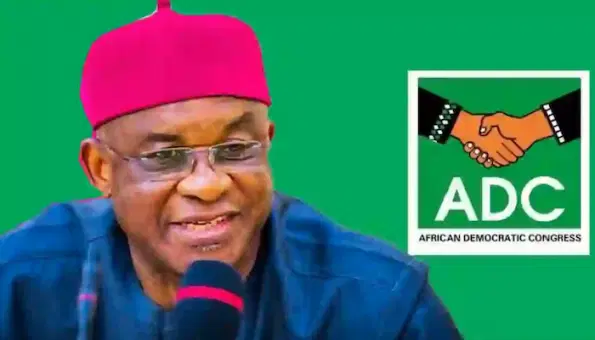
The African Democratic Congress's leadership crisis is on its way to the Supreme Court, but the real challenge may not be about winning the legal battle, as time is ticking away for the opposition coalition to convince Nigerians it is ready for the 2027 elections.
nBy the time the Supreme Court makes its final decision on the African Democratic Congress, the legal aspects of the crisis may have been resolved, but the political damage may already be irreparable, posing a significant irony for Nigeria's most prominent opposition coalition.
nFor months, the conversation surrounding the ADC has centered around court orders, rival factions, congresses, and constitutions, rather than policies, campaigns, or governance, with every judgment leading to another appeal and every appeal prolonging uncertainty.
nUncertainty can be as damaging as defeat in politics, which is why the Court of Appeal's judgment last Monday is about more than just the David Mark or Dumebi Kachikwu factions, but a test of whether an opposition coalition can remain electorally viable while fighting for control of itself.
nIn a split two-to-one decision, the Court of Appeal upheld an earlier Federal High Court judgment restraining the Independent National Electoral Commission from recognizing state congresses organized by committees appointed by the David Mark-led National Working Committee.
nThe appellate court agreed that under the ADC constitution, elected state executive committees, not a national working committee, possess the authority to conduct state congresses, and it also affirmed that the congresses and subsequent national convention organized by the David Mark leadership were a nullity due to alleged violations of an earlier court order.
nThe Mark camp has appealed to the Supreme Court, maintaining that the judgment neither removed its leadership nor invalidated candidates already uploaded to the INEC portal, meaning the dispute is far from over, both legally and politically.
nConstitutional lawyer Liborous Oshoma reduced the dispute to one decisive question on Arise TV's The Morning Show, stating that the ADC must present facts showing that the caretaker committee was suspended and did not conduct the congresses or primaries.
nAccording to Oshoma, the burden now rests on the ADC to prove that the disputed congresses were conducted by lawful party structures rather than the caretaker committee, and if it cannot, the implications could extend beyond state executives, even threatening the presidential ticket.
nTime, not merely law, has become the opposition's greatest adversary, as the final observation may be the most significant, with Oshoma cautioning that the truth will be laid bare, but time might not be on their side.
nThe legal arguments are relatively straightforward, but the political consequences are not, as the David Mark NWC currently enjoys INEC recognition for candidates already uploaded onto the commission's portal, including the Atiku Abubakar/Rotimi Amaechi presidential ticket and hundreds of legislative candidates.
nThe Kachikwu faction, despite claiming legitimacy over party state structures, does not control those submissions, creating a practical dilemma, as the faction recognized as controlling the party structure may still confront the reality that another faction submitted candidates to INEC months earlier.
nEither way, rebuilding confidence may prove harder than winning the case, as the opposition coalition faces the challenge of regaining public trust after months of internal disputes and organizational paralysis.
nOpposition politicians have repeatedly alleged that the ruling All Progressives Congress benefits from keeping rival parties trapped in endless litigation, although those allegations remain political claims without verified evidence.
nHowever, one fact is difficult to ignore: lengthy legal disputes consume energy, divide party elites, discourage donors, and confuse supporters, whether caused by political strategy or self-inflicted organizational failures.
nNigerian politics offers enough precedents to make every political party wary of unresolved internal disputes, as the PDP's prolonged Sheriff-Makarfi leadership crisis consumed valuable time before judicial certainty eventually emerged ahead of the 2019 presidential election.
nThe APC's failure to conduct valid primaries in Zamfara also cost it an election it had effectively won, after the Supreme Court nullified its victories in 2019, highlighting the lesson that political parties rarely lose only because opponents are stronger.
nSometimes they lose because internal disputes become more important than the election itself, and that is the danger staring the ADC in the face, as the party faces three possible outcomes: the Supreme Court affirming the Appeal Court, overturning the judgment, or delaying the final decision.
nThe first scenario could raise difficult questions about disputed congresses and trigger fresh political negotiations over party structures, while the second would restore legal certainty to the Mark-led NWC and allow the coalition to concentrate on campaigning.
nThe third, and perhaps most consequential, is delay, as if the final judgment comes too close to critical electoral deadlines, whichever faction prevails may inherit a party that has lost precious time, momentum, and public confidence.
nFor ordinary Nigerians, the issue extends beyond one opposition party, as democracy depends not only on competitive elections but also on credible political alternatives, and if opposition parties spend the months before an election litigating over who controls the party instead of persuading voters why they deserve power, the greatest casualty may not be the ADC.
nIt may be the quality of electoral competition itself, as the Supreme Court prepares to hear the case, and the legal battle will continue, but the larger political question already hangs over Nigeria's democracy: Can a party win its case in court after losing the confidence of the electorate?
Related Stories
 General News
CELEBRATING TWO YEARS OF TRANSFORMATIONAL LEADERSHIP IN THE PRESIDENTIAL AMNESTY PROGRAMME
Tomorrow, 14TH March 2026, as we look forward to the second anniversary, we reflect on the remarkable two years since the Administrator of the Preside
 General News
PRESIDENTIAL AMNESTY PROGRAMME PHASE 3: DISREGARD PURPORTED STATEMENT ON DELAYED ITA PAYMENTS — OFFICE OF NATIONAL CHAIRMAN
The Office of the National Chairman of the Presidential Amnesty Programme Phase 3, General Elaye ThankGod Dollar Slaboh, has called on beneficiaries a
 General News
RE: CLARIFICATION ON MY PERSONAL RELATIONSHIPS
PUBLIC NOTICErnrnRE: CLARIFICATION ON MY PERSONAL RELATIONSHIPSrnrnIt has become necessary to make this public clarification following the increasing