
2027: Maiduguri blasts put Tinubu’s security record on trial
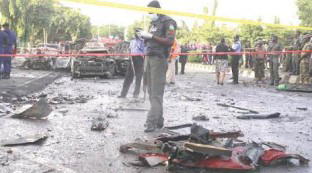
One of the bomb blast scenes
nBy Luminous Jannamike
nAfter breaking their fast, four brothers stepped out to buy eyeglasses for Sallah. They never returned. From one family’s loss to a nation’s reckoning, the Maiduguri attacks, and the rising tide of terror deaths, are turning grief into a defining political question ahead of 2027.
nRead Also: IDPs to FG: If you can’t take us home, say it; stop pretending
nIn Gwange Sabon Layi, a quiet neighbourhood in Maiduguri, Ba Musa sits in a house that no longer sounds like itself.
nAgainst the wall, four pairs of new shoes are still lined up. Black. Brown. Two slightly oversized, bought so the boys could grow into them. No one has touched them since Monday night. They belonged to his sons.
nDays earlier, Ba Musa had been preparing for Eid. New clothes. New shoes. A small, certain joy. On March 16, after breaking their Ramadan fast, the boys stepped out together. A quick errand. Eyeglasses for Sallah. They never came back.
nThree explosions; at Monday Market, the Post Office area, and the gate of the University of Maiduguri Teaching Hospital, tore through the city within minutes.
n“They came to buy eyeglasses for Sallah. The blast killed all of them,” a neighbour and fellow trader said quietly.
nAll four brothers died that night. They were buried the next day. In the official toll, they are part of the 23. In this house, they are everything. The receipt for the shoes is still tucked inside one of the boxes.
n“My Brother Saved My Life”
nAt Umaru Shehu Ultramodern Hospital, Abacha Mustapha is learning how to be alive again.
n“We broke our fast and were about to leave after closing our shops when the first bomb detonated. I heard a loud sound and suddenly my neck started bleeding,” he said.
nWithin seconds, the market was chaos. Mustapha was among more than 100 people injured that night, some estimates put the number between 108 and 146.
nHis brother did not hesitate. He tore a piece of cloth, pressed it hard against the wound, and forced his way through the crowd to get him to the hospital.
n“My brother saved my life,” Mustapha said. Around him, recovery is uneven. Some stabilise. Some don’t. For at least 23 people, there was no second chance.
nA City Broken at Iftar
nThe attacks came between 7:00 pm and 7:24 pm, just as families were breaking their fast. Three blasts. Minutes apart. Civilian targets. At least 23 people were killed. More than 100 were injured.
nJust 24 hours earlier, troops had repelled coordinated assaults on military formations across Borno State. Yet the attackers returned, bypassing the frontlines and striking the city itself.
nFor residents, that shift matters. Maiduguri had been inching back toward normal. Markets stayed open longer. Movement improved. For the first time in months, people were beginning to breathe.
nThat fragile calm is gone. In Gwange Sabon Layi, the shoes are still untouched.
nOrders from Above, Distance on the Ground
nPresident Bola Tinubu condemned the attacks and said Nigeria would not bow to terrorism. He approved additional support for the military and ordered service chiefs to relocate to Maiduguri.
nVice President Kashim Shettima visited victims, promising a tougher response. Security agencies later said normalcy had returned. But in Maiduguri, normalcy is no longer something you announce. It is something people remember.
nWhen Grief Meets Politics
nThis is how elections begin, not in campaign offices, but in places like this. As families buried their dead, the political battle followed. Former Vice President Atiku Abubakar said: “A mother in Maiduguri is not asking for press releases. She is asking why her child was blown apart in a place the government claimed was ‘liberated.’”
nFormer Minister of Transportation Rotimi Amaechi said: “This government is killing Nigerians… The Monday bombings… [are] a damning indictment of a leadership that has grown complacent, incompetent, and indifferent.”
nThe African Democratic Congress (ADC), through its National Publicity Secretary Bolaji Abdullahi, urged the president to prioritise security.
nThe Peoples Democratic Party (PDP), through its National Publicity Secretary Ini Ememobong, described the situation as “dancing on the blood of Nigerians.” Different voices. One direction.
nWhat the City Is Saying
nAway from politics, Maiduguri is speaking in quieter ways. Hospitals are stretched. Families are grieving. In one ward, a woman sat beside a bed that would not be used again, holding a plastic bag of food she had brought for someone who would never eat it. “We are not asking for speeches. We just want to live,” one resident said. There is anger. But more than anger, there is exhaustion.
nA Warning Beneath the Blasts
nFor security experts, the warning is clear. “We have to see this as the groups oozing confidence in their ability to wreck terror in that part of the country… We think this is the start of a spate of bombings, not just in Maiduguri but also less protected urban areas in the northeast,” said Ikemesit Effiong, Partner at SBM Intelligence.
n“It speaks to the intelligence failure and it shows that both factions (ISWAP and Boko Haram) are still very, very capable… Attacking Maiduguri is symbolic for these groups,” said Malik Samuel, Senior Researcher at Good Governance Africa-Nigeria. For Dr Hamza Talba, Security Analyst, the problem runs deeper.
n“What I am seeing in Maiduguri is actually political. The governor has not utilised the resources given to him appropriately. If the state governor had been able to do what he is supposed to do, there would not be any Boko Haram in Maiduguri whatsoever. “It is more of a political issue, because there are people profiting from it. That is what we call conflict entrepreneurs… this is the only way they can make their daily money.
n“To me, what is escalating this insurgency and insecurity is hunger… Whatever benefits the governor has received from the federal government, he should be able to utilise those resources for the people,” he said in an interview.
nTinubu’s Security Record Under the Microscope
nThe Maiduguri bombings land at a difficult moment for President Bola Tinubu. According to the latest Global Terrorism Index, Nigeria recorded 750 terrorism-related deaths in 2025, a 46 per cent increase from the previous year. The number of attacks rose from 120 to 171, up 43 per cent. The highest rise in over a decade. Nigeria is now ranked the 4th most terror-affected country in the world.
nBorno State alone accounts for about 67 per cent of attacks and 72 per cent of deaths. Two groups, ISWAP and Boko Haram, are responsible for roughly 80 per cent of fatalities. Civilians make up about 67 per cent of those killed.
nWhen Tinubu took office in 2023, deaths had fallen to one of their lowest levels since 2011. That trend has reversed. In Nigeria, insecurity has ended presidencies before.
nThe Numbers Behind the Names
nTwenty-three dead. More than 100 injured. 750 deaths in a year. But the numbers are not the story. The story is what they leave behind. Four brothers from one house in Gwange Sabon Layi. A man alive because his brother refused to let him die. Families learning how to live with absence. This is what security failure looks like: quiet houses, full hospitals, and names that do not return.
n2027 Is Already Taking Shape
nFor the ruling party, the ground is shifting. In 2015, insecurity became a decisive election issue. It helped unseat a government built on similar promises. Now, as 2027 approaches, the same question is returning; sharper, louder, harder to ignore. Across opposition lines, a narrative is forming: that the government has failed in its most basic duty, to protect lives.
nIf that narrative holds, Maiduguri may not only be remembered as a tragedy; it may also be seen as a turning point for many voters, particularly in the North.
nWhat Remains
nWhy can four boys leave home to buy eyeglasses, and not return? In Maiduguri, that question lingers. Life continues, but more carefully now. In Gwange Sabon Layi, the shoes are still lined up against the wall. They are still waiting.
n nRelated Stories
 General News
CELEBRATING TWO YEARS OF TRANSFORMATIONAL LEADERSHIP IN THE PRESIDENTIAL AMNESTY PROGRAMME
Tomorrow, 14TH March 2026, as we look forward to the second anniversary, we reflect on the remarkable two years since the Administrator of the Preside
 General News
PRESIDENTIAL AMNESTY PROGRAMME PHASE 3: DISREGARD PURPORTED STATEMENT ON DELAYED ITA PAYMENTS — OFFICE OF NATIONAL CHAIRMAN
The Office of the National Chairman of the Presidential Amnesty Programme Phase 3, General Elaye ThankGod Dollar Slaboh, has called on beneficiaries a
 General News
RE: CLARIFICATION ON MY PERSONAL RELATIONSHIPS
PUBLIC NOTICErnrnRE: CLARIFICATION ON MY PERSONAL RELATIONSHIPSrnrnIt has become necessary to make this public clarification following the increasing